LinkedIn Learning API for AI Agents: Course Data in a Single JSON Call

A third-party API turns LinkedIn Learning courses into structured JSON for AI agents to call directly.
The article introduces LinkedIn Learning API, a third-party tool hosted on Apify that organizes LinkedIn Learning course information into structured JSON records and returns them directly to Claude, Cursor, or ChatGPT via tool calls. It addresses the pain point of AI agents being unable to obtain clean course data for course recommendations, skill graph construction, and catalog benchmarking. The API offers basic and course modes, with the latter adding ratings, learner reviews, full syllabi, free-lesson flags, and skill tags. It supports Python, Curl, N8n, Make, and Zapier, with scheduled catalog refreshes. The author notes it is not an official LinkedIn product and that data sources, update frequency, and long-term stability require user assessment.
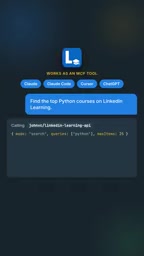
AI Agents that want to recommend courses, build skill graphs, or benchmark course catalogs often get stuck at the same step: they can't get structured course data. LinkedIn Learning doesn't offer a public API designed for agents, and scraping web pages introduces a lot of noise. A tool called LinkedIn Learning API aims to fill this gap—it organizes courses, ratings, learner reviews, and complete syllabi into clean structured data and feeds them directly to Claude, Cursor, or ChatGPT through tool calls.
What Problem It Solves
In the traditional approach, asking an AI assistant to recommend a course often yields a vague list of titles: no ratings, no syllabus, no way to tell whether a course includes free previews, and no alignment with skill tags. This API takes a clear approach—compressing "a course" into a single structured JSON record.
According to the tool's introduction on YouTube, the way to call it is to have Claude, Cursor, or ChatGPT make a request for a specific skill, and the API returns matching courses as a tool call. This means agents don't need an extra parsing layer; the data they receive can go directly into reasoning workflows or be written to a database.
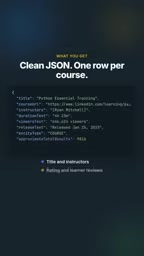
Tool call is a mechanism offered by mainstream LLM APIs today: developers declare several available functions and their parameter structures in a request, and if the model determines during reasoning that it needs external data, it returns a structured invocation intent. The host program then executes the actual request and passes the result back to the model to continue generating. For agents, this means the model doesn't have to rely on training-time memory or web scraping to get course information—it can obtain real-time data with fixed fields the same way it calls a local function. Compared with having the model parse HTML or stitch together fragments using retrieval-augmented generation (RAG), the return value of a tool call is an object that strictly conforms to a JSON Schema, with predictable field types and nesting levels. As a result, it can go directly into downstream logic such as ranking, filtering, or writing to a database, significantly reducing the risk of parse failures and hallucinations.
Two Data Modes: List and Detail
The API distinguishes between two levels of return granularity to suit different scenarios.
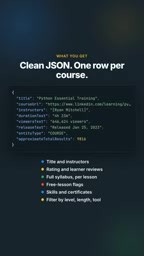
Basic mode returns essential course information, suitable for quickly pulling a list of courses in a given skill area. Course mode builds on this by adding ratings, learner reviews, complete syllabi, free-course flags, and associated skills. For agents that need to rank recommendations or filter by quality, the latter is the truly useful part.
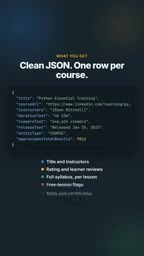
Reviews and syllabi are two data points whose value is easy to underestimate. Reviews provide supporting evidence of course quality, while syllabi let agents judge whether the course content actually covers the target skill points rather than relying solely on title matching. The free-course flag directly affects recommendation strategy—in budget-constrained scenarios, courses with free previews can be prioritized.
Integration Options and Automation
The API supports calls from Python, Curl, N8n, Make, or Zapier, and can refresh course catalogs on a schedule. This set of integration options covers different groups, from script developers to low-code users: those who write code can send HTTP requests directly, while those using automation platforms can treat it as a node in a workflow to sync data on a schedule.
The officially named use cases include building skills taxonomies, benchmarking course catalogs, discovering free courses, and course recommenders. These directions share one thing in common: they all require batch, structured, and regularly updated course data rather than scattered one-off queries.
Apify Actor is a reusable automation program unit on the Apify platform, typically packaged as a Docker container that encapsulates scraping, parsing, and output logic and exposes a unified run interface and dataset results. Developers can trigger it manually in the Apify console, or start a run programmatically via the REST API or official SDK and read the structured data produced by the run as needed. The "third-party Actor" mentioned in the article refers to a component published by an individual developer (johnvc), hosted on the Apify marketplace, and not officially maintained by LinkedIn. The advantage of this form is that it works out of the box, with billing and scheduling managed by the platform; the cost is that data sources, update cadence, and compliance responsibility fall on the Actor author, so users need to verify reliability and terms-related risks themselves.
Boundaries Worth Noting
This tool is not an official LinkedIn product but a third-party Actor hosted on the Apify platform (author identified as johnvc), offering a free trial. The source material does not explain its data sources and update frequency, whether it is subject to LinkedIn's terms of service, or how stable it is long term, so you need to assess these yourself before using it in production.
Another practical limitation is data coverage: the tool claims to return LinkedIn Learning courses, but scraping-based interfaces generally struggle to guarantee complete synchronization with the official catalog. If your business has high requirements for course timeliness, scheduled refreshes combined with manual spot checks will be more reliable.
Who It's For
For developers building course recommendation agents, this kind of API saves the repetitive work of data cleaning and field alignment. For teams building skill graphs, the association between courses and skill tags is ready-made input. For individual users who just want to compare course quality, asking Claude or ChatGPT to call the API once and get results with ratings and syllabi is much faster than browsing web pages.
Its positioning is more like a data building block than a complete product—once the entity "course" is standardized into JSON, what can be built on top depends on the design of the agent.
Related articles

Gemini 4 Neon Leak: A Potential Strong Contender Against Opus 5.5
A Hacker News thread suggests Gemini 4 Neon looks like an Opus 5.5 competitor. This article unpacks the product positioning behind this community signal, shifts in the top-model competitive landscape, and what it means for developers' model selection strategy.

Claude Fable 5.2's Self-Authored Short Film 'Fable' Sparks Discussion
A short film 'Fable,' credited to Claude Fable 5.2 for script, visuals, and directing, appears on Hacker News. This article analyzes the significance of full-pipeline AI creation, community reactions, and what it means for content creators.

Anthropic IPO Pricing: A Signal of AI Giants Going Public
Anthropic's IPO pricing draws attention. This article analyzes its potential impact on AI industry valuation, commercialization paths, and the competitive landscape, and highlights public-market expectations and challenges for AI companies.