LIPS-PC: Learning Illumination Patterns for Efficient Single-Pixel Classification

LIPS-PC directly learns illumination patterns for single-pixel classification, significantly outperforming fixed transforms under low measurement budgets.
Single-pixel imaging probes an object through a series of known illumination patterns, with each measurement consuming time and photons. For screening tasks that only need a class label, researchers propose LIPS-PC, which parameterizes the measurement operator as a residual correction to the 2D-DCT and trains it end-to-end with a compact classifier via cross-entropy loss, with no reconstruction target. At M=8 it achieves 9-15 percentage points higher accuracy than the best fixed transform and saves 2-4x measurements. The advantage shrinks as the measurement budget grows, being greatest when measurements are scarce. The method can reduce acquisition time and radiation dose in industrial defect screening.
The Bottleneck and Breakthrough of Single-Pixel Imaging
Single-pixel (ghost) imaging probes an object through a series of known illumination patterns, with a detector that has no spatial resolution returning a single value for each pattern. Every measurement consumes acquisition time and photons, and for ionizing probes it also increases radiation dose. In tasks such as automated radiographic defect screening where only a class label is needed, the conventional pipeline of reconstruct-then-classify is redundant. To address this, researchers propose LIPS-PC (Learning Illumination Patterns for Single-Pixel Classification), which directly learns illumination patterns for classification.
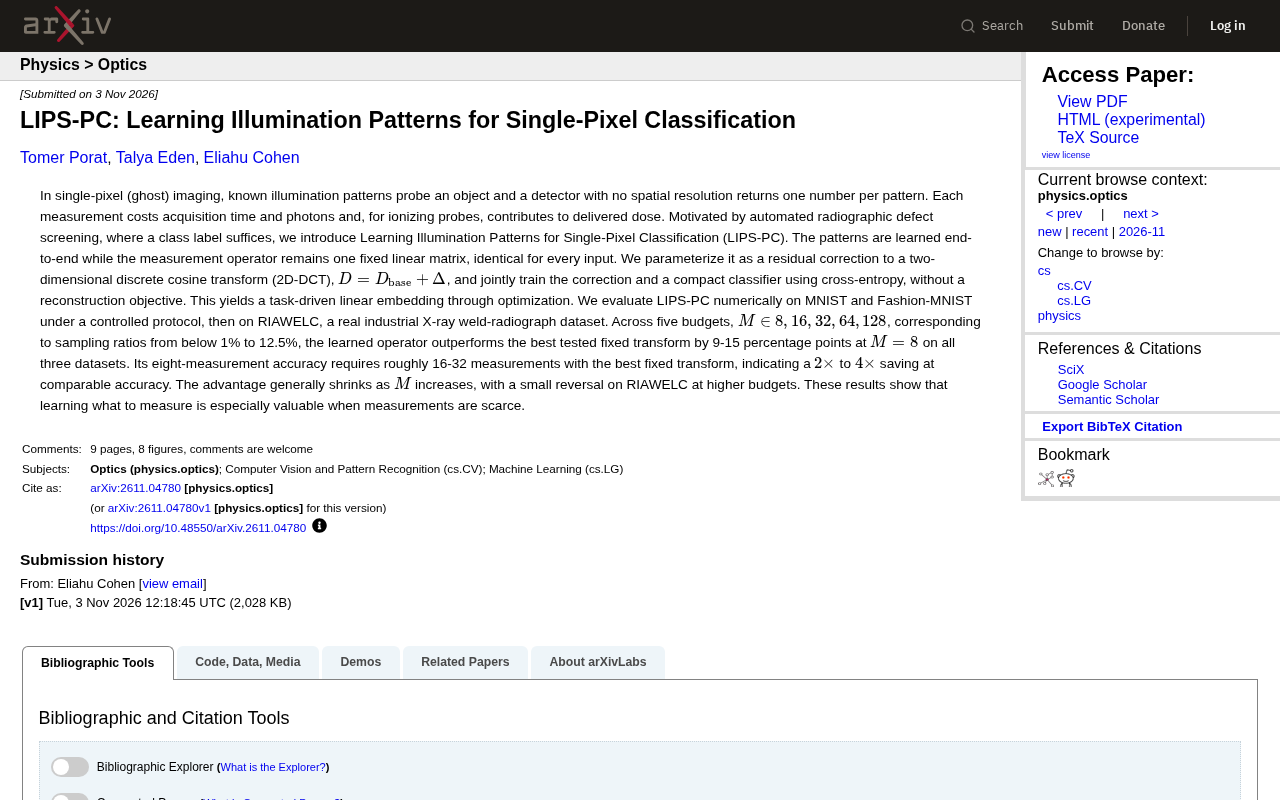
Unlike fixed transforms (such as 2D-DCT), LIPS-PC parameterizes the measurement operator as a residual correction to the 2D-DCT: (D = D_{\mathrm{base}} + \Delta). The correction matrix (\Delta) is trained end-to-end jointly with a compact classifier via a cross-entropy loss, with no reconstruction target. This yields a task-driven linear embedding whose optimization is directly oriented toward classification performance.
Single-pixel imaging (also known as ghost imaging) is an imaging paradigm that does not rely on pixel-array detectors. The basic idea: a spatial light modulator (such as a digital micromirror device, DMD) projects a series of known two-dimensional patterns onto the object, and a single-point detector (such as a photomultiplier tube) that can only record total light intensity measures the total reflected or transmitted intensity after each projection. Each pattern corresponds to one measurement value, and the image is ultimately reconstructed by solving a linear system or an optimization problem. Because the detector needs no spatial resolution capability, single-pixel imaging offers a significant cost advantage in non-visible bands (such as X-ray, terahertz, and short-wave infrared), where high-resolution array detectors are often expensive or even unavailable.
Compressive sensing is one of the theoretical cornerstones of single-pixel imaging. It states that if a signal is sparse in some transform domain (such as the discrete cosine transform or wavelet transform), it can be recovered with far fewer measurements than required by the Nyquist sampling theorem. This gives single-pixel imaging the ability to operate under low measurement budgets, but it also means the conventional pipeline typically must first reconstruct the image and then analyze it, with the reconstruction step itself consuming most of the measurement budget.
Method Core: Task-Driven Linear Embedding
The key to LIPS-PC is fusing "what to measure" with "how to classify." The measurement operator is a fixed linear matrix, identical for all inputs, but its parameters are adjusted through training. During training, only the classification loss (cross-entropy) is used, with no reconstruction loss, forcing the operator to learn the measurement directions most informative for classification. This end-to-end optimization allows the classifier to maintain high accuracy even under extremely low measurement budgets.
Advantages over Fixed Transforms
On MNIST, Fashion-MNIST, and RIAWELC, a real industrial X-ray weld radiography dataset, LIPS-PC was evaluated under five measurement budgets (M∈{8,16,32,64,128}, corresponding to sampling rates from below 1% to 12.5%). Results show that at M=8, the learned operator outperforms the best fixed transform by 9-15 percentage points on all three datasets.
More critically, the accuracy LIPS-PC achieves with only 8 measurements requires about 16-32 measurements for the best fixed transform to reach, meaning it achieves 2x to 4x measurement savings at comparable accuracy. As M increases, the advantage gradually shrinks, and at high budgets on RIAWELC a slight reversal even appears. This suggests that learning what to measure is especially valuable when measurements are scarce.
2D-DCT (two-dimensional discrete cosine transform) is an orthogonal transform that maps an image from the spatial domain to the frequency domain, widely used in image compression standards such as JPEG. In single-pixel imaging, using DCT bases as measurement patterns (i.e., each row of the measurement matrix corresponds to a DCT basis function) is a common choice, because the energy of natural images is highly concentrated in the DCT domain, and low-frequency coefficients can capture most of the information. LIPS-PC models the measurement operator as a residual correction to the DCT basis matrix ((D = D_{\mathrm{base}} + \Delta)). The cleverness of this parameterization is that the DCT bases provide an information-rich initialization starting point, and the residual term (\Delta) only needs to learn small task-relevant adjustments, thereby accelerating convergence and improving performance under low budgets. Learning from a random or zero matrix would make optimization significantly more difficult.
Sampling rate here is defined as the ratio of the number of measurements (M) to the total number of image pixels (N). For example, for a (28 \times 28) MNIST image, (N = 784), so M = 8 corresponds to a sampling rate of about 1%, and M = 128 to about 16%. The "below 1% to 12.5%" sampling rate range mentioned in the article corresponds to different datasets (MNIST/Fashion-MNIST are (28 \times 28), with a wider sampling rate span; the RIAWELC X-ray images have higher resolution, so the same (M) corresponds to a lower sampling rate). Understanding the distinction between sampling rate and number of measurements helps to accurately grasp the meaning of "2x to 4x measurement savings": what is saved is the absolute number of measurements, not the sampling rate itself.
Practical Applications and Implications
LIPS-PC's performance in industrial X-ray weld defect screening validates its real-world value. Conventional methods require many measurements to ensure reconstruction quality, whereas LIPS-PC targets classification directly, significantly reducing the number of measurements and thereby cutting acquisition time and radiation dose. For automated screening scenarios, this is undoubtedly a major advance.
Of course, the method has limitations: its advantage diminishes or even reverses at high budgets, suggesting the learned patterns may overfit to low-measurement conditions, and future work may need budget-adaptive adjustment. In addition, the experiments involve only linear measurements and simple classifiers, leaving more complex nonlinear scenarios to be explored.
Overall, LIPS-PC demonstrates the potential of task-driven learning in single-pixel classification and offers new ideas for resource-constrained imaging applications.
One-line Summary
LIPS-PC directly learns illumination patterns for single-pixel imaging classification, significantly outperforming fixed transforms under low measurement budgets.
Paragraph Summary
Single-pixel imaging probes an object through a series of known illumination patterns, with each measurement consuming time and photons. For screening tasks that only need a class label, researchers propose LIPS-PC, which parameterizes the measurement operator as a residual correction to the 2D-DCT and trains it end-to-end jointly with a compact classifier via a cross-entropy loss, with no reconstruction target. On MNIST, Fashion-MNIST, and the industrial X-ray weld dataset RIAWELC, at M=8 the learned operator achieves 9-15 percentage points higher accuracy than the best fixed transform, and can save 2-4x measurements to reach the same accuracy. The advantage shrinks as the measurement budget increases and even slightly reverses at high budgets, indicating that learned measurement is most valuable when measurements are scarce. The method can reduce acquisition time and radiation dose in industrial defect screening.
Related articles

Glasshand: Giving AI Agents a Real iPhone and Mac
Glasshand lets AI agents rent real iPhones and Macs, supporting Claude Code, Codex, and more to post, book services, and test iOS apps on real devices. This article explains how it works, its use cases, and potential boundaries.

ChatGPT Images 2.6 Released: GIF Generation, Reference Image Reuse, and 50% Speed Boost
ChatGPT Images 2.6 released: prompt-to-GIF animation with frame-by-frame editing, reusable reference images for yourself, pets, or characters, 50% faster generation, plus Flare and Sunburst API model variants and SVG export for developers.

Rerun: Turn Your AI Subscription into an AI Coworker Team
Rerun, #3 on Product Hunt, turns your ChatGPT or Claude subscription into a team of AI coworkers that run on schedules or triggers, each with tools, a computer, and a shared workspace. It asks before risky actions, is open source (AGPL v3), and supports self-hosting.