LipSpell: How a Cross-Lingual Phoneme Correction Framework Outperforms Traditional Spell Checkers

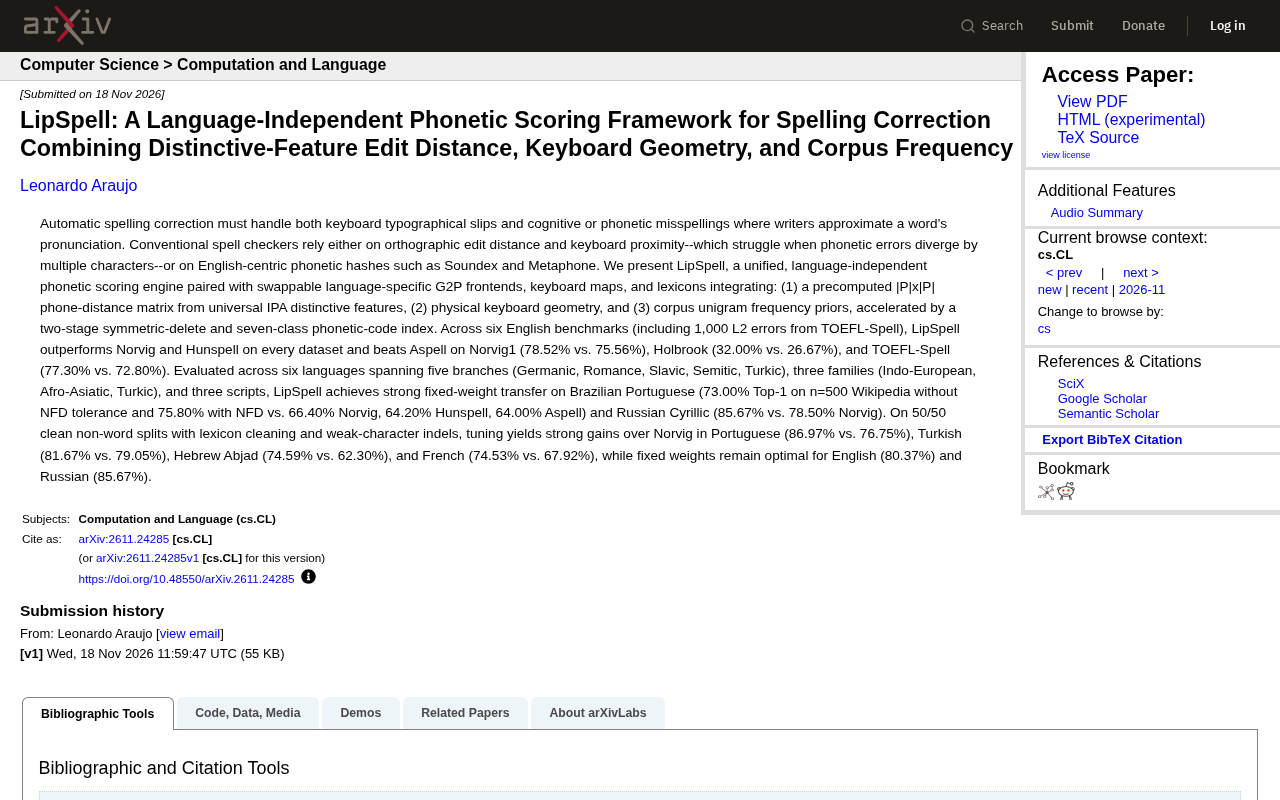
LipSpell uses a language-agnostic phoneme scoring core plus replaceable language frontends to achieve cross-lingual spelling correction.
LipSpell tackles two major bottlenecks of traditional spell checkers—edit distance's inability to capture phoneme-type errors and the English-centric nature of phoneme hashing—with a three-layer scoring structure: an IPA distinctive-feature phoneme distance matrix, keyboard geometry weighting, and a corpus unigram frequency prior, accelerated by two-stage symmetric deletion plus a seven-class phoneme encoding index. It surpasses Norvig and Hunspell on six English benchmarks and outperforms Aspell on multiple metrics. Cross-lingual evaluation covers six languages, five language branches, and three writing systems; fixed-weight transfer to Portuguese and Russian already yields significant gains. Limitations remain: some languages still require tuning, zero-tuning cross-lingual correction isn't fully realized, and G2P quality for low-resource languages is a key constraint.
Traditional spell checkers have long been stuck in two bottlenecks: first, they rely on edit distance and keyboard proximity to find errors, which fails when a misspelling sounds similar but differs by several letters in spelling; second, phoneme hashing methods (such as Soundex and Metaphone) are almost all designed around English and don't adapt well to other languages. LipSpell attempts to solve both problems at once—using a language-agnostic phoneme scoring engine paired with replaceable language frontends, pulling spelling correction from the "spelling layer" up to the "pronunciation layer."
Why Traditional Correction Collapses on Phoneme Errors
Spelling errors actually come in two types. One is keyboard slips—typing an adjacent key by mistake—which edit distance plus keyboard geometry can basically cover. The other is cognitive or phoneme-type errors, where the writer "guesses" the spelling based on pronunciation, resulting in a word form that deviates from the original by several characters. This latter type is precisely the blind spot of edit distance—the character-level distance is already large, but the pronunciation is actually very close.
Existing solutions either only handle the former, or force English-centric phoneme hashing onto other languages. LipSpell's judgment is: phoneme similarity itself is language-agnostic; what's truly language-bound is only the "grapheme-to-phoneme" conversion rules, keyboard layout, and vocabulary. Split these two layers apart, and you can achieve one scoring core reused across multiple languages.
LipSpell's Three-Layer Scoring Structure
Phoneme Distance Matrix Based on IPA Distinctive Features
LipSpell's first component is a |P|×|P| phoneme distance matrix precomputed from universal IPA distinctive features. Distinctive features describe acoustic and articulatory properties such as manner of articulation, place of articulation, and voicing—properties that don't depend on any specific language's spelling conventions. The closer two phonemes are in feature space, the lower the substitution cost—this is far more refined than simply treating phonemes as independent symbols.
IPA Distinctive Features originate from phonology: a set of binary or multi-valued properties used to describe the essential articulatory composition of a phoneme. Common features include: [±voice], [±nasal], [±continuant], [±round], place of articulation (bilabial, alveolar, velar, etc.), and manner of articulation (stop, fricative, approximant, etc.). Each phoneme can be represented as a feature vector, and the distance between two phonemes becomes a distance in feature space (such as Hamming distance or weighted Euclidean distance). The key advantage of this representation is that it is language-agnostic: regardless of the writing system, the distinction between /p/ and /b/ is always a voicing contrast, and the distinction between /i/ and /u/ always involves tongue position frontness/backness and rounding. LipSpell leverages this to build a universal phoneme distance matrix, so the scoring core doesn't need to be redesigned for each language.
Keyboard Geometry and Corpus Frequency as Weighting Terms
The second component is physical keyboard geometry, used to capture key proximity in typo scenarios. The third component is a corpus unigram frequency prior, giving high-frequency words an advantage in candidate ranking. The three combine into a unified scoring function, where phoneme similarity, key distance, and word frequency prior jointly determine candidate rankings.
Two-Stage Indexing to Accelerate Retrieval
To make this scoring run feasibly on real vocabularies, LipSpell uses two-stage symmetric deletion plus a seven-class phoneme encoding index to accelerate candidate recall. A coarse filter first shrinks the candidate set, then full scoring does fine ranking, avoiding computing phoneme distances one by one across the entire vocabulary.
Symmetric Delete is a classic candidate generation technique in spelling correction. Its core idea: generate a set of "deletion variants" for each word in the dictionary—all substrings obtained by successively deleting one or two characters—and build an inverted index from deletion variants to original words. At query time, perform the same deletion operations on the misspelled word, look up the generated variants in the index, and any hits recall candidate words. It's called "symmetric" because the same deletion process is executed on both the dictionary side and the query side. Compared to full-table scanning with edit distance, symmetric delete reduces candidate recall from O(dictionary size × word length) to near-constant-time index lookup. LipSpell builds on this by introducing seven-class phoneme encoding—grouping and encoding phonemes coarsely by distinctive features, so that words with similar pronunciation but different spelling can also collide at the index level, thereby recalling candidates corresponding to phoneme-type errors. The two-stage design first uses the index for coarse filtering to compress the candidate set, then uses the full scoring function for fine ranking, balancing recall and efficiency.
Performance on Six English Benchmarks
On six English benchmarks, LipSpell comprehensively surpasses Norvig and Hunspell. These include 1,000 L2 learner errors from TOEFL-Spell. In comparisons with Aspell, LipSpell achieves 78.52% vs. 75.56% on Norvig1, 32.00% vs. 26.67% on Holbrook, and 77.30% vs. 72.80% on TOEFL-Spell. The improvement on L2 learner data is noteworthy—such errors have more pronounced phoneme characteristics, falling right within LipSpell's design range.
Cross-Lingual Transfer: Validation Across Five Language Branches
LipSpell was evaluated on six languages, covering five branches—Germanic, Romance, Slavic, Semitic, and Turkic—spanning three language families (Indo-European, Afro-Asiatic, Turkic) and three writing systems.
When fixed weights were directly transferred to Brazilian Portuguese, it achieved 73.00% Top-1 on 500 Wikipedia samples (without NFD tolerance), rising to 75.80% with NFD tolerance, compared to Norvig 66.40%, Hunspell 64.20%, and Aspell 64.00%. On Russian Cyrillic it achieved 85.67%, compared to Norvig 78.50%. This demonstrates that the language-agnostic phoneme scoring core genuinely has cross-lingual transferability, without needing to redesign the core algorithm for each language.
Under 50/50 clean non-word splitting, combined with vocabulary cleaning and weak character insertion/deletion, the tuned improvements over Norvig are notably large in Portuguese (86.97% vs. 76.75%), Turkish (81.67% vs. 79.05%), Hebrew consonantal script (74.59% vs. 62.30%), and French (74.53% vs. 67.92%). English (80.37%) and Russian (85.67%) remain optimal with fixed weights—the ready-made configurations for these two languages are already sufficiently well-fitted.
NFD (Unicode Normalization Form D, i.e., Canonical Decomposition) is a character decomposition specification defined by the Unicode standard. It splits a precomposed character into a base character plus combining marks, e.g., "é" decomposes into "e" plus combining acute accent U+0301. For spelling correction, whether NFD is tolerated directly affects scoring: if the system treats letters with diacritics (such as ã, ç in Portuguese) as independent characters, then a user's missing or incorrect diacritic will be judged as completely wrong; if compared at the NFD level, a base character match can earn partial credit. LipSpell reports two tiers of results on Brazilian Portuguese: 73.00% "without NFD tolerance" and 75.80% "with NFD tolerance." The difference shows that diacritic handling strategy has a substantive impact on evaluation for Romance languages, and also suggests that Unicode normalization configuration must be explicitly specified in cross-lingual deployment.
The Real Significance of This Framework
LipSpell's value isn't in beating some benchmark score, but in validating a structural judgment: the language-agnostic parts and language-dependent parts of spelling correction can be cleanly separated. Phoneme distance comes from IPA distinctive features, and this part is shared across languages; the G2P frontend, keyboard mapping, and vocabulary are replaced per language. Given the long-standing English monopoly on spell checking, this is a reusable engineering paradigm.
Of course, the fact that fixed weights are optimal for some languages while others require tuning also shows that "fully zero-tuning cross-lingual correction" has not yet been truly achieved. The phoneme frontend's dependence on G2P quality for low-resource languages is an unavoidable constraint when extending this framework to more languages.
One-line Summary
LipSpell uses a language-agnostic phoneme scoring core plus replaceable language frontends to achieve cross-lingual spelling correction.
Paragraph Summary
LipSpell addresses two major bottlenecks of traditional spell checkers—edit distance failing to capture phoneme-type errors, and phoneme hashing methods being English-centric—by proposing a three-layer scoring structure: a phoneme distance matrix based on IPA distinctive features, physical keyboard geometry weighting, and a corpus unigram frequency prior, with two-stage symmetric deletion plus a seven-class phoneme encoding index to accelerate candidate recall. It comprehensively surpasses Norvig and Hunspell on six English benchmarks, and outperforms Aspell on multiple metrics. Cross-lingual evaluation covers six languages, five language branches, and three writing systems; transferring fixed weights to Portuguese and Russian already yields significant improvements. The article also notes limitations: some languages still require tuning, zero-tuning cross-lingual correction is not yet fully achieved, and G2P quality for low-resource languages is a key constraint.
Related articles

New Breakthrough in Model Merging: Interference Bounds and Curvature-Guided Training
This article interprets new theoretical advances in model merging: characterizing merging excess loss via an interference functional, proposing curvature-guided regularized training, and analyzing its experimental performance and limitations on Transformers.
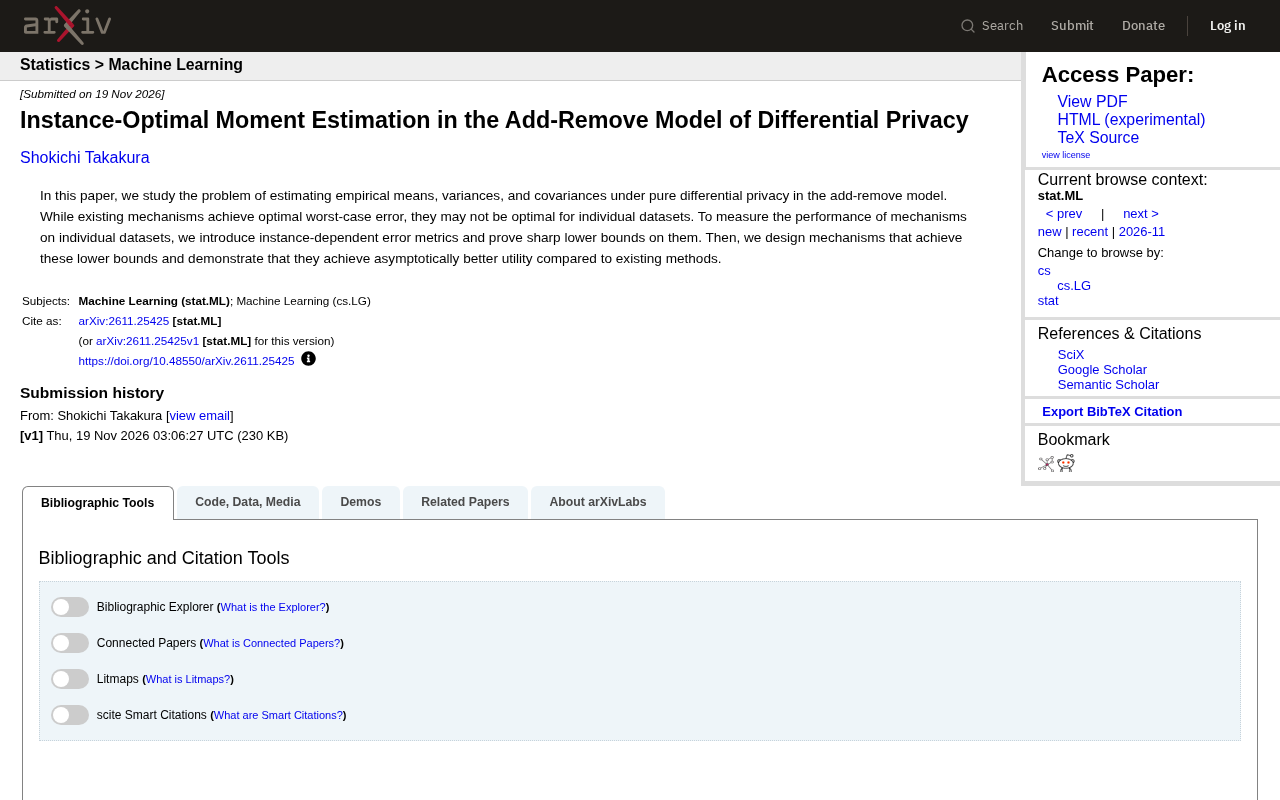
A New Breakthrough in Differential Privacy: How to Achieve Instance-Optimal Moment Estimation?
This article interprets research on instance-optimal moment estimation under the add-remove model of differential privacy, covering instance-dependent error metrics, tight lower bound proofs, and new mechanism design, comparing with existing methods to show utility gains and discussing implications for privacy-preserving practice.
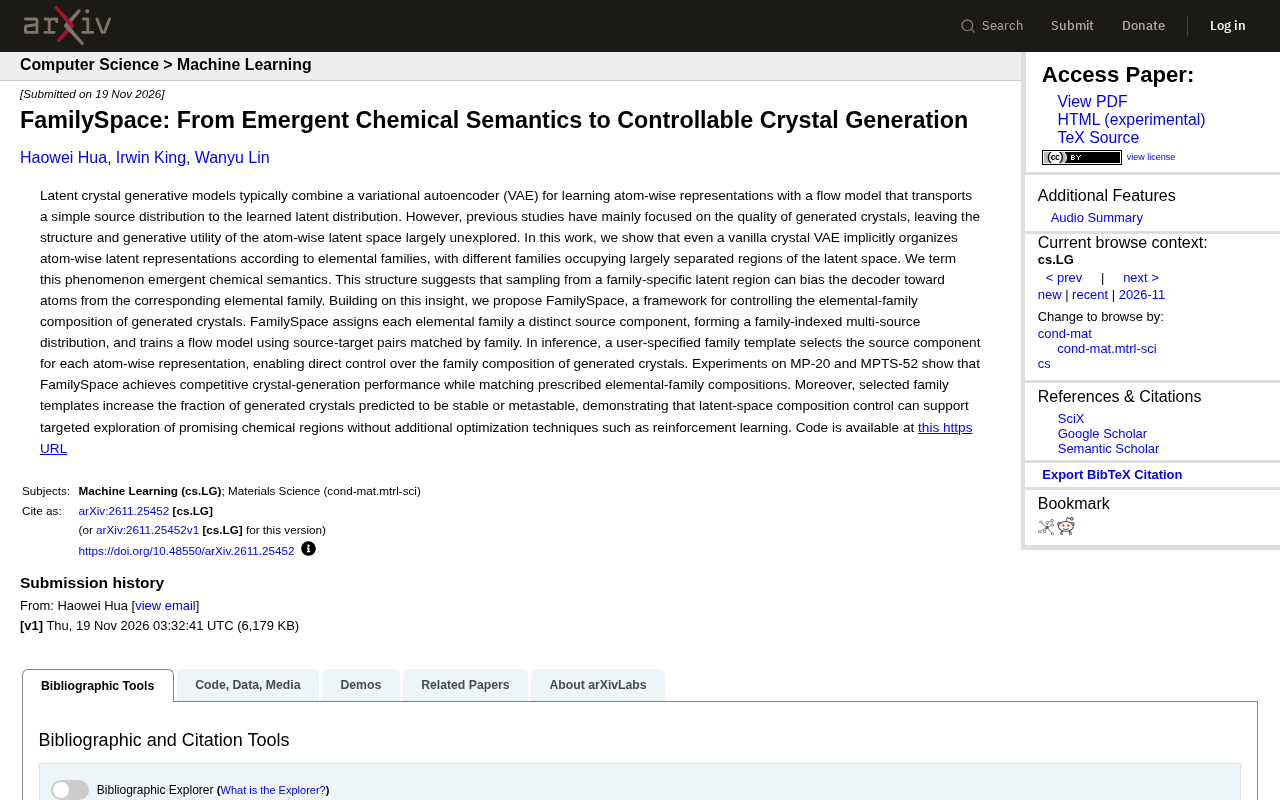
FamilySpace: From Emergent Chemical Semantics to Controllable Crystal Generation
Crystal generation latent spaces spontaneously cluster by elemental family? FamilySpace leverages this emergent chemical semantics to enable composition-controllable crystal generation via multi-source flow models, balancing quality and stable exploration on MP-20 and MPTS-52.