Liquid AI Decision Models d1.2 Land on AI Gateway: Moving Beyond Text Generation
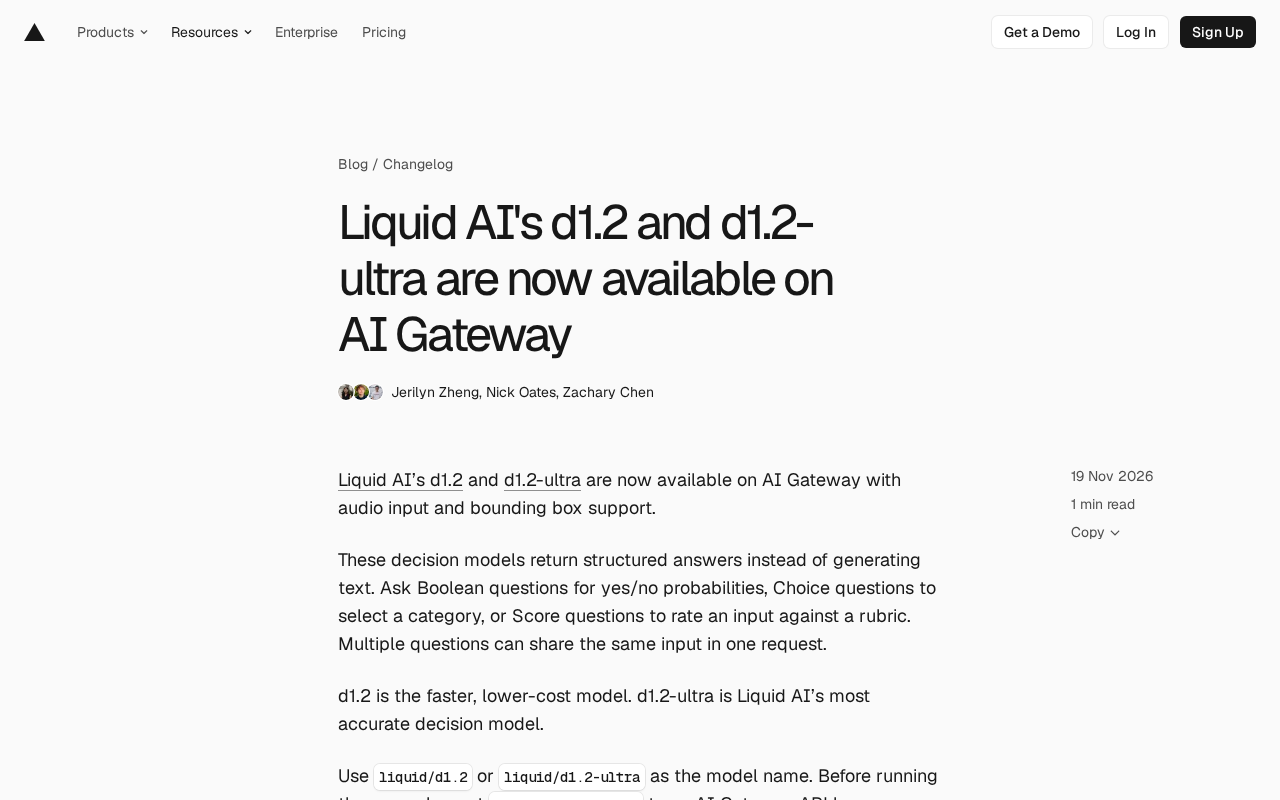
Liquid AI's d1.2 decision models launch on AI Gateway, returning structured judgments instead of generated text.
Liquid AI's d1.2 and d1.2-ultra decision models have arrived on AI Gateway. Unlike generative models, they return structured answers rather than free-form text. They support Boolean, Choice, and Score questions, with multiple questions sharing one input in a single request to cut redundant inference. d1.2 is faster and cheaper, d1.2-ultra is the most accurate, and switching between them is just a model name change. Multimodally, they accept audio and image input, and Box questions return proportional coordinates relative to image dimensions, decoupled from resolution. This design moves structured extraction into the model, reducing post-processing—but it suits well-bounded judgment tasks, not general-purpose assistance.
Liquid AI's d1.2 and d1.2-ultra decision models have officially landed on AI Gateway, bringing audio input and bounding box support. Unlike mainstream generative models, these two models do not produce free-form text—they return structured answers directly.
The Divide Between Decision Models and Traditional Generative Models
The dominant way to use large models today is "generation"—given a prompt, produce paragraphs, code, or conversation. Liquid AI's d1.2 series takes a different path: using the model as a decision engine.
Users can pose three types of questions to the model: Boolean questions return a yes/no probability, Choice questions select one option from a predefined set of categories, and Score questions rate the input according to a scoring rubric. Within a single request, multiple questions can share the same input, meaning that for one piece of audio or one image, judgments across multiple dimensions can be made simultaneously without repeatedly calling the model.
This design has real engineering value. Tasks like classification, moderation, and labeling often require a deterministic output format, and the free-form text of generative models actually adds post-processing overhead. Structured answers let downstream systems consume results directly.
Dual-Model Positioning: The Trade-off Between Speed and Accuracy
d1.2 and d1.2-ultra have a clear division of labor. d1.2 is faster and cheaper, suited to latency-sensitive or high-volume scenarios; d1.2-ultra is Liquid AI's most accurate decision model to date, aimed at tasks with stricter accuracy requirements.
To invoke them, simply specify liquid/d1.2 or liquid/d1.2-ultra in the model name and authenticate with an AI Gateway API Key. Developers don't need to integrate two separate interfaces—switching models is just a matter of changing one string.
AI Gateway is a model routing and observability service offered by Vercel. Developers access models from multiple vendors through a unified API Key and endpoint, without maintaining separate authentication and billing configurations for each provider. Beyond forwarding requests, it also logs calls, tracks token usage, and counts it against budgets, making it easy for teams to account for costs per project. For decision models like d1.2, the Gateway's value lies in bringing calls into an existing observability system: the input, output, and latency of every judgment request are recorded, making it easy to check whether structured results meet expectations.
Audio and Images: How Multimodal Decision-Making Works in Practice
The d1.2 series' support for multimodal input is what sets it apart from pure text classifiers. In the AI SDK example, the model can receive an audio file and determine whether the caller is requesting a refund—returning a probability value rather than explanatory text. The example requires ai 7.0.136 or later, with audio passed as a file type into the state parameter.
Image classification is supported too—just pass the image bytes with the corresponding media type, such as image/png.
More practically valuable is the bounding box capability. Box-type questions return top and bottom as proportions of the image height, and left and right as proportions of the image width, thereby locating the target object within the image. The Python example uses the Decisions API to locate the signature area in a form image and output its bounding box. This "proportional coordinates" design decouples results from image resolution, making them reusable across images of different sizes.
Decision requests appear in AI Gateway logs and count toward budget consumption.
AI SDK is an open-source TypeScript library from Vercel that provides a unified calling interface across model providers and uses types like file to describe multimodal input. The version number 7.0.136 mentioned in the article means the multimodal file parameter requires a relatively recent SDK to correctly serialize audio bytes and MIME type. With older versions, audio may be treated as an ordinary string, causing request failures or abnormal judgment results—so upgrading the SDK is a prerequisite check before integration.
A bounding box is the standard way to describe object location in computer vision, typically represented by the four edges of a rectangular box. The common approach is to output absolute pixel coordinates, but such results are tightly bound to the input image resolution—switching to an image of a different size requires recalculation. d1.2's Box questions instead return relative proportions: top and bottom relative to image height, left and right relative to image width, generally ranging from 0 to 1. Downstream rendering or cropping simply multiplies by the actual width and height to recover the position, so the same judgment logic can be reused directly across images of different sizes.
Practical Impact for Developers
Turning the model from a "generator" into a "judge" changes how you integrate it. The traditional approach is to have a generative model output text, then extract structured fields with regex or a parser—any format drift along the way can cause failure. The d1.2 series moves this step inside the model: the output is already structured.
The ability to share input across multiple questions is also worth noting. For a customer service recording, you can ask multiple Boolean or Choice questions at once—"Is a refund being requested?" "Is the sentiment negative?" "Does this need to be escalated to a human?"—reducing redundant inference overhead.
Keep in mind that these models are not a replacement for general-purpose assistants. They excel at well-bounded judgment tasks, not open-ended creation or complex reasoning. When choosing a model, distinguish by the nature of the task rather than simply swapping out existing solutions because something is "new."
Decision model documentation and the model list are available on AI Gateway, so developers can use them to evaluate whether to integrate.
Related articles
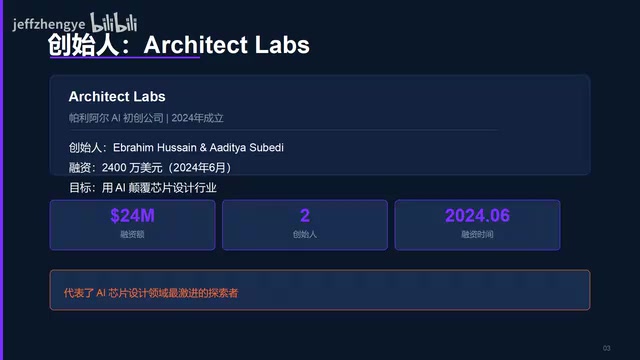
AI Independently Designs CPU Architecture 'Frostbite': 4.59x Energy Efficiency Boost
AI independently designed the complete CPU architecture Frostbite, achieving 4.59x better energy efficiency and 8.77x better performance per unit area. This article analyzes Architect Labs' technical path, five-step design flow, foreign media commentary, and current limitations, exploring the potential impact of AI chip design on Intel, AMD, and the RISC-V ecosystem.
Meta's Your Algorithm: Reshaping Recommendation Ranking with Natural Language
Meta reveals technical details of Facebook's "Your Algorithm": users describe interests in natural language, and the system uses LLM validation, 4-channel retrieval, layered filtering, and a fine-tuned LLM re-ranker to turn preferences into Feed and Reels ranking signals.
Huawei Found Liable for Trade Secret Theft: A New Legal Flashpoint in US-China Tech Rivalry
A jury found Huawei liable for stealing US trade secrets involving T-Mobile and Cisco source code. This analysis examines the legal, business, and geopolitical implications and compliance lessons for Chinese tech firms.