Living with Sonos: From a Small Apartment to a Whole-Home Audio System

A 10-year Sonos user shows how the ecosystem scales seamlessly from apartment to home theater.
Following a long-time Sonos user's journey from a small apartment to a full house, this piece highlights the core strengths of the Sonos ecosystem: low barrier to entry, effortless scalability via the app, and flexible multi-role hardware. The Sonos Play portable speakers prove equally at home on a work desk or as wireless surround channels in a living room home theater setup — demonstrating how a single device can serve multiple purposes and reduce the overall cost of building a complete audio system.
A Decade with Sonos: One User's Story
This is a sponsored piece built around the Sonos ecosystem — but the real-world scenarios it captures speak directly to the core value of a smart audio system: seamless connectivity, scalability, and the freedom to take your music anywhere.
The creator behind this video has been a long-time Sonos user. More than ten years ago, while living in a tiny apartment, he bought his first Sonos setup. Back then, just two speakers were enough to fill the entire space with sound. That starting point is telling: the barrier to entry with Sonos is low. Even a studio apartment can deliver a complete listening experience.

Scalability: From Apartment to Full House
What truly sets Sonos apart is how effortlessly the system scales. When the author's family moved into a standalone house, upgrading the setup was surprisingly painless — every new speaker could be added to the existing system with just a few taps in the Sonos app.
This "plug and expand" experience has been a Sonos hallmark for years. There's no need to reconfigure the entire setup or worry about compatibility between older and newer devices. The home audio network grows naturally alongside your living space. For long-term users, this means early investments don't lose their value when you move or upgrade.
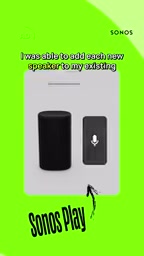
Sonos's multi-room audio technology is built on its proprietary SonosNet mesh network protocol (with some newer devices transitioning to standard Wi-Fi). This allows all speakers to play in sync across the same system, with latency differences kept within milliseconds — no audible echo or phase issues. Users can choose between "group play" (all rooms in sync) or "independent play" (different content in different rooms), and switch freely within the app. The key advantage of this architecture is that the system is software-defined at its core: adding a new device only requires connecting it to the same network and identifying it in the app — no complex hardware pairing involved. This is precisely why speakers purchased a decade apart can still be managed from the same app interface. Software compatibility is the technical backbone that keeps Sonos users loyal for years.
Sonos Play Portable Set: Music That Follows You
For this review, the brand sent over an "adventure set" containing two Sonos Play portable speakers. They integrate seamlessly with the author's existing Sonos system — a natural extension of Sonos's ecosystem-first philosophy.
As someone who works from home, the author finds the portable speakers genuinely meaningful: he almost never has to be without music. Whether he's at his desk, relaxing in the backyard, or lifting weights in the garage, the speaker comes along. He jokes that "the louder the music, the heavier you can lift" — not exactly scientific, but it does capture the emotional value a portable speaker adds to everyday life.

Flexible Enough for Any Setting
The biggest advantage of a portable speaker like this is freedom from fixed placement. Traditional home audio systems tend to live in the living room or study. A portable like the Play can move freely between indoors and outdoors, covering everything from work and leisure to exercise.

More Than Portable: Double Duty as Surround Channels
Beyond on-the-go use, the two Play speakers can take on another role — serving as wireless surround channels for a Sonos Soundbar, adding a fuller soundstage to the living room setup. The author also mentions that pairing them with the Sonos Beam Ultra down the road would take things to another level.
This is where the Sonos ecosystem gets clever: the same portable speaker can be your everyday music companion and a surround speaker in a home theater system. That kind of multi-role flexibility amplifies the value of a single product and lowers the marginal cost of building out a complete home audio setup.
Sonos's surround sound solution is entirely wireless — a major departure from traditional home theater setups that require running meters of audio cable across the room. The soundbar maintains sync with the surround speakers via Sonos's proprietary wireless protocol, with millisecond-level latency to ensure audio stays perfectly aligned with the picture. The only requirement is that all devices are on the same Wi-Fi network, managed centrally through the Sonos app. The Sonos Beam Ultra is one of Sonos's current flagship soundbars, supporting Dolby Atmos spatial audio decoding. Paired with wireless surround speakers, it can simulate a basic height-channel soundstage — delivering a near-cinematic surround experience without ceiling-mounted speakers. For users who want a true home theater feel without running cables through the living room, this all-wireless solution is one of the more mature options available today.
Final Thoughts: What Makes Sonos Competitive
Sponsorship aside, this story surfaces a few genuine strengths of the Sonos product line: a low barrier to entry, a system that scales naturally with your living space, portable speakers that adapt across multiple scenarios, and seamless connectivity between devices.
For anyone who treats music as a daily essential, a system that can follow you from apartment to house, from desk to garage, from casual listening to home theater — that's a genuinely compelling proposition. And the ecosystem experience Sonos has built over the years remains the core reason it continues to hold its ground in the smart speaker market.
Related articles

LangChain Retry Middleware Configuration: Practices and Selection Guide
Based on Reddit community discussion, this article analyzes LangChain ModelRetryMiddleware retry parameter configuration practices, covering the selection logic and alternatives for key options like max_retries, backoff_factor, and jitter.

Texas Senate Race in Trouble: Why Are Republicans Nervous?
Texas Senate race stirs Republican anxiety. Based on street interviews, this article analyzes the Democratic offensive in funding, organization, and running everywhere, and how Republicans are defending "Texas, Texas" amid the political pendulum effect.

Gemini Chat Now Generates and Edits Google Docs Directly, a New Breakthrough in Office Productivity
Google Gemini's chat interface now generates and edits PDF, Google Docs, Sheets, Slides, Markdown, TXT, and code files. Available to all users; web supports all formats, mobile only PDF for now.