LlamaIndex Integrations Get a Major Overhaul: Key Upgrade Points Every Developer Should Know
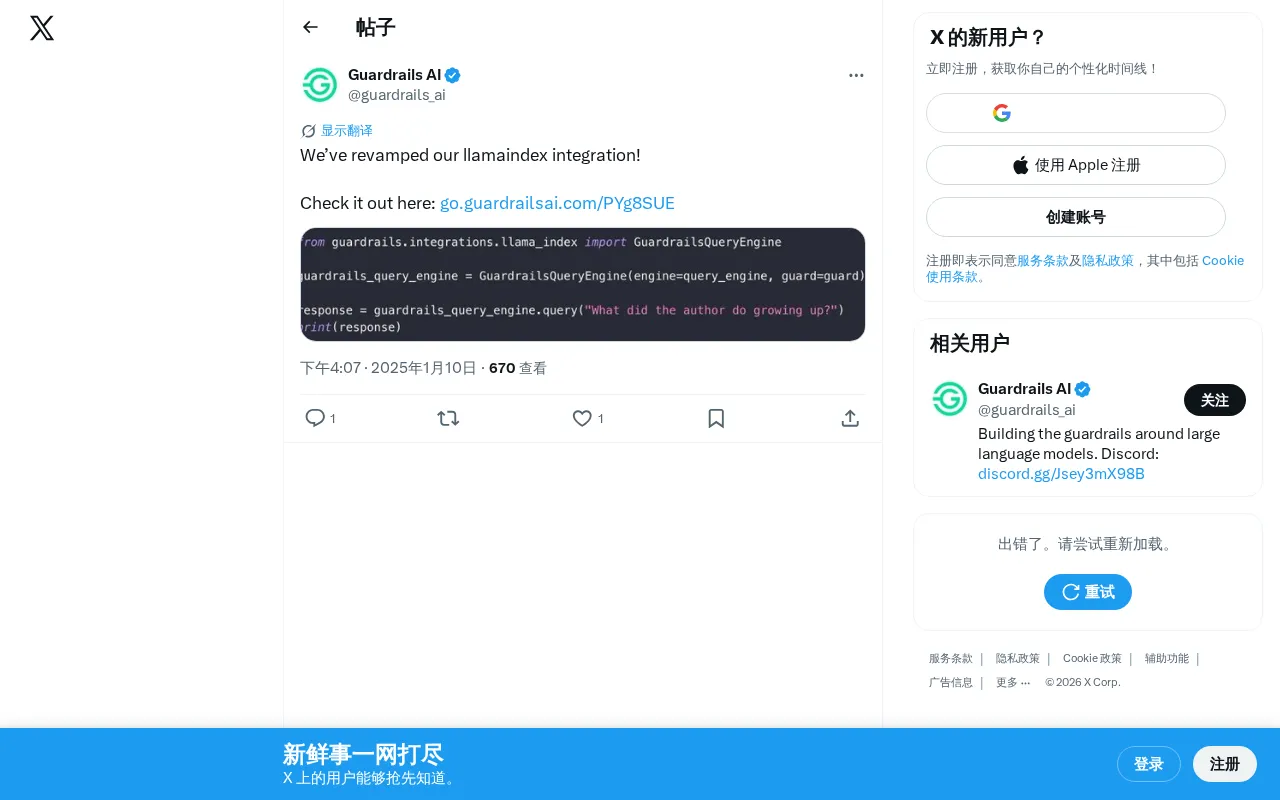
LlamaIndex's official integration modules receive a comprehensive overhaul, improving developer experience and ecosystem quality.
LlamaIndex recently announced a comprehensive overhaul of its official integration modules, covering plugin architecture optimization, API unification, and documentation improvements. This upgrade enhances integration quality for vector databases, embedding models, LLM providers, and other external tools, with significant implications for both RAG and AI Agent development. It further solidifies LlamaIndex's ecosystem advantage in the competitive LLM framework landscape. Developers are advised to review the changes and plan their migration accordingly.
Overview
LlamaIndex's ecosystem has received another important update — its official integrations recently underwent a comprehensive overhaul. The development team announced this via social media. While the announcement itself was brief, it's a development worth paying close attention to for developers currently using or planning to use LlamaIndex to build AI applications.
What Is LlamaIndex?
LlamaIndex (formerly known as GPT Index) is one of the most popular Large Language Model (LLM) application development frameworks available today. Its core value lies in helping developers efficiently connect private data with large language models, supporting various application patterns including Retrieval-Augmented Generation (RAG), intelligent agents, and more.
RAG: LlamaIndex's Core Use Case
RAG (Retrieval-Augmented Generation) is one of the most critical architectural patterns in LLM applications today. The basic principle works as follows: when a user asks a question, the system first retrieves relevant document fragments from an external knowledge base, then feeds these fragments as context along with the user's question into the LLM, which generates the final answer. This approach effectively addresses two major LLM pain points — knowledge cutoff date limitations and hallucination issues (where models generate content that sounds plausible but is factually incorrect). A typical RAG pipeline includes: document chunking, vector embedding, vector storage and indexing, semantic retrieval, and context-augmented generation. LlamaIndex provides end-to-end toolchain support around this entire pipeline, which is precisely why its integration layer is so important.
In practice, LlamaIndex needs to integrate with various external tools and services, including:
-
Vector Databases: Such as Pinecone, Weaviate, Milvus, etc. Vector databases are the core infrastructure of RAG architecture. Unlike traditional databases that rely on exact-match queries, vector databases perform semantic retrieval by computing similarity between high-dimensional vectors (e.g., cosine similarity, Euclidean distance). After text is converted into vectors with hundreds or even thousands of dimensions by embedding models, vector databases are responsible for efficiently storing these vectors and supporting Approximate Nearest Neighbor (ANN) search. Among them, Pinecone is a fully managed cloud-native vector database ideal for getting started quickly; Weaviate supports hybrid search (vector + keyword); and Milvus is one of the highest-performing open-source options, supporting billion-scale vector volumes. Different vector databases vary in indexing algorithms (such as HNSW, IVF), filtering capabilities, and deployment methods. The quality of LlamaIndex's integrations directly determines how conveniently developers can switch between and use these databases.
-
Document Loaders: Supporting multiple data sources including PDFs, web pages, databases, and more
-
Embedding Models: OpenAI Embedding, HuggingFace, etc. Embedding models are the key components that convert text into dense vector representations. Through contrastive learning on large-scale text corpora, they ensure that semantically similar texts are closer together in vector space. OpenAI's text-embedding-3-small/large series are currently the most widely used embedding models in commercial scenarios, offering different dimension and performance options. HuggingFace hosts a large number of open-source embedding models such as BGE, E5, and GTE, some of which have achieved performance on the MTEB benchmark that approaches or even surpasses commercial models. The choice of embedding model directly impacts retrieval quality — higher dimensions generally mean stronger semantic representation, but also higher storage and computational costs.
-
LLM Providers: OpenAI, Anthropic, local models, etc.
The quality and usability of these integrations directly affect the developer experience and the ultimate effectiveness of RAG applications.
What Does the LlamaIndex Integration Overhaul Mean?
Evolution of Integration Architecture
Designing a framework's integration module is a complex software engineering challenge. Early LLM frameworks typically bundled all integration code into the main repository, leading to dependency bloat — users might be forced to install dozens of unrelated dependencies even if they only needed one vector database. The modern approach is to split each integration into an independent Python package (e.g., llama-index-vector-stores-pinecone, llama-index-llms-openai, etc.), achieving on-demand installation through a plugin-based architecture. This design also brings version management advantages: updating a single integration won't affect other modules, and third-party developers can more easily contribute new integrations. This LlamaIndex integration overhaul likely involves these kinds of architecture-level optimizations, including unified base class interface definitions, standardized error handling mechanisms, and more comprehensive type annotation support.
Significant Improvements to Developer Experience
An integration layer overhaul typically means optimized API design, improved documentation, and simplified workflows. For developers, this could bring the following improvements:
- More unified interface standards: More consistent calling patterns across different integration modules, reducing the learning curve
- Clearer documentation and examples: Helping developers get started faster and spend less time debugging
- More stable version management: Overhauled integrations typically come with better version compatibility and dependency management
Continued Refinement of the LlamaIndex Ecosystem
In the competitive landscape of LLM application development frameworks, LlamaIndex and LangChain have been in fierce competition. The two have distinctly different design philosophies: LangChain positions itself as a general-purpose LLM application orchestration framework, offering abstractions like Chain, Agent, and Tool, making it suitable for building complex multi-step workflows and intelligent agent systems — its ecosystem coverage is broader but has also been criticized for over-abstraction. LlamaIndex, on the other hand, focuses more on data indexing and retrieval scenarios, providing finer-grained control in the RAG domain, such as custom retrieval strategies and multiple index structures (tree index, keyword index, knowledge graph index, etc.). Recently, both have been expanding into each other's areas of strength — LlamaIndex has launched Workflows and Agent frameworks, while LangChain has strengthened its state management capabilities through LangGraph.
The quality of the integration layer is a vital component of a framework's ecosystem — the more tools supported and the smoother the integrations, the more willing developers are to adopt the framework as part of their tech stack. This overhaul demonstrates the LlamaIndex team's continued investment in ecosystem development and further solidifies its leading position in the RAG development space.
AI Agent: Another Key Beneficiary of the Integration Overhaul
AI Agent (intelligent agent) is one of the hottest directions in the LLM application space for 2024–2025. Unlike traditional single-turn Q&A, agents can autonomously plan tasks, invoke tools, perform multi-step reasoning, and dynamically adjust strategies based on intermediate results. A typical agent architecture includes: a planning module (decomposing complex tasks into subtasks), a memory module (short-term working memory and long-term knowledge storage), a tool invocation module (search engines, code executors, API calls, etc.), and a reflection module (evaluating execution results and self-correcting).
LlamaIndex's presence in the agent space includes its Workflows framework and built-in support for multiple agent strategies, and the quality of its integration layer directly determines the richness and reliability of tools available to agents. This integration overhaul is equally significant for agent developers — more stable and unified tool integrations mean significantly improved reliability when agents execute complex tasks.
How Should Developers Respond to This Upgrade?
Review Official Change Documentation Promptly
If you're currently using LlamaIndex integrations, it's advisable to check the official changelog as soon as possible to understand the specific changes. The overhaul may involve API signature modifications, and existing code may need corresponding adaptations.
Assess Project Migration Costs
For existing projects, you'll need to weigh the costs and benefits of migrating from old integrations to the new versions:
- If the new integrations offer significant performance improvements or feature enhancements, migrating early is a wise move
- If the changes are minor and the current version is running stably, you can handle the migration during your next version iteration
- It's recommended to validate in a test environment first and confirm compatibility before deploying to production
Follow Community Feedback and Lessons Learned
When new integrations are first released, it's a good idea to monitor GitHub Issues, the Discord community, and tech blogs for feedback from other developers. Learning from others' experiences can help you upgrade more efficiently and avoid repeating common pitfalls.
Conclusion
Although the announcement itself was light on details, the comprehensive overhaul of LlamaIndex integrations reflects that LLM application development toolchains are rapidly maturing. From RAG retrieval optimization to AI Agent tool invocation, the quality of the integration layer remains the critical bridge connecting framework capabilities to real-world application scenarios. As more enterprises and developers invest in building RAG applications and AI Agents, continuous optimization of underlying frameworks will drive higher development efficiency across the entire industry. Developers are encouraged to visit the official LlamaIndex documentation for detailed update information and develop a reasonable upgrade plan based on their specific project needs.
Key Takeaways
- LlamaIndex has officially announced a comprehensive overhaul of its integration modules
- Integration layer overhauls typically mean API optimization, improved documentation, and enhanced developer experience
- The overhaul likely involves plugin architecture optimization, enabling independent package management and on-demand installation for integration modules
- As a mainstream LLM application development framework, LlamaIndex continues to advance its ecosystem across both RAG and Agent directions
- In the competition with frameworks like LangChain, integration ecosystem quality has become a key factor in developers' technology selection
- Existing users are advised to review the changes promptly and assess migration costs
Related articles
 Tech Frontiers
A Rare Quiet Day in AI: Recursive Self-Improvement Stirs Beneath the Surface
A rare quiet day in AI sees multiple sources go silent simultaneously. Behind the calm, Recursive Self-Improvement (RSI) research continues. What this means for the industry.
 Tech Frontiers
Reve 2 vs. Ideogram 4: A Deep Dive into Layout Control in AI Image Generation
A deep comparison of Reve 2 and Ideogram 4's layout control capabilities, covering technical approaches, real-world use cases, and industry trends for designers and creators.
 Tech Frontiers
In the Weights: Check Your Influence Score in the AI World
In the Weights is an AI influence search engine that quantifies your presence in the AI world with a score. Explore how it evaluates practitioners and what it means for digital identity.