LlamaIndex v0.14.25 Released: Sweeping Security Fixes and Core Feature Enhancements

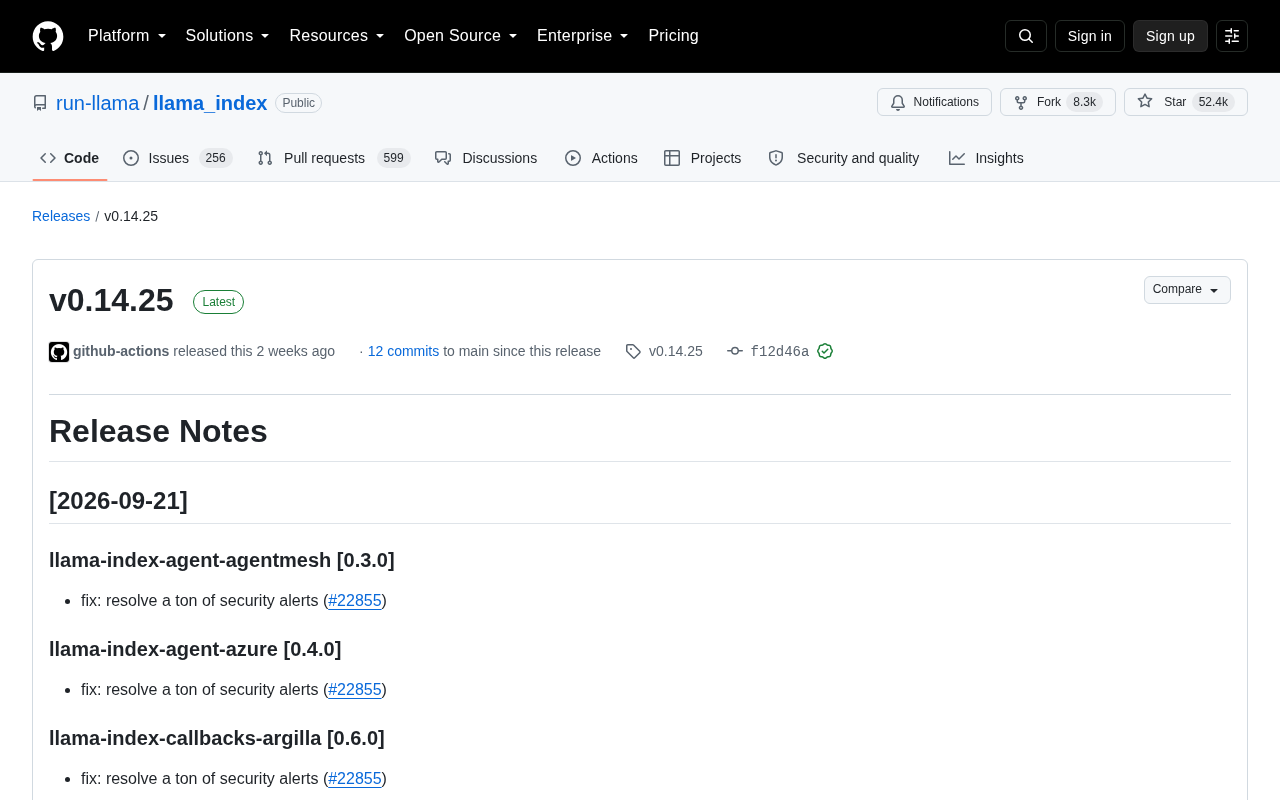
LlamaIndex v0.14.25 hardens security across dozens of packages and fixes critical production bugs.
LlamaIndex v0.14.25 is a maintenance release focused on security and stability rather than new features. It sweeps security vulnerabilities across dozens of integration packages, re-locks 93 Dependabot-stalled dependency manifests, restores streaming output for compact and refine modes, adds async support to StructuredLLMRerank, and unifies the openai-like base dependency to 0.8.x across 26 LLM integrations. OpenAI and Gemini multimodal tool result fixes are also included. Teams with compliance requirements have clear grounds to upgrade.
LlamaIndex is one of the most popular frameworks for RAG (Retrieval-Augmented Generation) and LLM application development, boasting over 52.4k GitHub stars and 8.3k forks. Its latest release, v0.14.25, is not an aggressive feature iteration — it's a maintenance update centered on security hardening and stability improvements. For teams running LlamaIndex in production, this version deserves your attention.
A Sweeping Security Fix Campaign
The most prominent theme of this update is the fix: resolve a ton of security alerts commit (#22855), which spans nearly every sub-package. From agent modules and callbacks integrations to embeddings adapters and instrumentation tools, dozens of integration packages received minor version bumps to address security alerts in a unified sweep.
This "broad sweep" approach to fixes reflects LlamaIndex's modular architecture — beyond the core framework, a large number of features are delivered through independently released integration packages. Whether it's Azure, Bedrock, Cohere, or ecosystem players like Alibaba Cloud AI Search, Zhipu AI, or DashScope, each has its own dedicated package. When a security vulnerability surfaces in an underlying dependency, the maintenance team must upgrade every affected package individually.
Alongside the security fixes, the team executed chore: re-lock the 93 manifests with stuck Dependabot alerts (#22921), re-locking 93 dependency manifests that had been stalled due to Dependabot alerts in a single batch. This means many long-standing dependency version conflicts have been resolved all at once — a significant holistic improvement to the project's supply chain security.
Dependabot is GitHub's automated dependency security scanning tool. It detects known CVE vulnerabilities in project dependencies and automatically submits Pull Requests recommending upgrades. For an ecosystem like LlamaIndex with hundreds of integration packages, Dependabot alerts accumulate rapidly over time — when a foundational library (such as
cryptographyorrequests) contains a vulnerability, every integration package that directly or indirectly depends on it receives its own independent alert. "Re-locking manifests" essentially means regenerating each package'spoetry.lockorrequirements.txtlockfile, pinning every package version in the dependency tree to the latest security-vetted state, thereby eliminating supply chain risks caused by ambiguous version ranges. For enterprises with SOC2 or ISO 27001 compliance requirements, periodically re-locking dependency manifests is often a mandatory item in security audits.
Key Improvements in llama-index-core
As the central hub of the entire framework, llama-index-core [0.14.25] delivers several substantive bug fixes and enhancements:
Streaming and Tool Call Stability
- Restored streaming output for compact and refine modes (#22836): These two response synthesis modes had broken streaming support, which has now been fixed — critical for applications that need to return generated results in real time.
- Avoid retrying failed function tools (#22841): When a function tool fails, the framework no longer blindly retries, reducing unnecessary calls and potential side effects.
- Cover empty argument cases in streaming tool calls (#22825): Added test coverage for edge cases, improving the robustness of Agent tool chains.
Compact and refine are two classic Response Synthesis strategies in LlamaIndex. Compact mode compresses multiple retrieved text chunks together before sending them to the LLM, minimizing API calls. Refine mode takes an iterative approach, feeding each text chunk to the LLM one at a time and progressively refining the answer. Both modes are particularly useful for long-document or multi-document Q&A. Streaming output allows the LLM to return results token by token in real time rather than waiting for a complete response — this is crucial for chat interface user experience. This fix means applications built with these two modes can once again achieve low-latency, real-time responses.
Metadata and Reranking Capabilities
- Null fallback handling for metadata replacement (#22773): When a metadata replacement target value is
None, the core library now performs a safe fallback instead of throwing an error. - Added native async support to StructuredLLMRerank (#22842): The structured LLM reranker now has async capabilities, which directly benefits performance optimization in high-concurrency retrieval scenarios.
Additionally, the core library removed the deprecated ipex-llm and optimum-intel IPEX integrations (#22406), continuing to clean up technical debt.
Ecosystem-Wide Upgrades in the LLM Integration Layer
A notable action in this release is the unified bump of the llama-index-llms-openai-like dependency version lock to 0.8.x (#22907), affecting as many as 26 downstream consumers. Integration packages for DeepSeekAd, Groq, Together, Databricks, Perplexity, Zhipu AI (zhipuai), MiniMax, StepFun, and many other mainstream LLM providers all released corresponding patch versions as a result.
This "pull one thread, move the whole web" upgrade reflects LlamaIndex's heavy reliance on the OpenAI-compatible interface — a large number of third-party LLM services connect via the OpenAI-like protocol, and unifying the base dependency version helps prevent compatibility fragmentation within the ecosystem.
Specific integration improvements include:
- OpenAI (0.8.1): Fixed an issue where images and files could not be preserved in Responses API tool results (#22906).
- Google GenAI (0.11.2): Fixed the Gemini tool request ID issue (#22368), and ensured images are preserved in Gemini function responses (#22919). Both fixes are especially critical for multimodal Agent applications.
- Perplexity (0.6.1): Added integration attribution request headers (#22854).
Security Fix for the AG-UI Protocol
Also worth noting is a fix in llama-index-protocols-ag-ui [0.5.0]: frontend tool results are no longer persisted on the server side (#22727). This is a data isolation change that prevents frontend tool execution results from being accidentally saved on the server, aligning with the principles of least privilege and data security.
AG-UI (Agent-UI) is a standardized protocol proposed by LlamaIndex for governing communication between AI Agent backends and frontend interfaces, covering tool calls, state synchronization, streaming events, and other interaction patterns. "Frontend tools" refer to tool functions running in the user's browser or client (such as form submissions or local file reads), and their execution results are theoretically client-side data. If the server persists these results to a database, it may cause user privacy data to be inadvertently retained — and in multi-tenant scenarios, it could even create risks of cross-tenant data access. This fix strictly follows the "data minimization" principle by discarding frontend tool execution results on the server side rather than persisting them. For enterprise-grade Agent applications that handle sensitive user input, this is a security improvement that cannot be overlooked.
What This Means for Developers
Taken together, v0.14.25 is a classic "polish" release. It introduces no groundbreaking new features, but it delivers on three dimensions:
- Security: Vulnerability fixes spanning dozens of packages and the re-locking of 93 dependency manifests significantly reduce supply chain risk.
- Stability: Restored streaming output, optimized tool call retry logic, and safe null handling — these fixes directly impact production reliability.
- Ecosystem Consistency: Unified OpenAI-like dependency versioning reduces version conflicts when integrating multiple LLMs.
For teams building RAG systems or Agent applications with LlamaIndex — especially those relying on Gemini multimodal capabilities, the OpenAI Responses API, or compact/refine streaming responses — evaluating an upgrade is recommended. For enterprise users with security compliance requirements, the large-scale security alert cleanup alone is sufficient justification for upgrading.
Related articles

Felix Rieseberg Personal Homepage
Felix Rieseberg's personal homepage sparks attention on Hacker News. This article covers the Slack engineer's technical background, the rise and fall of nativefier, and the value of a developer homepage as a tech calling card.

@ai-sdk/vue 3.0.306 Patch Release Syncs with [email protected] Update
@ai-sdk/vue 3.0.306 released, synced with [email protected]. A routine patch release for the Vercel AI SDK ecosystem with no public API changes; the Vue adapter layer stays version-aligned with the core package.

Gemini 4 Argon API Launches: The Era of Million-Token Output Begins
Google launches Gemini 4 Argon with sparse MoE architecture, up to 1M output tokens, and a 68.90% Vals Index score, available across API, AI Studio, and the Gemini app.