LLM 0.36 Released: GPT-6 Model Support and Single-Turn Conversation Restrictions

LLM 0.36 adds GPT-6 model support, single-turn conversation constraints, and collapsible reasoning traces in logs.
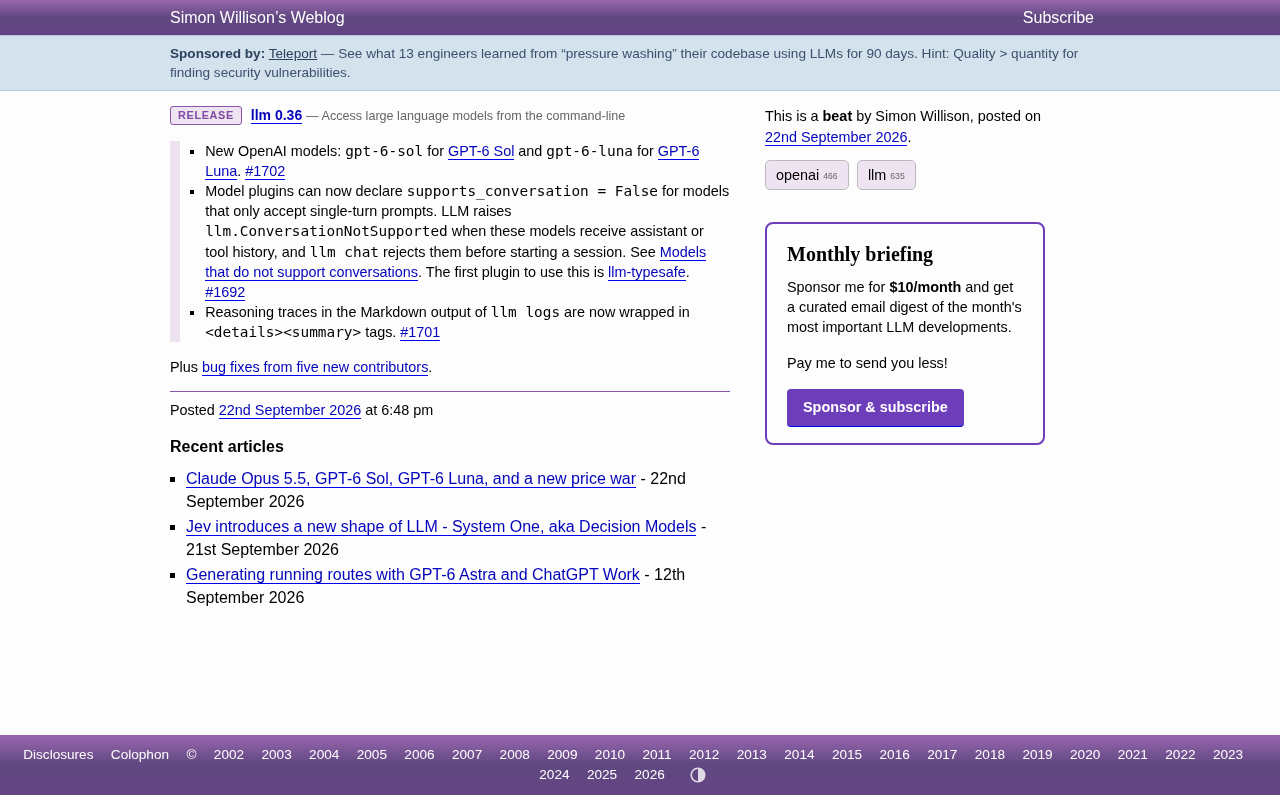
Simon Willison's LLM command-line tool releases version 0.36 with three key improvements: support for OpenAI's GPT-6 Sol and Luna models, a new `supports_conversation = False` plugin declaration that intercepts incompatible multi-turn requests early, and collapsible `<details><summary>` wrapping for reasoning traces in `llm logs` Markdown output. Five new contributors also submitted bug fixes, reflecting the project's growing community.
Simon Willison's open-source command-line tool LLM has reached version 0.36. As a tool that provides a unified interface for calling various large language models, each LLM release reflects careful attention to real-world developer workflows. While this version increment is modest, it delivers meaningful improvements across three areas: model support, plugin capabilities, and log readability.
New GPT-6 Series Model Support
The most notable addition in this release is support for two new OpenAI GPT-6 models: gpt-6-sol (GPT-6 Sol) and gpt-6-luna (GPT-6 Luna). Developers can now call these models directly through the LLM command-line tool without writing any additional adapter code.
For long-time LLM users, this ability to quickly adopt new models is one of the tool's core strengths. LLM's plugin-based architecture allows it to rapidly support new models as major providers release them — users simply update the version and can switch between different models within the same workflow for side-by-side comparison.
Single-Turn Conversation Restriction Mechanism
This version introduces a feature with solid engineering value: model plugins can now declare supports_conversation = False to mark models that only accept single-turn prompts and do not support multi-turn conversations.
When such a model receives input that includes assistant replies or tool call history, LLM will proactively raise an llm.ConversationNotSupported exception. The llm chat interactive command will also reject these models before a session begins, preventing users from entering a conversation flow that is bound to fail.
The value of this design lies in moving constraints earlier in the pipeline. Rather than letting developers encounter cryptic runtime errors, explicitly declaring limitations at the model capability level allows the toolchain to provide clear feedback at the earliest possible point. The first plugin to adopt this feature is llm-typesafe, which focuses on type-safe structured output — a use case that typically requires only a single call rather than a continuous conversation.
The supports_conversation = False design reflects two primary interaction paradigms in LLM APIs. Multi-turn conversation models (such as GPT-4, Claude, etc.) accept a messages array containing a history of previous messages, with each request carrying the full context so the model can maintain conversational coherence. Certain specialized models — particularly those designed for structured output, single-pass inference, or batch processing — only accept a single prompt input and do not process historical context. Forcing multi-turn message structures on these models can produce unpredictable results at best, or trigger direct API errors at worst. LLM's plugin system previously relied on developers to handle this boundary themselves; version 0.36 elevates it to a first-class capability declaration, enabling the tooling layer to validate at the routing stage rather than waiting until an actual API call exposes the problem.
Improved Readability for Reasoning Traces in Logs
As reasoning models become more widespread, model outputs increasingly include lengthy "thinking" sections (reasoning traces). While these are helpful for understanding a model's reasoning path, they can cause information overload when browsing logs.
Version 0.36 improves the Markdown output of the llm logs command: reasoning traces are now wrapped in <details><summary> collapsible tags. In environments that support rendering these tags, the reasoning content is collapsed by default and can be expanded on demand. It's a small but practical change that directly improves the experience of navigating long logs.
Reasoning models are models that output an internal "chain of thought" before generating a final answer — notable examples include OpenAI's o1/o3 series and DeepSeekAd-R1. These reasoning traces can sometimes span thousands of tokens, capturing the model's step-by-step problem decomposition and self-correction process. For debugging and research, this content is invaluable; in bulk processing or everyday use, it can significantly dilute the signal-to-noise ratio of logs. The HTML <details><summary> tag is a native collapsing solution supported by environments like GitHub Markdown and Jupyter Notebook — no extra JavaScript required. When collapsed, only the title text in the <summary> is shown; clicking expands the full content. Wrapping reasoning traces in this tag is a low-cost, broadly compatible engineering choice.
Five New Contributors Join with Bug Fixes
Beyond the feature updates, this release also includes a series of bug fixes from five new contributors. For an open-source project, the number of new contributors is a direct indicator of community vitality. LLM's continued ability to attract new participants reflects the considerable influence and user base it has built within the developer community.
Summary
LLM 0.36's three main improvements — new model support, single-turn conversation constraints, and collapsible reasoning traces in logs — all point in the same direction: making the tool better suited to today's rapidly evolving LLM ecosystem. Rapid support for new models keeps the tool current; the single-turn conversation restriction reflects fine-grained handling of different model capability boundaries; and the log optimization addresses a real pain point in the age of reasoning models. For developers who rely on the command line for model calls and experimentation, this update is worth the upgrade.
Related articles

JobRunner MCP Server: AI Agents Can Now Fix Failed Java Jobs
JobRunner launches an open-source MCP server enabling AI agents to view cluster status, diagnose failures, and recover Java jobs—incident response from any cloud coding environment or existing agent.

MLAI Digital Launches 9 Security Agents: MCP Server Safeguards the Full Lifecycle of Agentic AI
MLAI Digital launches Security MCP Server with nine built-in specialized security agents covering vulnerability discovery, attack simulation, prompt injection detection, API and infrastructure assessment, and accelerated remediation—embedding security validation across the full Agentic AI lifecycle from development to production.

Running Isaac Lab on H100 GPUs: Exploring Better Approaches
Exploring optimization methods for running Isaac Lab on NVIDIA H100 GPUs, including MIG configuration, mixed precision, TensorRT acceleration, and community experience to improve robotics simulation and reinforcement learning efficiency.