LLM Agent Development Learning Path: A Three-Step Practical Guide from Zero to Freelancing

A systematic three-step path to mastering AI Agent development in three months.
The article identifies AI Agent development as a market with severe supply-demand imbalance, offering attractive salaries and freelance opportunities. The author proposes a three-step learning path: first, build foundations in Prompt Engineering, Transformer basics, and API calls; second, master the core toolchain including RAG, vector databases, and knowledge graphs; third, build real Agents using the ReAct reasoning-action paradigm. With two hours a day, a complete skillset is achievable in three months.
Why Agent Development Is the Most Worthwhile Technical Direction Right Now
Search for "AI Agent" on any job platform and you'll find an exciting reality: salaries for related roles start at 18K and go up to 45K, and freelance projects for intelligent agents start at five figures. More importantly, there simply aren't enough people who can build Agents — this is a classic market window with severe supply-demand imbalance.

Yet many people, when faced with LLM development, either get scared off by the overwhelming number of concepts, or fall into the trap of "saving = learning." In reality, with the right approach and two hours of daily investment, three months is enough to build a complete Agent development skillset.

Of course, this requires a few basic prerequisites: a consistent study schedule, the discipline to practice hands-on, and the willingness to follow a systematic, step-by-step path rather than jumping around randomly.
Step One: Build the Foundation — Getting the API Working Matters More Than Training Models
The first mistake many beginners make is jumping straight into model training and fine-tuning. That's like trying to modify an engine before you've learned to drive — the priorities are completely backwards.
For Agent developers, the first step involves three things:
-
Prompt Engineering: This is the core skill for interacting with LLMs. Prompt engineering is a systematic methodology for designing and optimizing input text to guide large language models toward desired outputs. LLMs are fundamentally probability-based text completion systems, and well-crafted prompts can activate specific knowledge and reasoning patterns the model acquired during pre-training. System prompts define an Agent's role boundaries and behavioral guidelines; few-shot examples help the model understand task formats by embedding a small number of input-output samples in the prompt; and Chain-of-Thought (CoT) techniques significantly improve accuracy on complex reasoning tasks by guiding the model to show its reasoning step by step. The quality of your prompts directly determines the ceiling of the Agents you build — these skills require repeated practice to master.
-
A Basic Understanding of Transformer Architecture: You don't need to derive every mathematical formula, but you should understand the core idea behind the attention mechanism, the tokenization process, and the concept of context windows. This foundational knowledge will help you make sound technical decisions later in development. Understanding context window length limits is a critical prerequisite for avoiding pitfalls when designing RAG systems and multi-turn conversations.
-
API Calling Skills: Being able to fluently call APIs from OpenAI, Claude, and major domestic Chinese models, and understanding request parameters, streaming output, token billing, and other practical concerns. Streaming output returns results token by token via the Server-Sent Events protocol, which significantly improves user experience; token billing directly affects your project cost calculations. This is the everyday bread-and-butter of Agent development.
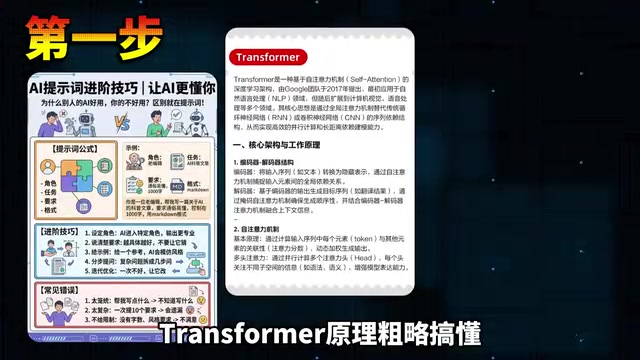
The core principle for this step is good enough is fine — mastery isn't required. Many people spend too much time in the foundational stage chasing perfect understanding, and as a result never make it to hands-on practice. Remember: theoretical understanding deepens naturally through practice.
Step Two: Master the Core Toolchain — From RAG to Knowledge Graphs
Once the foundation is solid, the second step is learning the core tech stack for Agent development. This stage is where the real differentiation happens.
RAG (Retrieval-Augmented Generation)
RAG (Retrieval-Augmented Generation), proposed by Meta AI in 2020, is the mainstream engineering solution for addressing two core weaknesses of large language models: hallucination and outdated training data. The way it works: before the model generates a response, it first retrieves document chunks relevant to the query from an external knowledge base, then injects those chunks as context into the prompt, allowing the model to answer based on accurate, up-to-date information.
To truly master RAG, you need to work through several components: how to clean and preprocess data, how to chunk documents (the choice of chunking strategy directly affects retrieval quality — chunks that are too large introduce noise, while chunks that are too small may lose semantic completeness; you typically need to adjust dynamically based on document type and query patterns), how to select an Embedding model, and how to set up and query a vector database (such as Milvus, Pinecone, or ChromaDB). Once you've got this entire pipeline running, you can connect a private knowledge base to an LLM and solve the two major pain points of hallucination and knowledge staleness.
Hands-On with Vector Databases
Vector databases are database systems specifically designed for storing and performing similarity search on high-dimensional vectors — they're also the core infrastructure of any RAG system. Unlike the exact matching of traditional relational databases, vector databases use Approximate Nearest Neighbor (ANN) algorithms to achieve fuzzy matching at the semantic level. Embedding models convert text into floating-point vectors of hundreds to thousands of dimensions, and semantically similar texts end up closer together in vector space.
It's not enough to just know how to use them — you also need to understand the appropriate use cases for different retrieval strategies: semantic search (dense vectors) excels at capturing semantic relevance, keyword search (sparse vectors) excels at exact matching of proper nouns, and hybrid retrieval strategies combine both to achieve more consistent results across different query scenarios. Additionally, reranking models perform fine-grained re-ranking of candidate results after initial retrieval, further improving the accuracy of the final recalled results. In real projects, retrieval accuracy often determines the final outcome more than model capability does.
Agent Architecture and Knowledge Graphs
When you connect RAG, vector databases, and API calling skills together, and then layer in Agent architecture design and knowledge graph thinking, you'll find that your perspective suddenly opens up — you'll feel like you can build almost anything. This isn't an illusion; it's the natural breakthrough that happens when your tech stack reaches a critical mass.
A Knowledge Graph is a knowledge representation system that stores entities and their relationships in a graph structure. Introduced by Google in 2012 to enhance the semantic understanding of its search engine, it complements vector databases: vector databases excel at semantic retrieval over unstructured text, while knowledge graphs can precisely express structured relationships like "A is a subsidiary of B" or "C happened before D," enabling AI to not only retrieve text but also understand the logical connections between entities. The emerging GraphRAG direction combines graph-structured retrieval with generative AI, showing significant advantages in complex question-answering scenarios that require multi-hop reasoning. In complex business domains — such as financial risk control, medical consultation, and legal advisory — this kind of structured reasoning capability is especially valuable.
Step Three: Get Your Hands Dirty — Build Your First Agent
The first two steps are about accumulation. Step three is where you actually realize the value.

Master the ReAct Pattern
The ReAct (Reasoning and Acting) framework was formally introduced by a Google research team in 2022 in the paper ReAct: Synergizing Reasoning and Acting in Language Models, and it is the core paradigm of Agent development. It enables AI to alternate between reasoning and acting, forming a closed-loop cycle of three steps: Thought → Action → Observation. The model first thinks about what it should do, then calls the appropriate tool to execute, then continues reasoning based on the execution results.
Compared to pure reasoning modes, ReAct allows the model to dynamically adjust its subsequent strategy based on real results returned by tools, rather than relying on static, pre-defined logic — which is precisely why it became the foundational design basis for mainstream frameworks like LangChain. Understanding and implementing the ReAct pattern is the key leap from "calling an API" to "building an Agent."
Related articles
 Tutorials
ChatGPT Plus Subscription Guide: Are GPT-5.5, image-2, and Codex Worth the Upgrade?
A detailed look at ChatGPT Plus features — GPT-5.5, image-2, and Codex — with a Plus vs Pro comparison and a complete step-by-step subscription guide for users outside the US.
 Tutorials
Harness AI Engineering in Practice: Using Claude Code to Master Enterprise-Level E-Commerce Development
Deep dive into Harness AI Engineering: master enterprise e-commerce development with Claude Code using the Rules, Skills, Wiki, and Changes framework.
 Tutorials
Cursor + Codex Dual-IDE Collaboration: A Practical Methodology for Open-Source Project Customization
A complete methodology for open-source project customization based on real-world experience, detailing the Cursor+Codex dual-IDE workflow, seven-stage process, MVP validation, and AI source code reading techniques.