LLM-Driven Multi-Objective Reinforcement Learning: A New Approach to 5G UPF Selection
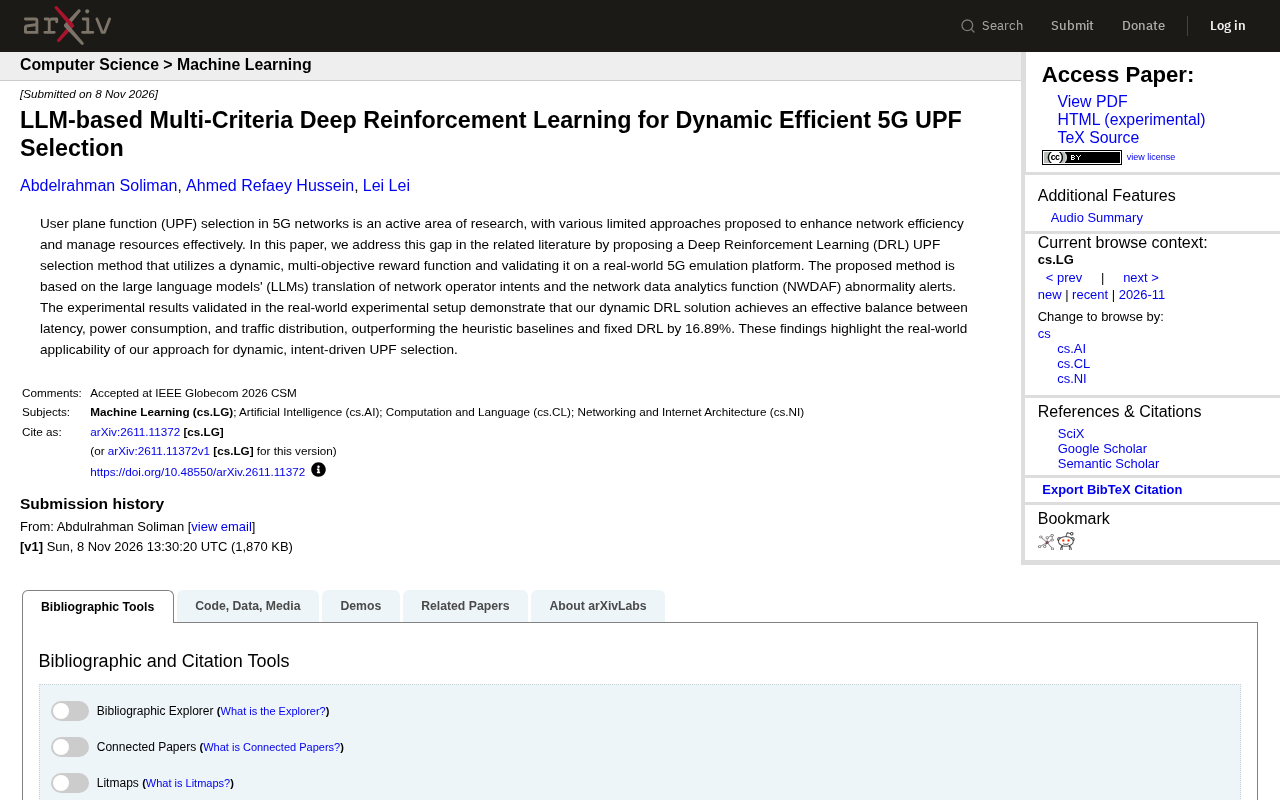
LLM-translated intents combined with NWDAF alerts drive dynamic multi-objective DRL to optimize 5G UPF selection.
The article introduces a study on User Plane Function (UPF) selection in the 5G core network. It proposes using a large language model (LLM) to translate operators' natural-language intents into quantifiable optimization objectives, and combining NWDAF anomaly alerts to dynamically adjust the DRL reward function, achieving real-time balance among latency, power consumption, and traffic distribution. On a real 5G simulation platform, the scheme achieves a 16.89% comprehensive performance improvement compared with heuristic baselines and fixed-reward DRL. The article notes that the advantage lies in effective trade-offs among multiple objectives rather than extreme optimization of a single metric, offering reference value for differentiated QoS scenarios such as network slicing and edge computing, while also highlighting engineering challenges in commercial network generalization, LLM inference real-time performance, and intent parsing reliability.
5G UPF Selection: From Static Rules to Dynamic Intelligence
In the 5G core network, the selection of the User Plane Function (UPF) directly affects user experience and network resource efficiency. Traditional methods often rely on static rules or single-objective optimization, making it difficult to cope with dynamically changing network conditions and diverse service requirements. A recent paper proposes a UPF selection scheme based on large language models (LLMs) and multi-criteria deep reinforcement learning (DRL), and validates its effectiveness on a real 5G simulation platform.
The core idea of this research is to translate network operators' intents into quantifiable optimization objectives via an LLM, and to dynamically adjust the reward function in combination with anomaly alerts from the Network Data Analytics Function (NWDAF), so that the DRL agent can strike a balance among latency, power consumption, and traffic distribution.
UPF (User Plane Function) is a key network element in the 5G core network's Service-Based Architecture (SBA), responsible for routing and forwarding user data, policy enforcement, traffic statistics, and lawful interception. In 5G, the user plane and control plane are completely separated (CUPS), and UPFs can be deployed in a distributed manner at the edge or in the cloud. Therefore, selecting the most appropriate UPF instance for different service flows becomes a core issue affecting latency, bandwidth, and power consumption. UPF selection is typically decided by the SMF (Session Management Function) based on information such as DNN, S-NSSAI, and location. Traditionally, static configuration or rules such as weighted round-robin are used, which struggle to adapt to dynamic loads and differentiated SLA requirements.
Method Architecture: Collaboration Between LLM and DRL
Intent Translation and Anomaly Awareness
The paper uses an LLM to translate operators' natural-language intents (e.g., "prioritize low latency" or "balance load") into weight parameters in the reward function. Meanwhile, anomaly alerts provided by NWDAF serve as environmental feedback, triggering readjustment of the reward function. This dual-driven mechanism enables the policy to respond to changes in network conditions in real time, rather than sticking to preset static objectives.
NWDAF (Network Data Analytics Function) is a standardized analytics network element introduced by 3GPP into the 5G core network. It is responsible for collecting NF (Network Function) and OAM (Operations, Administration, and Maintenance) data, outputting analytics results such as load levels, anomalous behavior, and network performance, and providing subscription-based analytics to other NFs (such as SMF and PCF) through service-based interfaces. In this study, NWDAF anomaly alerts are used as external feedback signals for the DRL environment, enabling the reward function to perceive events such as congestion and failures and to reweight in real time. This design connects standardized network analytics capabilities with a learning-based decision-making loop, and is a typical pattern for implementing Intent-Driven Networking (IDN).
Dynamic Multi-Objective Reward Design
Traditional DRL schemes usually use reward functions with fixed weights, making it difficult to adapt to trade-offs among multiple objectives. The dynamic reward function proposed in this research dynamically adjusts the weights of each objective according to the intents parsed by the LLM and NWDAF alerts, so that the agent automatically favors key metrics in different scenarios. For example, when an alert indicates congestion in a certain area, the weight of the traffic distribution objective is increased accordingly.
Deep Reinforcement Learning (DRL) learns policies through the interaction between an agent and the environment, with the goal of maximizing cumulative reward. In multi-objective optimization scenarios, a common practice is to weight and sum multiple objectives into a scalar reward, but fixed weights cannot reflect time-varying trade-offs among objectives. Dynamic reward shaping allows weights to change with environmental states or external instructions, enabling the agent to favor different objectives at different stages. In essence, it delegates the choice of a point on the Pareto frontier to the upper-layer intent. By contrast, heuristic baselines (such as shortest-latency-first and round-robin) lack learning ability, while fixed-reward DRL cannot adapt to scenario switching. This is precisely the source of the 16.89% comprehensive improvement achieved by the dynamic scheme.
Experimental Validation: Performance Improvement on a Real Platform
The research team compared the proposed scheme with heuristic baselines and fixed-reward DRL methods on a real 5G simulation platform. Experimental results show that the dynamic DRL scheme outperforms the baselines on the comprehensive metrics of latency, power consumption, and traffic distribution, achieving an overall performance improvement of 16.89%. This result validates the feasibility of dynamic multi-objective optimization in real network environments.
Interestingly, the advantage of this scheme does not come from extreme optimization of a single metric, but rather from achieving a more effective balance among multiple competing objectives. This has reference value for scenarios such as 5G network slicing and edge computing, because these scenarios often need to simultaneously satisfy differentiated quality-of-service requirements.
Industry Implications and Future Directions
This research demonstrates the potential role of LLMs in network automation—not only as a human-machine interaction interface, but also as a key component for intent-driven policy generation. Combining the semantic understanding capabilities of LLMs with the decision-making capabilities of DRL provides a new approach for resource management in 5G and future networks.
However, the scheme is currently still validated only on a simulation platform, and issues such as generalization capability in real commercial networks, the real-time performance of LLM inference, and multi-vendor device compatibility still need further exploration. In addition, the accuracy of intent translation directly affects the design of the reward function, and how to ensure the reliability of LLM parsing is also an important challenge for engineering deployment.
Overall, this research provides a dynamic, intent-driven intelligent optimization framework for 5G UPF selection, and its multi-source fusion design (LLM + NWDAF + DRL) deserves attention. As 5G networks evolve toward more complex service-based architectures, such adaptive methods are expected to become important support for network automation.
One-line Summary
LLM-translated intents combined with NWDAF alerts drive dynamic multi-objective DRL to optimize 5G UPF selection.
Paragraph Summary
This article introduces a study on User Plane Function (UPF) selection in the 5G core network. It proposes using a large language model (LLM) to translate operators' natural-language intents into quantifiable optimization objectives, and combining anomaly alerts from the Network Data Analytics Function (NWDAF) to dynamically adjust the reward function of deep reinforcement learning (DRL), thereby achieving real-time balance among latency, power consumption, and traffic distribution. The research team compared the scheme with heuristic baselines and fixed-reward DRL methods on a real 5G simulation platform, achieving a comprehensive performance improvement of 16.89%. The article notes that the scheme's advantage lies in effective trade-offs among multiple objectives rather than extreme optimization of a single metric, offering reference value for differentiated QoS scenarios such as network slicing and edge computing, while also pointing out that engineering challenges remain in commercial network generalization, LLM inference real-time performance, and intent parsing reliability.
Related articles

Prompt Engineering for Beginners: From Writing Prompts to Engineering Thinking
Starting from the essence and four functions of prompts, this article systematically explains the six-step process, four success criteria, learning value, and practical limitations of prompt engineering to help you build a complete understanding.

Anthropic Launches Nasdaq IPO: AI Giant's Listing and Risk Disclosures
Anthropic officially launches its Nasdaq IPO under ticker ANT, with market valuation expected to potentially exceed SpaceX's record. The prospectus devotes nearly 100 pages to AI risks, while first-half revenue grew over 14x but net losses widened sharply, reigniting the AI bubble debate.

Rust cURL Clone Uses 4,832 unsafe Blocks—Is the Memory Safety Myth Broken?
A Rust cURL clone uses 4,832 unsafe keywords, challenging Rust's memory safety narrative. We analyze what unsafe really means, compare Fil-C, and examine rewrite motives.