LLM Fiction Names Cluster Around "Elara" and "Elias": Speculative Naming Cuts Repetition by 95%

A paper tests eight prompt strategies and proposes a fine-tuning-free speculative naming method that cuts AI fiction name concentration by 95%.
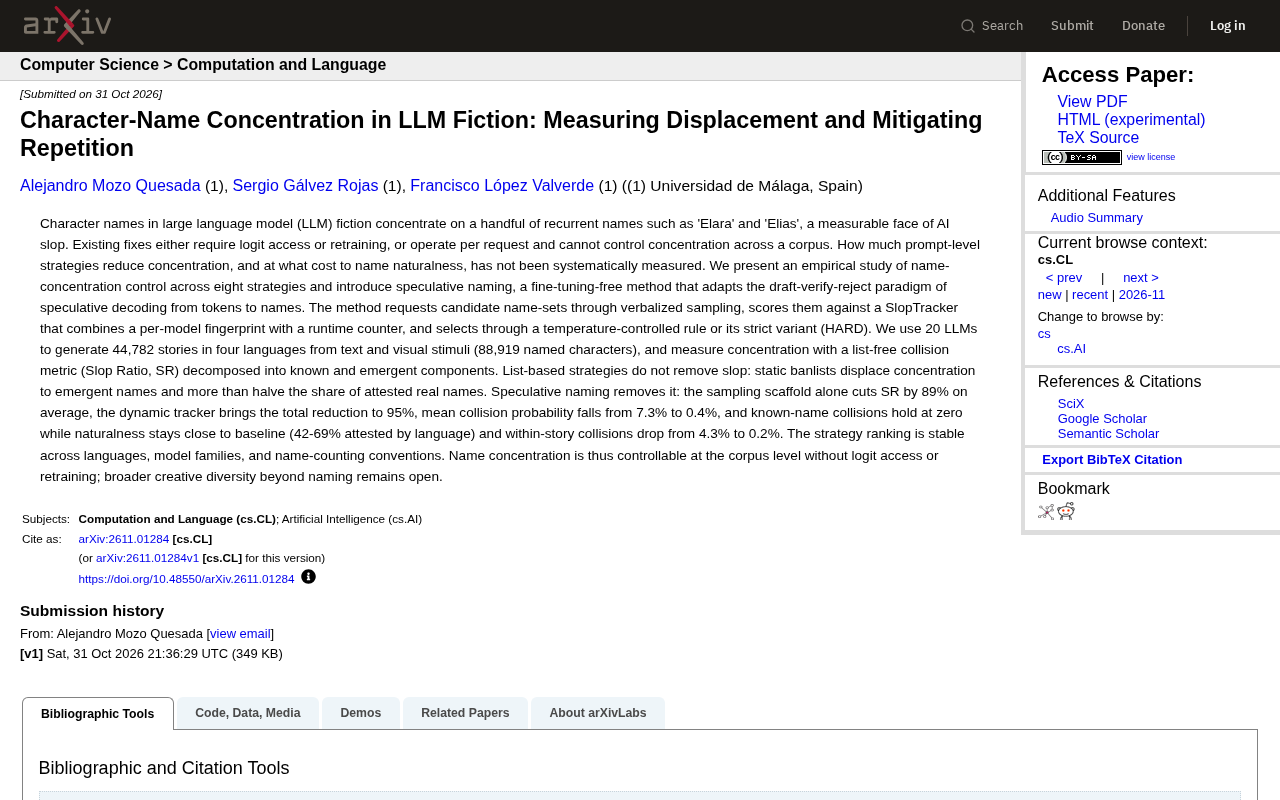
To address the homogenization of highly concentrated character names (like Elara and Elias) in LLM-written fiction, a recent paper systematically measures eight prompt-level naming strategies across 20 LLMs, four languages, 44,782 stories, and 88,919 named characters using the list-free collision metric Slop Ratio (SR). It finds that static blacklists only shift concentration rather than eliminate it, halving grounded names. The authors propose "speculative naming," migrating the draft—verify—reject paradigm of speculative decoding to name selection with verbalized sampling and SlopTracker scoring, reducing SR by 89% on average (95% with a dynamic tracker) and collision probability from 7.3% to 0.4% without fine-tuning or logit access, while keeping naturalness near baseline.
When large language models write fiction, certain names are almost unavoidable—Elara and Elias have become the de facto "brand faces" of AI-generated novels. This name clustering phenomenon is a measurable facet of the homogenization of AI-generated content, but for a long time it lacked systematic measurement and intervention methods that did not rely on internal model access. A recent paper conducts an empirical study of eight prompt-level strategies and proposes "speculative naming," a method that dramatically reduces name concentration without fine-tuning the model or accessing logits.
The Problem: Name Concentration as a Measurable Facet of "AI Slop"
Existing fixes either require access to logits or retraining the model, or only act on a single request, making it impossible to control name concentration at the corpus level. How much prompt-level strategies can actually reduce concentration, and at what cost to name naturalness, had not been systematically measured before.
The research team used 20 LLMs to generate 44,782 stories in four languages from text and visual stimuli, involving a total of 88,919 named characters. They employed a list-free collision metric called Slop Ratio (SR) to measure concentration and decomposed it into a known component and an emergent component.
Slop Ratio (SR) is a list-free collision metric proposed in this paper, used to quantify name concentration without relying on a predefined name list. The basic idea is to count the collision frequency of repeated names in generated text and decompose total concentration into two components: the known component refers to the proportion of names that the model frequently prefers and that recur across multiple samples (such as Elara and Elias); the emergent component refers to the proportion of new names that arise temporarily and cluster within a specific corpus.
The significance of this decomposition lies in distinguishing "the model's inherent brand-name preferences" from "clusters that dynamically form within a corpus." A static blacklist can only suppress the known component, but may push up the emergent component, so SR decomposition can reveal whether a strategy truly reduces overall concentration rather than merely shifting where the concentration occurs.
Testing Eight Strategies: Static Blacklists Merely "Shift" Concentration
The paper compares eight naming strategies. The core finding is that list-based strategies do not eliminate slop. A static blacklist can indeed prevent "Elaras" from appearing, but concentration shifts to emergent new names, while the proportion of grounded real names drops by more than half—in other words, the model simply clusters around a different set of names rather than becoming more diverse.
This conclusion holds across multiple languages, model families, and name-counting conventions, indicating that the problem is not a quirk of any single model but a corpus-level systematic phenomenon.
Grounded names in this paper refer to naming that has a real-world source or reasonable basis, such as names that fit the cultural background of the target language, come from real name distributions, or relate to text/visual stimuli. In contrast, names generated out of thin air by the model and highly templated (such as the recurring Elara) are considered lacking grounding.
The naturalness metric is measured by "the proportion of grounded names": the higher the proportion, the closer the generated names are to real naming habits. Although a static blacklist prevents high-frequency names from appearing, it forces the model toward other templated or randomly assembled names, causing the proportion of grounded names to drop by more than half. This also explains why a blacklist alone cannot truly improve naming quality—it changes the surface of names, not the source of the model's naming preferences.
Speculative Naming: Bringing Speculative Decoding to Names
The speculative naming method proposed by the researchers is a fine-tuning-free approach that migrates the "draft—verify—reject" paradigm of speculative decoding from tokens to names. The specific workflow is: request a set of candidate names through verbalized sampling, score them with SlopTracker—which combines each model's fingerprint and runtime counters—and then select via a temperature-controlled rule or its stricter variant HARD.
The results are striking: the sampling scaffold alone reduces SR by an average of 89%, and the dynamic tracker pushes the total reduction to 95%; average collision probability drops from 7.3% to 0.4%; known-name collisions remain at zero; naturalness is close to baseline (42%–69% grounded depending on language); and within-story collisions drop from 4.3% to 0.2%.
Speculative decoding is a common technique for accelerating large model inference: a lightweight "draft model" first quickly generates several candidate tokens, and then the target large model verifies these candidates in parallel, accepting those that match its distribution and rejecting and falling back to the target model to resample. Its core idea is to trade low-cost drafting for high-cost verification, thereby improving efficiency without changing the output distribution.
The "speculative naming" in this paper borrows this "draft—verify—reject" structure but changes the object of operation from tokens to names: the model first produces multiple candidate names at once (draft), then SlopTracker scores each candidate and compares it against a threshold (verify), and finally qualified ones are kept while high-concentration names are rejected (reject). The difference is that speculative decoding focuses on speed, while speculative naming focuses on distribution-level diversity control, and it does not touch the model's logit outputs at all.
Verbalized sampling refers to not relying on the probability distribution or logits of the model's output, but instead using natural language prompts to let the model "say for itself" a set of candidate answers and their approximate likelihood. For example, asking the model to list 10 candidate names and indicate the degree of preference, rather than returning only the single highest-probability result.
The value of this method lies in externalizing the sampling process as parseable text, allowing researchers to obtain candidate sets even without internal model access (such as in API scenarios), providing room for subsequent scoring, filtering, and rejection. In speculative naming, verbalized sampling serves as the "draft" stage, and the quality and diversity of its candidate set directly affect how much the final name concentration can be reduced.
Significance and Boundaries: Corpus-Level Controllability, but Creative Diversity Remains Unsolved
These results show that name concentration can be controlled at the corpus level without logit access or retraining. The strategy ranking remains stable across different languages, model families, and counting conventions, and the method has good transferability.
However, the authors also clearly point out that broader creative diversity beyond naming remains an open problem. In other words, reducing name repetition only removes one conspicuous homogenization label from AI fiction; there is still a gap before truly diverse story generation. For developers and researchers concerned with the quality of AI-generated content, this provides a reusable control framework and also delineates the scope that needs to be tackled next.
One-line Summary
A paper empirically tests eight prompt strategies and proposes a fine-tuning-free speculative naming method that reduces name concentration in AI fiction by 95%.
Paragraph Summary
To address the homogenization problem of highly concentrated character names (such as the recurring Elara and Elias) when large language models write fiction, a recent paper systematically measures the effects of eight prompt-level naming strategies. Based on 20 LLMs, four languages, 44,782 stories, and 88,919 named characters, the study uses a list-free collision metric called Slop Ratio (SR) to measure concentration. The core finding is that static blacklists can only shift concentration rather than eliminate it, and cause the proportion of grounded names to drop by more than half. The authors propose "speculative naming," which migrates the draft—verify—reject paradigm of speculative decoding to name selection, combining verbalized sampling with SlopTracker scoring. Without fine-tuning or logit access, it reduces SR by an average of 89%, reaching 95% when combined with the dynamic tracker, with collision probability dropping from 7.3% to 0.4% and naturalness close to baseline.
Related articles
 Tech Frontiers
MuJoCo: An Analysis of DeepMind's Open-Source General-Purpose Physics Simulator
An in-depth analysis of Google DeepMind's open-source physics simulator MuJoCo: high-performance C++ kernel, MJCF modeling format, contact solving principles, MJX GPU acceleration, and robot reinforcement learning use cases.
 Tech Frontiers
Claude API Quick Start: The Official Quickstarts Project Collection
Anthropic's official claude-quickstarts project collection helps developers quickly build deployable apps with the Claude API. Nearly 20k stars, Python-based, great for beginners and prototyping.
 Tech Frontiers
AI Agents Connecting Directly to APIs: Which Calls Can Be Safely Allowed?
AI agents can call any API, but the real challenge is deciding which calls can be safely allowed. This article analyzes allowance decisions from three dimensions—intent matching, least privilege, and controllable impact—and argues that the control layer should sit outside the agent, combined with audit traceability to build a trustworthy API call governance mechanism.