LLM Learning Roadmap: A Three-Phase Practical Guide

A three-phase guide to mastering LLM application development in three months.
This article presents a structured three-phase LLM learning roadmap: starting with Python fundamentals and API calls, progressing to mastering LangChain and LlamaIndex frameworks alongside RAG, Agent, and fine-tuning core skills, and culminating in hands-on projects like medical Q&A systems and intelligent customer service. The guide targets career switchers aiming to become job-ready in three months.
How Long Does It Really Take to Learn LLMs?
For many people looking to transition into AI, the biggest question isn't "what to learn" but "how long until I'm job-ready." According to popular AI tutorial creators on Chinese video platforms, the answer is more optimistic than you might think: with consistent effort and no slacking off, three months is enough for a complete beginner to become an AI talent that companies are eager to hire.
The logic behind this claim is that LLM Application development is fundamentally different from traditional algorithm research. It's more about "engineering and deployment." You don't need to derive Transformer math formulas from scratch or pretrain a model with tens of billions of parameters. Instead, you need to learn how to call, orchestrate, and fine-tune existing large models, turning them into products that solve real business problems. Traditional algorithm research—like training a GPT-4-level foundation model—requires deep mathematical foundations (linear algebra, probability theory, optimization theory), massive computing resources (clusters with thousands of GPUs), and months or even years of R&D. LLM application development, on the other hand, stands on the shoulders of giants, leveraging foundation models already trained by OpenAI, Anthropic, Alibaba Cloud, and other providers. Through API calls, Prompt engineering, RAG architectures, and Agent orchestration, developers package model capabilities into end-user-facing products. This is similar to how web developers don't need to write their own OS kernel—they build applications on top of existing infrastructure. This positioning dramatically lowers the entry barrier, making the LLM learning roadmap clear and manageable.
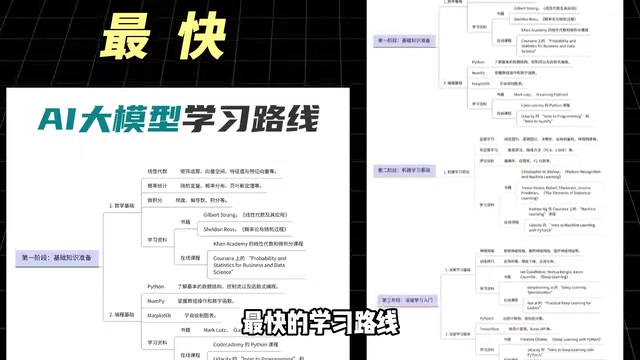
This article outlines a proven three-phase learning roadmap: Build a solid foundation → Master core skills → Project practice. This roadmap covers the most critical competencies demanded by current AI positions, and completing it qualifies you for over 90% of LLM application roles on the market.
Phase 1: Python Fundamentals and API Calls Are Non-Negotiable
Many people rush ahead, wanting to jump straight into Agents or RAG, only to hit walls everywhere—the root cause is a weak foundation. The core tasks in this phase are just two things: master Python fundamentals and become proficient in LLM API calls.
Why Python and API Calls Are Fundamental
Python became the lingua franca of AI because virtually all major frameworks (LangChain, LlamaIndex, Transformers, etc.) treat Python as a first-class citizen. This dominance stems from Python's rich scientific computing ecosystem (NumPy, Pandas), deep learning frameworks (PyTorch, TensorFlow), and comprehensive support from LLM application frameworks. More importantly, Python's dynamic typing and concise syntax enable rapid prototyping—in LLM application scenarios, developers frequently perform JSON parsing, async HTTP requests, and string manipulation, and Python's standard library and third-party packages (like httpx, pydantic) provide extremely convenient support for these tasks.
What you need to master isn't fancy advanced syntax, but data structures, functions, classes, exception handling, and most importantly—how to make an LLM API request using requests or an official SDK.
API calls represent the "minimum viable loop" for interacting with models. From a technical perspective, LLM APIs are essentially RESTful or gRPC interfaces where developers send Prompts to the model server via HTTP POST requests. The server performs a Forward Pass, generating responses token by token. Mainstream APIs support Streaming to reduce first-token latency, Function Calling for structured output, and multimodal inputs (text, images, audio). When you can send a Prompt to OpenAI, Qwen, or DeepSeekAd with a few lines of code and get a response, you've already understood the most fundamental mechanism of LLM applications: input text, model inference, output text. Understanding this mechanism means you can control conversation Temperature, max tokens, stop sequences, and other parameters to precisely control model behavior. All the complex frameworks and skills that follow are essentially enhancements and orchestrations built on top of this loop.
Never underestimate these fundamentals—they're the bedrock of working with models. Without a solid foundation, you'll find yourself "knowing what but not why" at every step when learning frameworks later.
Phase 2: Two Major Frameworks and Three Core Skills
This is the heart of the entire LLM learning roadmap and the critical phase that determines whether you can successfully transition into AI. It consists of "two major frameworks" and "three core skills."

Two Major Frameworks: LangChain and LlamaIndex
These two frameworks have distinct roles, and understanding their positioning differences is crucial:
-
LangChain: Primarily used for building Agent logic frameworks. It provides a complete set of components including Chains, Tools, Memory, and Agent decision-making, helping you upgrade LLMs from "single Q&A chatbots" to "intelligent agents that can autonomously plan and use tools to complete tasks." LangChain's core design draws inspiration from the Unix pipe philosophy—each component does one thing, and complex functionality is achieved through chaining. Its LCEL (LangChain Expression Language) allows developers to define data flows with declarative syntax. After 2024, LangChain further split into langchain-core (core abstractions), langchain-community (third-party integrations), and LangGraph (stateful multi-step Agent orchestration). LangGraph introduces graph structures to manage Agent state transitions, supporting conditional branches, loops, and human-in-the-loop nodes, making complex multi-Agent collaboration possible.
-
LlamaIndex: Primarily used for building the connection layer to external data. It excels at efficiently "feeding" enterprise documents, databases, and knowledge bases to LLMs, making it the go-to tool for building RAG systems. LlamaIndex (formerly GPT Index) derives its core value from its rich Data Connector ecosystem, supporting information extraction from hundreds of data sources including PDFs, Word documents, Notion, Slack, databases, and APIs. It splits documents into Nodes, builds index structures (vector indices, keyword indices, knowledge graph indices, etc.), and during queries, Retrievers and Response Synthesizers work together. Its latest version also introduces a Workflow engine supporting event-driven asynchronous data processing pipelines.

In real projects, these two frameworks are often used together: LlamaIndex handles data retrieval while LangChain orchestrates the overall logic. Mastering them is like having "two keys" to LLM application development.
Three Core Skills: RAG, Agent, and Model Fine-tuning
If frameworks are tools, then skills are the methodologies for solving problems. These three skills directly correspond to the core requirements of current AI positions:
RAG (Retrieval-Augmented Generation): Solves the pain points of LLMs "not knowing enterprise private knowledge" and "hallucinating." The complete technical pipeline includes: document loading → text chunking → vector embedding → storage in a vector database (e.g., Milvus, Pinecone, Chroma) → vectorizing user queries → performing Approximate Nearest Neighbor (ANN) search in the vector store → concatenating retrieved Top-K document chunks with the original question as context → feeding into the LLM for answer generation. By grounding answers in retrieved evidence, RAG is currently the most widely deployed enterprise technology—virtually all "intelligent Q&A" and "knowledge base assistant" applications are based on RAG. Real-world engineering challenges include: chunking granularity affecting recall quality, domain adaptation of Embedding models, multi-path retrieval and Reranking strategies, and handling complex reasoning across multiple documents. Advanced approaches like Graph RAG incorporate knowledge graphs into the retrieval process, while HyDE enhances retrieval through hypothetical document generation.
Agent (Intelligent Agents): Gives LLMs autonomous decision-making and execution capabilities. Agents can decompose tasks based on goals, call external tools (search, computation, databases, APIs), observe results, and adjust strategies. The Agent concept originated from the intelligent agent paradigm in reinforcement learning but gained entirely new meaning in the LLM era. The ReAct (Reasoning + Acting) framework has models alternate between reasoning and action; the Plan-and-Execute pattern creates a complete plan before step-by-step execution; and multi-Agent systems (like AutoGen, CrewAI) enable multiple specialized Agents to collaborate on complex tasks. The recently popular MCP (Model Context Protocol) is an open protocol released by Anthropic in late 2024, aimed at standardizing how LLMs connect with external tools and data sources—similar to a "USB-C port" for AI. It defines specifications for tool registration, context passing, and permission management, allowing Agents to plug-and-play with various third-party services, significantly reducing the development cost of tool integration.
Model Fine-tuning: When general-purpose models can't meet specific domain requirements, you retrain the model with domain data to make it perform more professionally in vertical scenarios. Fine-tuning technology has evolved from Full Fine-tuning to Parameter-Efficient Fine-Tuning (PEFT). Current mainstream approaches include LoRA (Low-Rank Adaptation, training only 0.1%-1% of parameters through low-rank matrix decomposition), QLoRA (LoRA on top of 4-bit quantization), and Adapter methods. Key aspects of fine-tuning include: constructing high-quality training data (instruction format alignment), hyperparameter tuning (learning rate, epochs, LoRA rank), training process monitoring (loss curves, overfitting detection), and evaluation (automated metrics + human evaluation). On the tooling side, Hugging Face's TRL library, LLaMA-Factory, and other open-source projects have significantly lowered the fine-tuning barrier, making it possible to fine-tune 7B-14B models on a single consumer-grade GPU. This skill has a relatively higher threshold but is also the dividing line between "API wrapper developers" and "real engineers."
These three skills build upon each other progressively: RAG solves knowledge injection, Agent solves autonomous action, and fine-tuning solves capability customization. Combined, they cover virtually all LLM application scenarios.
Phase 3: Project Practice to Validate Learning
After completing the first two phases, you have the theoretical knowledge and tooling. But what companies look for in hiring is what you can build, not what you've studied. Therefore, hands-on projects are the final and most critical step.

Choose the Right Projects for Maximum Impact
I recommend selecting 2 to 3 common and representative application scenarios that tie together all the frameworks and skills you've learned:
-
RAG Medical Q&A System: Build a Q&A assistant based on medical literature and knowledge bases that can accurately answer professional questions. Focus on practicing the complete pipeline of data processing, vector retrieval, and answer generation. This project gives you deep experience with the complexity of document parsing (tables, formulas, and images in medical PDFs), selection and evaluation of domain-specific Embedding models, and how to improve accuracy through Reranking and answer confidence scoring.
-
Agent-Based Intelligent Customer Service: Have an intelligent agent automatically understand user intent, query orders, and call ticket systems, demonstrating multi-tool orchestration capabilities. The core challenge of this project lies in designing robust Tool Descriptions so the model accurately selects tools, handling context switching in multi-turn conversations, and implementing human-AI collaboration fallback mechanisms (routing to human agents when the Agent is uncertain).
-
Stock Analysis Assistant: Combine real-time data APIs with LLM reasoning for data scraping, analysis, and report generation, demonstrating comprehensive use of Agents with external data.
These projects not only become highlights on your resume but more importantly, they sharpen your engineering skills in real environments where "data is messy, requirements change, and results disappoint." During company interviews, a candidate who can clearly explain how they optimized RAG recall rates or designed Agent tool-calling logic is far more competitive than someone who can only recite concepts.
Conclusion: A Clear Learning Roadmap Beats Blind Effort
Learning LLMs isn't mysterious—there's a clear, replicable path: Build your foundation with Python and API calls, master the two major frameworks with LangChain and LlamaIndex, develop three core skills with RAG, Agent, and fine-tuning, and finally complete the loop with 2 to 3 hands-on projects.
For those looking to transition or break into the field, the biggest enemy isn't technical difficulty—it's the detours and abandonment caused by a lack of systematic planning. Instead of feeling anxious amid an ocean of tutorials, commit to this main path and make steady progress over three months. When the direction is right, persistence delivers results.
Related articles

Chain of Thought Isn't Just for AI: How Humans Can Use CoT to Improve Thinking Quality
Chain of Thought isn't just a prompt trick for large models. Starting from a Hacker News discussion, this article analyzes why CoT works for human thinking too, breaks down actionable ways to transfer it, and highlights the key differences between human CoT and machine CoT.
Cloudflare Teams Up with OpenAI: Closi…
Cloudflare Teams Up with OpenAI: Closing the Loop from Vulnerability Discovery to Defense with AI
Cloudflare uses OpenAI Daybreak to investigate security vulnerabilities and generate reviewable remediation plans, while developers use Codex to boost coding efficiency and quality.

Orca Multi-Agent Orchestration in Practice: A Guide to Parallel Collaboration with Claude and Codex
Orca is Stable AI's free open-source agent workbench supporting 34 agents like Claude Code and Codex in parallel. Learn its Git worktree isolation, multi-model orchestration, and mobile management.