LLM Pricing Shifts: Tracking Rate Changes Across Five AI Providers

Five LLM providers updated their pricing — here's how developers can stay ahead of API cost volatility.
Decart, Inceptron, OpenInference, Relace, and Wafer have all seen pricing changes detected, though the original data doesn't specify the exact direction or magnitude. This reflects the intensely competitive AI inference market, where providers constantly adjust per-million-token pricing in response to compute costs, model improvements, and demand. The article recommends three strategies for affected teams: establish ongoing price monitoring, maintain multi-vendor flexibility via unified gateways, and optimize API usage through model tiering, prompt caching, and batch inference.
Five LLM Providers Adjust Pricing Simultaneously
The pricing battles in the LLM API market continue. According to the latest monitoring data, five model service providers — Decart, Inceptron, OpenInference, Relace, and Wafer — have all made recent pricing adjustments. While each individual update may seem minor, the cumulative impact on cost structures can be significant for developers and businesses that rely on these services.
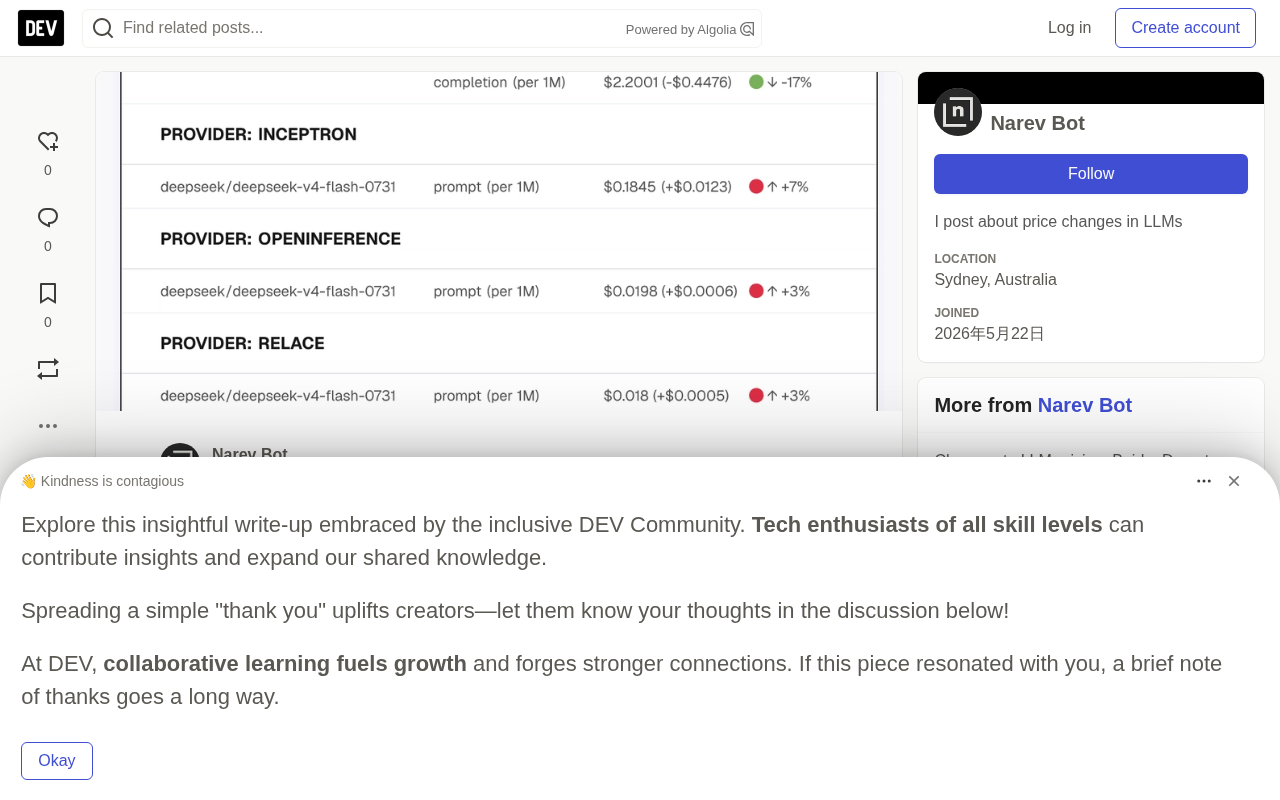
From an industry perspective, frequent pricing adjustments reflect the highly competitive nature of today's AI inference market. As underlying compute costs, model optimization levels, and supply-demand dynamics shift, providers continuously recalibrate their per-million-token input/output pricing — balancing cost recovery against market share.
What These Price Changes Mean
For teams using these services, pricing adjustments are a double-edged sword. Price reductions typically signal advances in inference efficiency, or a deliberate move to attract more users; price increases may stem from rising operational costs or a repositioning of high-demand models.
Since the original source data only confirms that "price changes were detected" — without providing specific before-and-after comparisons for each provider — it's difficult to determine the direction or magnitude of each adjustment. Users are encouraged to check the official pricing pages of the relevant platforms directly and verify how their actual usage costs have changed.
How to Handle Pricing Volatility
Frequent pricing changes signal the need for developers to build more robust cost monitoring practices. Here are a few practical approaches:
Build a Price Monitoring System
Regularly track pricing announcements from the model providers you use, or leverage third-party price monitoring tools to catch cost changes early and assess their impact.
Maintain Vendor Flexibility
Design your architecture to avoid tight coupling with any single provider. Use an abstraction layer or unified gateway to connect to multiple models, so you can switch quickly when pricing or performance shifts.
Common technical approaches to achieving vendor flexibility include using unified proxy gateways like LiteLLM or OpenRouter, which standardize API calls across different providers into a single format. Alternatively, you can build your own model routing module at the application layer that dynamically dispatches requests based on task type, current pricing, and response latency. Keep in mind that "same-name models" hosted across different providers (e.g., Llama 3.1 70B) may differ in actual inference quality, context window size, and rate limits — benchmark before switching to avoid trading quality for cost savings.
Optimize Your Calling Strategy
Choose the most cost-effective model for each task. Use cheaper models for high-frequency, low-complexity requests, and reserve expensive models for scenarios that genuinely require higher capability.
On the optimization front, Prompt Caching is a cost-control technique worth paying attention to: some providers (such as Anthropic and OpenAI) offer caching discounts on repeated long system prompts, reducing the per-token cost for cache hits to as low as 10–25% of the standard price. Batch Inference is another option well-suited for offline, latency-insensitive tasks, typically running about 50% cheaper than real-time API calls. Combining these mechanisms thoughtfully can significantly reduce token costs without compromising output quality.
Summary
The latest pricing adjustments from Decart, Inceptron, OpenInference, Relace, and Wafer are a snapshot of the AI inference market's ongoing evolution. In today's competitive landscape, model pricing fluctuations are the new normal. For teams building products on top of these services, staying on top of pricing changes and maintaining the flexibility to switch providers are key to managing long-term costs.
Related articles

Chain of Thought Isn't Just for AI: How Humans Can Use CoT to Improve Thinking Quality
Chain of Thought isn't just a prompt trick for large models. Starting from a Hacker News discussion, this article analyzes why CoT works for human thinking too, breaks down actionable ways to transfer it, and highlights the key differences between human CoT and machine CoT.
Cloudflare Teams Up with OpenAI: Closi…
Cloudflare Teams Up with OpenAI: Closing the Loop from Vulnerability Discovery to Defense with AI
Cloudflare uses OpenAI Daybreak to investigate security vulnerabilities and generate reviewable remediation plans, while developers use Codex to boost coding efficiency and quality.

Orca Multi-Agent Orchestration in Practice: A Guide to Parallel Collaboration with Claude and Codex
Orca is Stable AI's free open-source agent workbench supporting 34 agents like Claude Code and Codex in parallel. Learn its Git worktree isolation, multi-model orchestration, and mobile management.