LLM Pricing Tracker: Decoding the Wafer Model Price Adjustment

An automated alert flagged a Wafer LLM price change, but the raw signal lacks specifics on direction or magnitude.
An automated monitoring alert flagged a pricing adjustment for Wafer-related large language models, but the raw signal only confirms that a change occurred — with no details on magnitude, direction, or effective date. Using this as a starting point, the article outlines three key drivers behind LLM pricing changes: compute supply and demand, competitive dynamics, and model version transitions. It recommends that developers and enterprises establish pricing monitoring practices, maintain model portability in their architectures, and always verify changes against official provider documentation or LLM price aggregation platforms.
Overview
A pricing monitoring alert for large language models (LLMs) indicates that Wafer-related models have undergone a price adjustment. The raw signal only notes that "a model pricing change for Wafer has been detected" — no specific price ranges, adjustment magnitude, or effective dates were included.
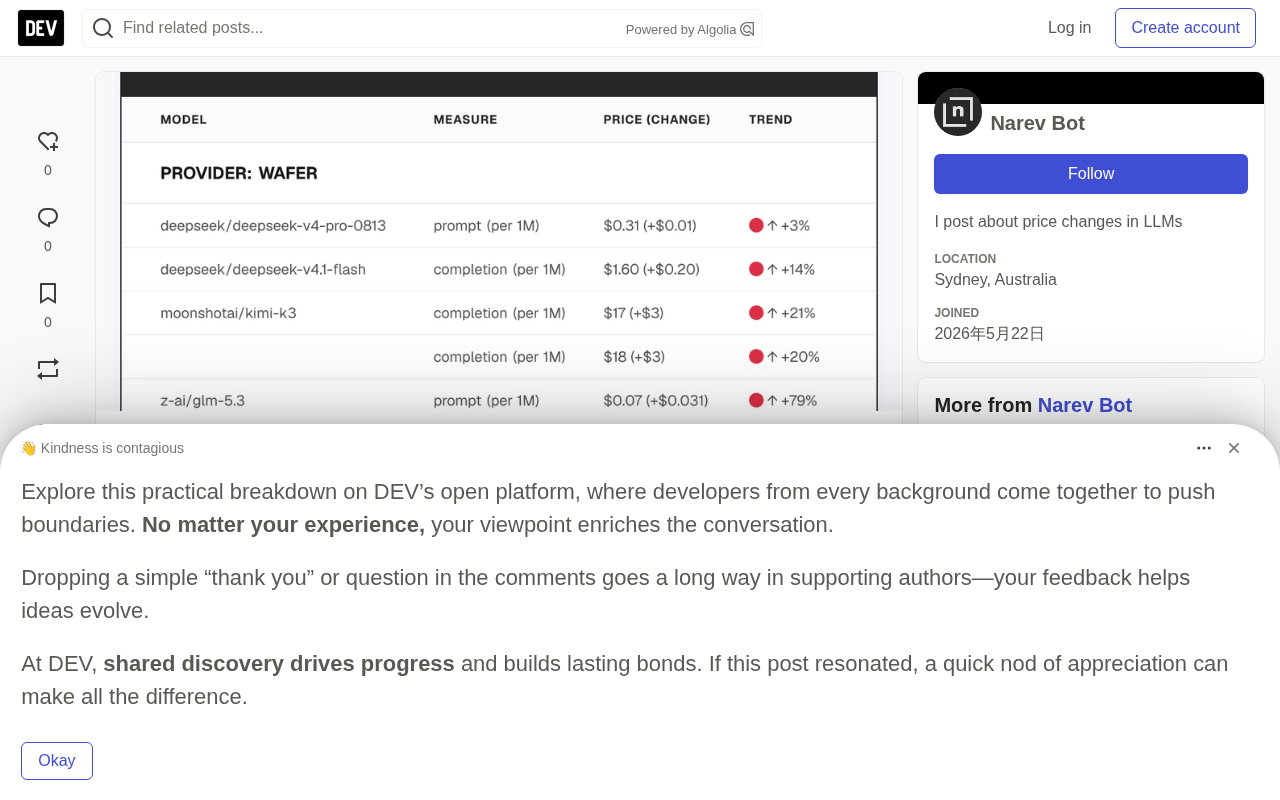
For developers and enterprise users who closely track AI infrastructure costs, any fluctuation in model pricing deserves attention. API call prices directly determine a product's marginal cost — especially in high-concurrency, large-scale inference scenarios where even a few cents' difference per million tokens can translate into significant monthly bills.
Why LLM Pricing Changes Matter
Most large model providers charge on a per-million input/output token basis, with substantial variation across vendors and model tiers. Pricing adjustments typically signal several things:
Shifts in compute supply and demand. When GPU supply tightens or inference demand surges, providers may raise prices. Conversely, as hardware improves and inference optimization matures, per-unit inference costs fall — and prices tend to follow.
Changes in the competitive landscape. Price wars among leading providers are common; one vendor cutting prices often triggers a chain reaction. For relatively niche models or services like Wafer, a pricing adjustment may also reflect a deliberate repositioning strategy in the market.
Model version transitions. New versions launching, older versions being discounted, or models being deprecated all show up as changes in a provider's pricing table.
It's worth noting that LLM pricing structures can be quite complex. Most mainstream providers bill input tokens (prompts) and output tokens (completions) separately, with output tokens typically priced higher because generation consumes more compute than encoding. Some providers also distinguish between "cache hit" pricing (discounts when the same prompt prefix is reused) and standard pricing, as well as differences between batch async calls (batch API) and real-time calls. Models with very long context windows (e.g., those supporting 100K+ tokens) may also involve tiered billing or additional context fees. Understanding these billing details is a prerequisite for accurately calculating real-world inference costs.
What This Means for Users
If you rely on a specific model in a production environment, establishing a pricing monitoring mechanism is essential. Price increases can erode your profit margins, while price decreases are an opportunity to optimize your cost structure — or even reconsider your model selection.
In practice, developers should keep the following in mind:
- Lock down your cost structure: Understand the billing method and latest unit prices for your current model, and calculate your true call costs.
- Maintain model portability: Design your architecture to decouple from specific model providers where possible, so you can switch quickly if prices or performance change.
- Track official announcements: Third-party monitoring alerts like this one are useful as timely signals, but the provider's official pricing page should always be your authoritative source.
Information Limitations and Recommendations
To be transparent: the source material here is extremely limited — it's an automated monitoring trigger for a pricing change, with no background on the Wafer model, no before/after figures, and no official explanation. As a result, it's not possible to make accurate judgments about the direction (price increase or decrease), magnitude, or impact of this change.
Readers interested in this topic should consult Wafer's official pricing documentation directly, or use LLM price aggregation tools (such as model price comparison platforms) for authoritative, real-time data. Automated monitoring tools are valuable for detecting that a change has occurred — but interpreting what changed still requires going back to primary sources.
Several LLM price tracking aggregators are available today. Platforms like OpenRouter and LLM Pricing regularly scrape and compare the latest pricing across mainstream models, and offer historical price change records. Keep in mind that these tools vary in update frequency and coverage, and some niche or enterprise-custom models may not be included. Wafer — the model mentioned in this article — has relatively limited visibility in mainstream communities, and its exact nature (whether it's an independent provider, a proprietary model on a specific platform, or a hosted version of an open-source model) remains unclear. That ambiguity is part of why this article cannot provide more contextual detail.
Related articles

How Big Can Stars Really Get? The Physical Limits of the Largest Stars
Red supergiants are the largest stars by volume, with radii up to 2,000 times the Sun, engulfing the inner solar system. But there is no precise upper limit on stellar size—models predict up to 15,000 solar radii. The most massive blue stars are far smaller than red supergiants—biggest and heaviest are two different things.

Apple HomeView Smart Display Full Feature Breakdown: Wall-Mount or Desktop, $299
Apple launches HomeView, a $299 smart display with wall-mount and desktop options, 12MP camera for facial recognition, smart home control, music playback, and recipe step-by-step cooking. Full breakdown of watch faces, apps, privacy, and cooking integration.

Where Did the Promised New Studio Go? Craft Computing Answers After Five Years
Craft Computing's host responds to viewer questions: the new studio promised five years ago was shelved as construction costs soared from $30,000 to $75,000, and was replaced by a 168-square-foot garage conversion.