LLM Wiki + Graph RAG + Traditional RAG: Enterprise Knowledge Base Selection and Implementation
Traditional RAG, Graph RAG, and LLM Wiki are complementary, not replacements—gather evidence in layers and combine on demand.
Based on a tech livestream, this article addresses whether enterprises should choose traditional RAG, Graph RAG, or LLM Wiki for their knowledge base. The conclusion is that the three are complementary rather than replacements: traditional RAG excels at localized fact retrieval like policy manuals and product specs; Graph RAG relies on entity relationship networks, suiting terminology-dense domains like finance and healthcare; LLM Wiki distills a small corpus into reusable business concepts, processes, and rules. For implementation, it recommends layered evidence gathering and on-demand combination—building text, Wiki, and graph repositories, with agents retrieving by query type and ranking via mechanisms like "dual-path hits." The article also covers a streaming voice agent practice based on a sandwich architecture and notes that industry interviews are getting stricter, with coding ability a hard threshold.
Three Knowledge Base Approaches: Complementary, Not Replacements
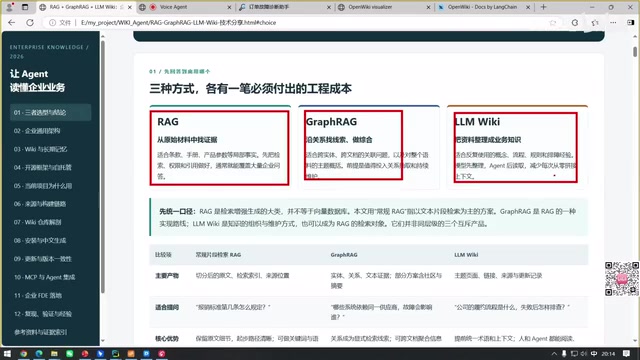
When building a knowledge base, many enterprises face a choice: traditional RAG, Graph RAG, or LLM Wiki—which one should you pick? The speaker in the livestream gave a straightforward answer: adults don't make choices—go with all three. But that doesn't mean the three are freely interchangeable; they complement each other, each covering a distinct capability.
The choice depends on business requirements. You can deploy all three, or pick two, or just one. The key is understanding what each excels at. Let's break them down one by one.
Traditional RAG: The Precision Tool for Locating Source Details
Traditional RAG is suited for retrieving localized facts like policy manuals and product specifications. Its core function is finding evidence from source materials; get retrieval, permissions, and citations right, and it will cover a large number of enterprise Q&A scenarios.
If your enterprise has accumulated a large volume of manuals, customer operation documents, product spec sheets, contract data, etc., traditional RAG is the most cost-effective choice. It doesn't aim to understand complex relationships—it precisely locates source details, and with evaluation and reranking mechanisms, it meets everyday query needs.
RAG (Retrieval-Augmented Generation) is a technical paradigm that combines external knowledge retrieval with large model generation. The basic workflow: enterprise documents are split into chunks, converted into vectors via an embedding model, and stored in a vector database. When a user asks a question, the system vectorizes the question, performs similarity search in the database, recalls the most relevant chunks, stitches them into the prompt as context, and hands them to the large model to generate an answer. Traditional RAG's advantage is that answers are traceable—sources can be cited—and knowledge can be updated without fine-tuning the model. Its limitations are also clear: retrieval operates on text chunks, making it hard to express multi-hop relationships between entities, and it has limited effectiveness on questions requiring cross-document reasoning.
Graph RAG: Connecting Specialized Domains with Relationship Networks
Graph RAG's core is finding clues through relationships. It's especially suited for domains dense with specialized terminology and complex interconnections—banking, finance, logistics, healthcare, and similar industries.
In these industries, specialized terms often have complex relationships among them; in finance, for example, metrics like the P/E ratio are connected through business logic. By building these entity relationships into a graph database, agents can follow the relationship network to find clues rather than relying on isolated text matching.
If your business needs to understand relationships between entities, Graph RAG is a necessary complement.
Knowledge Graph is a structured knowledge base that organizes data as "entity—relationship—entity" triples—essentially a semantic network: nodes are entities like people, organizations, metrics, and products; edges are the business relationships between them. Graph RAG typically uses a large model during construction to extract entities and relationships from source text and write them into a graph database (such as Neo4j or NebulaGraph). During querying, it transforms user questions into graph queries or subgraph traversals, recalls evidence along relationship paths, and hands it to the large model to compose an answer. Compared with vector retrieval, graph retrieval excels at multi-hop reasoning and relationship-constrained queries—for example, "which downstream businesses will be affected if a certain metric becomes abnormal." The trade-off is higher graph construction and maintenance costs, and extraction quality directly determines recall effectiveness.
LLM Wiki: Turning a Small Corpus into Business Knowledge
LLM Wiki is a relatively new concept; the livestream mentioned it was proposed in April 2026, with vendors only beginning full implementation in June. It excels at distilling a small corpus into business knowledge—suited for frequently reused concepts, processes, rules, and troubleshooting experience.
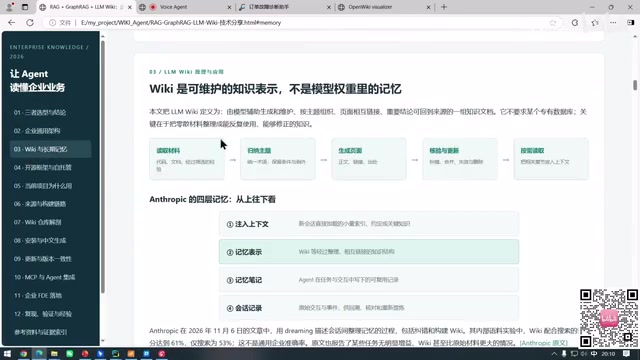
The workflow: a large model first helps organize and extract enterprise knowledge experientially, converting it into Markdown organized for directory-based retrieval, building a complete evidence chain; once organized, agents handle querying and reading.
The open-source project open wiki mentioned in the livestream is an implementation fully conforming to the LLM Wiki standard, one of the frameworks under the langchain ecosystem (the other three being deep agent, langchain, and langgraph).
Markdown directory-based retrieval is the key organizational difference between LLM Wiki and traditional vector retrieval. Traditional RAG chops documents into pieces and recalls by vector similarity, leaving chunks without structure; LLM Wiki instead has a large model distill and rewrite materials into structured Markdown documents, building directory hierarchies by business topic, so queries first locate the directory and section, then read the corresponding content. This "organize first, retrieve later" approach essentially compresses knowledge into more refined business semantic units—suited for content requiring holistic understanding rather than fragment matching, such as concept definitions, process steps, and rule constraints. Since the number of entries is typically far smaller than the original documents, maintenance and manual review are also more feasible—but the organization step depends on the large model's comprehension quality, requiring spot-check and update mechanisms.
Layered Evidence Gathering, On-Demand Combination: A General Enterprise Approach
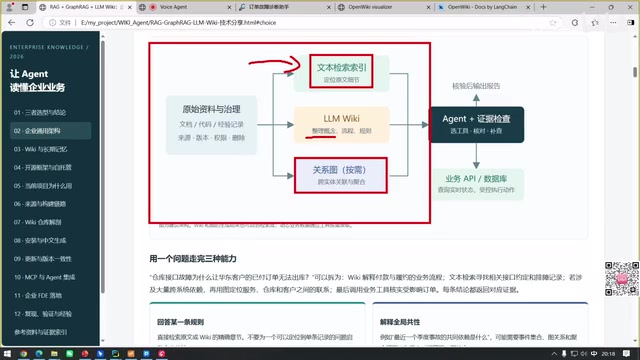
With the characteristics of the three approaches understood, the implementation path becomes clear: layered evidence gathering, combined on demand.
Specifically, you can establish three repositories: first, a text repository using traditional RAG to locate source details—product manuals, contract data; second, a Wiki repository holding organized business processes, foundational concepts, and security boundary rules, making it easy for agents to query overall business logic; third, a graph database holding relationships between entities. Agents retrieve from different repositories as needed—to understand a business line's processes, go to the Wiki repository; to look up specific contract details, go to the text repository.
The multi-tenant knowledge base platform project demonstrated in the livestream adopts exactly this approach. The project uses both a vector RAG database and a Graph RAG graph database; when both hit, it's called a "dual-path hit" and ranked first. The project also displayed evaluation data such as relevance scores, total time, knowledge graph invocation counts, large model invocation counts, input/output tokens, and cost, along with recall results from vector and graph retrieval.
Voice Agent: Engineering Practice of the Sandwich Architecture
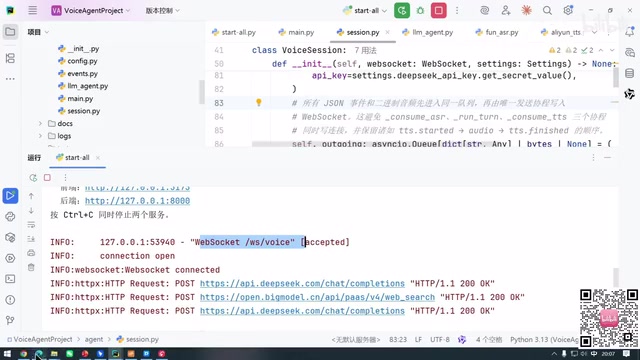
Beyond knowledge bases, the livestream also demonstrated a deployable voice agent project using a sandwich architecture, achieving streaming input and streaming output.
In practice, the user holds a button to speak and releases it to stop listening. Speech recognition doesn't wait for the whole sentence to finish—it runs in real time as the user speaks; and once an answer emerges, voice playback begins without waiting for the full result to be generated. This streaming processing brings response times down to milliseconds—currently the voice agent approach that can truly be deployed in enterprises.
In the demo, when querying the weather, the agent returned information like Changsha being sunny, temperatures of 11 to 14 degrees, and a gentle north wind, along with a note that light rain was expected in the coming days with lows around two degrees, and suggested checking the latest weather. This project demonstrates the complete chain of speech recognition, large model understanding, and voice playback.
Interviews Getting Tougher: Coding Ability Is a Hard Threshold
At the end, the livestream touched on the current state of the agent industry: wailing everywhere outside, and finding large model-related jobs is exhausting and fiercely competitive. "Competitive" means interview requirements have risen. What if the instructor doesn't know how to code? The answer is direct—you must read code.
This echoes the positioning of the entire livestream: from beginner to hands-on, walking you step by step through building an enterprise-grade code knowledge and troubleshooting Agent. Understanding concepts isn't enough—being able to run the project, read the logs, and debug the pipeline is what enterprises truly need.
One-line Summary
Traditional RAG, Graph RAG, and LLM Wiki are complementary rather than replacements; enterprises should gather evidence in layers and combine on demand.
Paragraph Summary
Based on a tech livestream, this article answers whether enterprises should choose traditional RAG, Graph RAG, or LLM Wiki for their knowledge base. The conclusion: the three are complementary, not replacements. Traditional RAG excels at retrieving localized facts like policy manuals and product specifications; Graph RAG relies on entity relationship networks and suits terminology-dense, highly interconnected domains like finance and healthcare; LLM Wiki distills a small corpus into reusable business concepts, processes, and rules. For implementation, it recommends layered evidence gathering and on-demand combination—building text, Wiki, and graph repositories, with agents retrieving by query type and ranking via mechanisms like "dual-path hits." The article also covers a streaming voice agent practice based on a sandwich architecture and notes that industry interviews are getting stricter, with coding ability a hard threshold.
Related articles

From 0 to 1: Vibe Coding an AI Knowledge Base — A Practical Retrospective and Tech Stack Breakdown
A retrospective on building the AI knowledge base OilBook from scratch with Vibe Coding: Next.js+Neon stack, Oil Dev Skill workflow, Stripe paywall security, interview-style writing, AI-flavor control, and Vercel deployment.

GLM-5.4 Hands-On: Native Vision Meets a New Vibe Coding Workflow
Hands-on with Zhipu GLM-5.4: native vision tested across a 3D product demo, pure-code video generation, and remote-control Vibe Coding, compared with GPT-6.2 and Gemini Neon.

AI and Humans Claim to Prove the Riemann Hypothesis: Machine-Verified, Yet Nobody Can Understand It
Anthropic mathematician and AI Claude claim to prove the Riemann Hypothesis with 17 million lines of Lean code, machine-verified but unreadable by humans. This article analyzes the event, the zero proportion record from 41.6% to 67.2%, and the gap between machine verification and human understanding.