LMSY: Buy a Slot on a 24-Hour Video Channel for $5
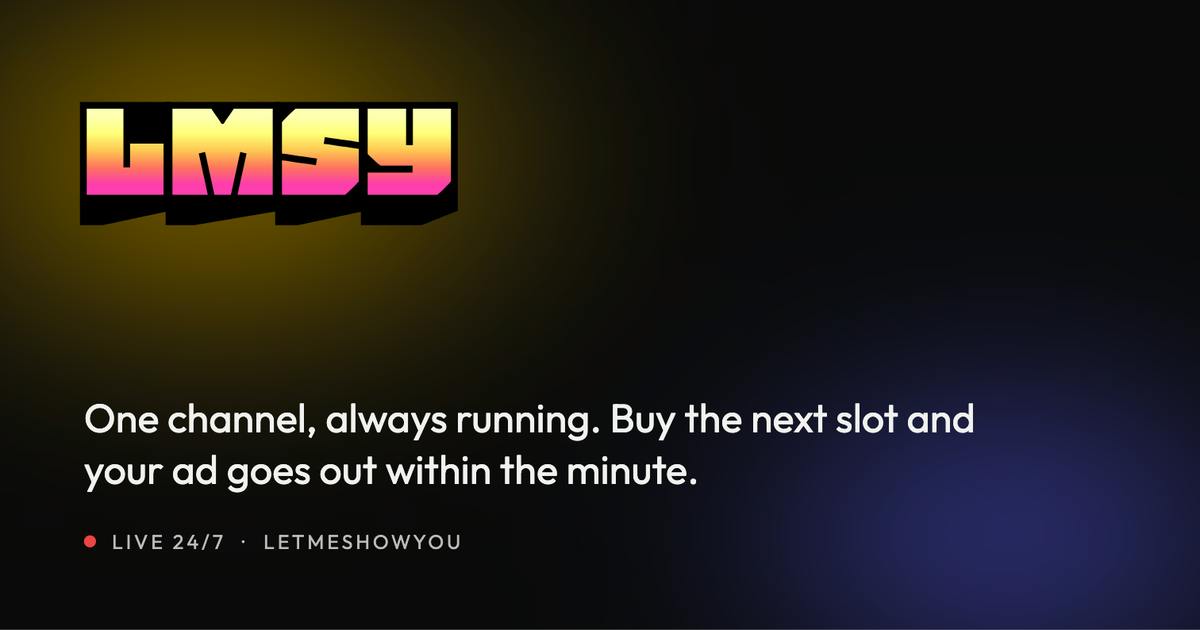
LMSY lets you buy a slot on a live 24-hour channel for $5, with permanent archiving instead of reach promises.
LMSY is a continuously running 24-hour video channel where anyone can insert content for as little as $5 ($1/minute), going live within about a minute of payment. Its standout trait is radical honesty: it openly admits viewership is low, offers no targeting, and has every slot reviewed by a real human. Each aired slot gets a dedicated page preserved permanently, shifting its value from "momentary exposure" to "content archiving." Less a marketing tool than a lightweight experiment in leaving a digital mark on a public channel.
A Channel That Never Stops — And Anyone Can Buy a Slot
At a time when advertising and content distribution are monopolized by algorithms and platforms, a product called LMSY has taken a nearly counterintuitive approach: it's a 24-hour, non-stop video channel where anyone can pay $5 to insert their content into the live broadcast stream.
The mechanics are refreshingly simple — once you purchase a slot, your content enters an already-running six-hour loop, going live roughly one minute after payment. Pricing is based on airtime: $1 per minute, with a $5 minimum. The team's reasoning is straightforward: Stripe charges a flat $0.30 processing fee, making any transaction below that threshold economically unviable.
No sales calls, no complicated setup process. This "pay and go live" experience is the core proposition LMSY uses to differentiate itself from traditional ad platforms and content hosting services.
A Product Pitch That's Honest to the Point of Being a Turnoff
What's most unconventional about LMSY is its candor about its own limitations. The product description explicitly states: "It won't get you reach. Viewership is low — the site says so itself."
This kind of self-deprecating positioning is rare on Product Hunt, where most products go out of their way to amplify their value proposition. LMSY does the opposite — nothing is targeted, and no exposure is promised. It even emphasizes that every slot is reviewed by a real human before going live.
Looked at from a different angle, this is precisely what gives LMSY its distinctive character. While the rest of the industry chases scale, automation, and precision targeting, LMSY offers something closer to performance art — you're not paying to reach anyone; you're paying for your content to have existed on a public channel.
This reverse-marketing strategy has a basis in psychology, known as "two-sided messaging" — proactively acknowledging a product's drawbacks can actually increase audience trust and persuasion effectiveness. Research shows that when brands openly admit their limitations, consumers tend to rate their overall credibility higher. LMSY's approach carries commercial risk, but it aligns perfectly with the indie developer community and Product Hunt users' appetite for authenticity — an audience broadly immune to, and often repelled by, over-packaged marketing speak.
Permanent Archiving: Every Slot Gets Its Own Page
One design detail worth noting is the permanence of the content. Every slot that has ever aired gets a dedicated page that remains live indefinitely.
This means LMSY isn't just a one-time broadcast insertion — it's more like a timestamped content archive. The $5 you spend doesn't just buy you a minute of airtime; it buys a permanently accessible record. For users who want to leave a public mark for a project, an idea, or a personal milestone, the "permanent archiving" aspect may be more meaningful than brief exposure.
From a product logic standpoint, this also lowers the expectation gap around viewership — since the content persists, its value isn't entirely dependent on how many people happen to be watching at the moment it airs.
This design philosophy shares some similarities with the Web3 concept of "on-chain permanent attestation," but is implemented far more lightly — no blockchain involved, just centralized server hosting of a dedicated URL for content persistence. This "timestamped archive" logic also positions LMSY closer to a digital memorial service than a traditional media placement platform. It's somewhat analogous to the early internet's "Million Dollar Homepage" — where part of the motivation for paying was the psychological satisfaction of leaving a mark on the public internet, rather than any expectation of real traffic conversion.
Who Is This Actually For?
Categorically, LMSY sits in the video streaming, marketing, and advertising verticals — but it's clearly not an efficient marketing tool. It's more of a conceptual experiment: exploring the intrinsic value of the act of "public broadcast" itself.
Potential use cases might include: an indie creator wanting their work to appear on a real channel, an enthusiast looking to leave a digital keepsake with a public page, or someone who's simply curious about what it feels like to "pay five dollars to be on TV." The low barrier to entry — no setup required, live within a minute — and the low cost make the experiment nearly risk-free.
The product currently has 10 upvotes and 2 comments on Product Hunt, ranking 18th — a niche project with genuine conversation around it. The human review process for every piece of content also means it can never truly scale, but that may be exactly the kind of "handcrafted feel" its creator wants to preserve.
Summary
LMSY is a small product that commits fully to simplicity and honesty. It doesn't solve any grand problem, nor does it promise traffic dividends. Instead, it redefines what "buying a broadcast slot" means in the most straightforward way possible — one minute of public airtime, plus a permanently accessible page. Nothing more. In an ocean of overhyped products, that kind of candor turns out to be its most memorable quality.
Related articles
AI Agent Fundamentals: The Three Core Components — Brain, Memory, and Tools
A beginner's guide to AI Agents: covering the three core components (brain, memory, tools), four stages of LLM deployment, and why Agents matter for real business use cases.
Boycotting Software That Doesn't Support Linux: One Developer's Philosophy of Choice
A Linux-only developer shares his philosophy of boycotting non-Linux software — without sacrificing productivity — and explains how coding agents like Claude Code are closing the gap with commercial tools.
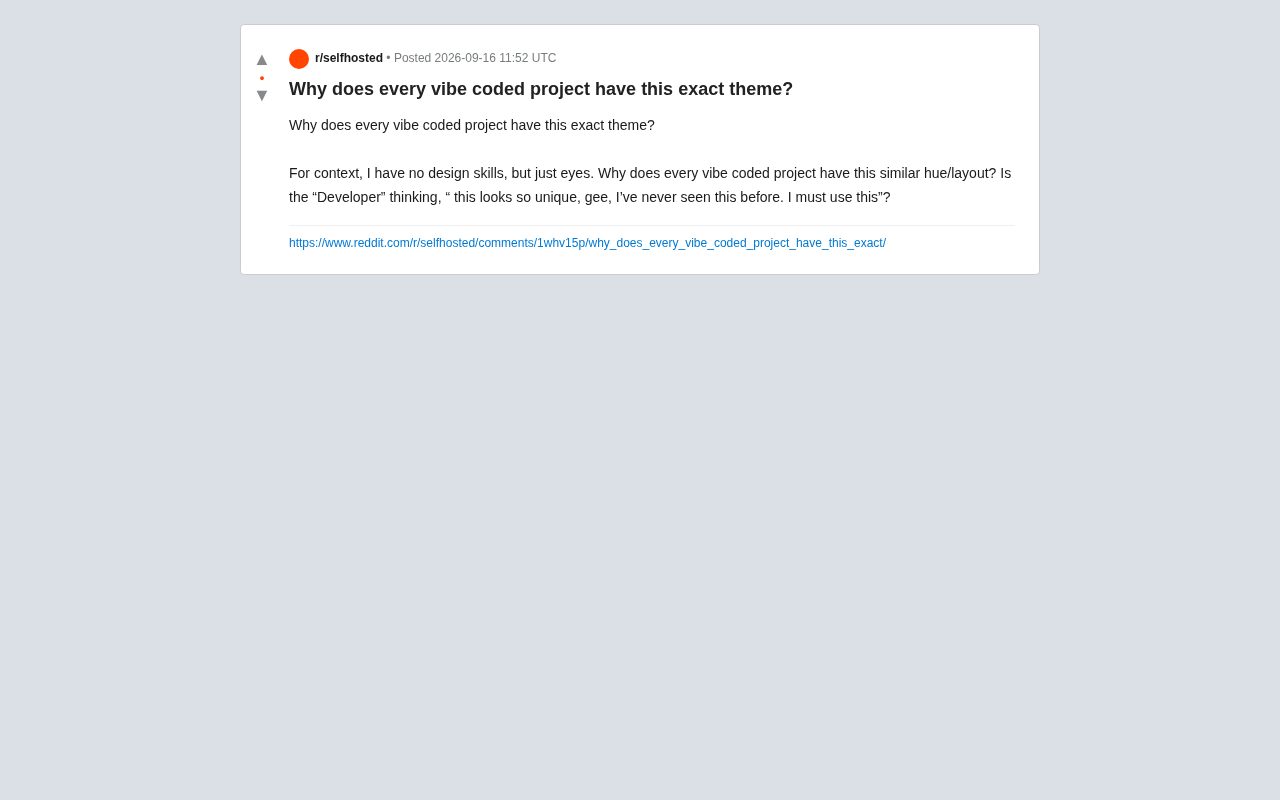
Why Do All AI-Generated Projects Look the Same? The Aesthetic Homogenization Problem in Vibe Coding
Why do vibe coding projects all use purple gradients and dark glassmorphism? We break down the technical roots of AI aesthetic homogenization and how to escape it.