Local 27B Model Reads Lease and Spots Billing Leak: Row-Bot + qwen3.8 in Practice
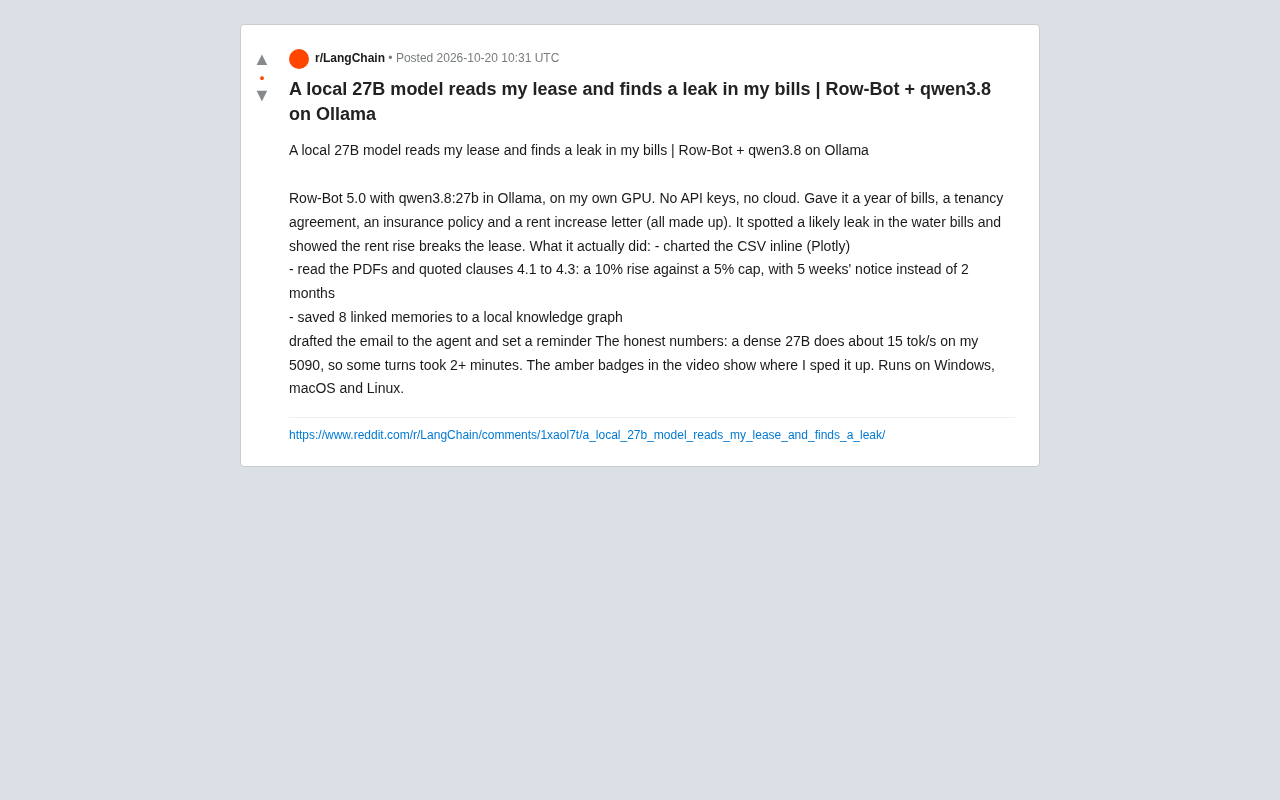
Using Row-Bot 5.0 with qwen3.8:27b locally on Ollama, completing full contract review and bill analysis on a single consumer GPU.
The article covers a Reddit user's practice of using Row-Bot 5.0 as the interaction framework and qwen3.8:27b as the inference engine running locally on Ollama. With just one consumer-grade GPU (5090), he processed a year of utility bills, a lease, an insurance policy, and a rent increase notice—plotting CSV charts, locating PDF clauses (flagging a 10% rent increase exceeding the 5% cap and a 5-week notice short of the agreed 2 months), storing 8 associated memories in a local knowledge graph, and drafting emails and setting reminders. The dense 27B model runs at about 15 tok/s, with some turns exceeding 2 minutes. The author sees clear privacy and cost advantages for local solutions, suitable as an efficient "first reader" for sensitive documents, though legal judgments still require professional review.
Title
Local 27B Model Reads Lease and Spots Billing Leak: Row-Bot + qwen3.8 in Practice
Meta Description
A Reddit user ran Row-Bot 5.0 with qwen3.8:27b locally on Ollama to read a lease and a year of bills, uncovering a water bill anomaly and flagging that a rent increase violated contract terms. No API keys, no cloud calls, ~15 tok/s on a 5090.
Article Content
As privacy concerns and costs around cloud APIs keep growing, moving large models back to local machines has become a popular choice. A Reddit user shared his practice: using Row-Bot 5.0 with the qwen3.8:27b model, running locally on Ollama, he completed the full workflow of reading a lease, checking bills, writing emails, and setting reminders—all with a single consumer-grade GPU. No API keys, no cloud calls, all data staying on the local machine.
A Complete Closed Loop of a Local Toolchain
The setup this user built combines Row-Bot 5.0 as the interaction framework, qwen3.8:27b as the inference engine, running on Ollama, with his own GPU as the hardware. He fed the model a year of utility bills, a lease agreement, an insurance policy, and a rent increase notice—all fictitious data.
The model's processing chain was quite complete: it used Plotly to plot the CSV data directly into charts displayed inline in the conversation; read the PDF and located clauses 4.1 to 4.3, pointing out that the 10% rent increase exceeded the contract's 5% cap, and that the notice period was only 5 weeks rather than the agreed 2 months; stored 8 associated memories into a local knowledge graph; and finally drafted an email to the agent and set a reminder.
The value of this workflow isn't in how strong any single capability is, but in stringing "data understanding—clause comparison—action recommendations—follow-up" into a localized automation chain. For scenarios involving sensitive contracts and financial records, the privacy benefits of local execution are hard for cloud solutions to match.
Ollama is an open-source framework for running and managing local large models. It packages model weight downloads, quantization format adaptation, inference engine scheduling, and a local API service into a unified command-line and HTTP interface. Users only need to run a command like ollama run qwen3.8:27b to launch a model on a consumer-grade GPU or CPU and communicate with frontend applications via localhost. Compared to using llama.cpp or vLLM directly, Ollama's advantages lie in unified model library management, well-developed cross-platform installers (official support for Windows/macOS/Linux), and default quantization strategies, letting users without deep learning deployment experience quickly get local inference running. Row-Bot in this article calls qwen3.8:27b through Ollama's local port, thereby completely bypassing cloud APIs.
The Performance Ledger of a 27B Model
The author honestly recorded the speed data: a dense 27B model runs at about 15 tok/s on his 5090, with some conversation turns taking over 2 minutes. The amber markers in the video are precisely the segments he sped up.
This number sets a realistic expectation—a local 27B model can do the work, but interaction smoothness is far below that of cloud APIs. For tasks like batch document analysis and contract review that don't need real-time responses, waiting is acceptable; but for rapid multi-turn Q&A, the experience suffers. The tool supports Windows, macOS, and Linux, and cross-platform availability is a plus.
Dense Model refers to the traditional Transformer architecture in which all parameters are activated for every token during inference. The opposite is the MoE (Mixture of Experts) model—the latter activates only part of the expert networks each time, so the total parameter count can be large while the actual computation is smaller. The article emphasizes "dense 27B," meaning all 27 billion parameters participate in computation for every token generated, so memory usage and compute consumption are relatively fixed and high. This explains why it only reaches about 15 tok/s on a 5090: a dense 27B needs about 54GB of VRAM at FP16, around 15GB even with 4-bit quantization, and every token generated requires a full forward pass. By contrast, MoE models with the same total parameter count often achieve higher throughput, which is why distinguishing model types is essential when evaluating local deployment feasibility.
Lessons from Local AI Handling Contract Documents
The most noteworthy aspect of this case is the model's ability to locate and compare structured clauses. A 10% rent increase versus the contract's 5% cap, a 5-week notice versus the agreed 2 months—these judgments requiring precise citation are exactly where general-purpose chatbots tend to be vague. That qwen3.8:27b could cite specific clause numbers and give conclusions shows that mid-sized models already have practical value on vertical document tasks.
Another detail is the 8 associated memories in the local knowledge graph. This lets the model continuously reference previous analysis results in later turns rather than re-reading the original files each time. For scenarios requiring repeated consultation of contract details, this memory mechanism can significantly reduce redundant computation.
Of course, one must keep a clear head: all the files in the case are fictitious, and judgments about the legal validity of real contracts still require professional review. A local model can quickly locate suspicious points, organize evidence, and draft communication emails, but the final decision should not be outsourced to the model. Treating it as an efficient "first reader" rather than a legal advisor is a more reasonable positioning.
Local knowledge graph here refers to structuring key facts extracted from the conversation (such as clause numbers, amounts, dates, and obligated parties) as entities and relations stored locally in a graph database or lightweight store, for retrieval and reference in later turns. It complements vector-database RAG approaches: vector retrieval excels at fuzzy semantic recall, while knowledge graphs excel at precise relational queries and multi-hop reasoning, for example "clause 4.1's rent increase cap → applies to this notice → notice period requirement is 2 months." Since the graph resides entirely on the local machine, sensitive entities in the contract never leave the device, and the model can reuse existing conclusions without re-reading the original PDF each turn, significantly reducing redundant computation and context window pressure.
Who Should Try This Approach
Users with a GPU capable of local inference, who are sensitive about data privacy, and who are willing to accept slower response speeds can reproduce this workflow. Typical scenarios include rental contract review, insurance clause comparison, and personal financial anomaly detection. Compared to cloud solutions, local deployment saves API costs and key management, at the price of hardware investment and inference speed.
From the tooling ecosystem perspective, Ollama's model management plus frontend frameworks like Row-Bot are lowering the barrier to local AI. The 27B scale can run on consumer-grade hardware while retaining sufficient document understanding capability—a pragmatic compromise.
One-line Summary
Using Row-Bot 5.0 with qwen3.8:27b running locally on Ollama, completing the full contract review and bill analysis workflow on a single consumer-grade GPU.
Paragraph Summary
The article introduces a Reddit user's practice of using Row-Bot 5.0 as the interaction framework, qwen3.8:27b as the inference engine, running locally on Ollama. With just one consumer-grade GPU (5090), he processed a year of utility bills, a lease agreement, an insurance policy, and a rent increase notice, completing CSV chart plotting, PDF clause location (flagging that the 10% rent increase exceeded the contract's 5% cap and the 5-week notice fell short of the agreed 2 months), storing 8 associated memories in a local knowledge graph, and drafting emails and setting reminders. In terms of speed, the dense 27B model runs at about 15 tok/s, with some turns exceeding 2 minutes. The author believes local solutions have clear advantages in privacy and cost, suitable as an efficient "first reader" for sensitive documents, though legal judgments still require professional review.
Related articles

iPhone Duo Hands-On: Is the $2,000 Small-Screen Foldable Worth It?
YouTube's Allison shares her iPhone Duo hands-on: dual-screen multitasking doubles efficiency, great video viewing, nice matte finish—but thick body, small outer screen, and a $2,000 luxury price.

Sentry's Ad Cracks Up Developers: Can On-call Actually Be Fun?
Sentry's ad short film taps into developers' on-call anxiety, using humorous dialogue to showcase its observability platform—errors, logs, traces, metrics, replays, and releases in one place.

LLM App Getting Worse With Every Change? Build an Effective Evaluation System in Three Steps
How do you know if your LLM app is getting better or worse? A Reddit-based guide to test sets, automated regression evaluation, LLM-as-judge scoring, and structured agent tracing.