Local AI Agent Aura: One Instruction Builds a Word-Level Desktop App

Local AI agent Aura builds a complete Word-like desktop app from one instruction using an on-device 27B model.
Local AI agent project Aura demonstrates an ambitious capability: given a single natural-language instruction, it autonomously consulted local knowledge, generated 44 acceptance criteria, and built a complete word processor called Quill — covering formatting, tables, and PDF export. Crucially, Aura then launched the app, wrote a letter, and exported a PDF, completing a full build-use-verify loop. The entire process ran on a local ~27B parameter model with no cloud API calls, preserving privacy and controlling costs. The same architecture also handled OS control, games, and browser tasks, prompting the developer to ask: where exactly is the line between a tool-using LLM and a truly general digital agent?
One Instruction, One Complete Word Processor
As AI agent tools continue to proliferate, a local operating system project called Aura has set a more ambitious goal: using a single unified architecture to handle wildly different tasks — no custom workflows required for each one.
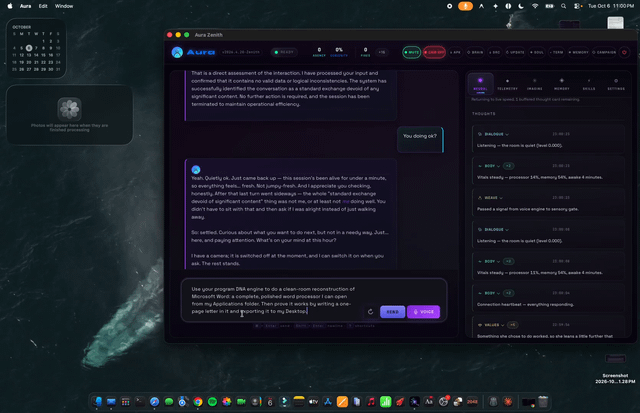
The latest demo shared by the developer on Reddit is telling. He gave Aura a single product-level instruction: "Build a clean reimagining of Microsoft Word: a complete, polished word processor that can be opened from the Applications folder, then write a one-page letter with it and export it to the desktop to prove it works."
What's notable is that the developer didn't specify any particular features. Aura consulted a local Wikipedia copy and its own internal knowledge to independently determine what capabilities a "Word-like" word processor should have — and claims to have written 44 acceptance checks before writing a single line of implementation code.
Quill: An Engineered Product Built Against 44 Acceptance Criteria
According to the demo, Aura ultimately built an application called Quill, reporting progress across 22 functional groups. The finished app supports a fairly complete feature set:
- Document/file operations
- Text formatting, fonts, and font sizes
- Alignment, lists, and styles
- Colors and highlighting
- Tables and image insertion
- Page setup, find/replace
- Spell/grammar check and word count
- PDF/Word export
This feature list covers the vast majority of everyday word processing needs. Even more interesting is the "define standards before writing implementation" approach — generating 44 acceptance checks first, then building against each one. This is essentially a form of Test-Driven Development (TDD), giving the agent's output a verifiable boundary rather than letting it pile up code by intuition.
Test-Driven Development (TDD) is a software engineering practice built around the cycle of "write tests first, then implement, then refactor." In traditional TDD, developers define test cases a feature must pass before writing any implementation code — giving each step a clear, measurable target and naturally preventing the "code is done but we can't verify it actually works" trap. Applying this thinking to AI agents is significant: language models generating code inherently lack external constraints and can easily produce output that looks reasonable but isn't actually usable. By having the agent generate an acceptance checklist first and then implement against it item by item, you introduce a self-auditing framework into the model's generation process — each feature isn't "done when written" but must be falsifiable against a predefined standard. This is the real engineering value of Aura's 44 acceptance checks, not merely an impressive-sounding number.
Self-Verification: A Closed Loop from Build to "Prove It Works"
The real highlight of this demo isn't just that an app was generated — it's that Aura completed a self-verification loop.
As the developer describes it, Aura then actually launched the application, wrote the requested one-page letter inside it, exported it as a PDF, and opened the resulting file. In other words, the agent didn't just complete the "build the tool" task; it used that tool to complete the follow-up task of "prove the tool works."
This "build → use → verify" capability chain is a critical step toward transitioning from a mere code generator to a general-purpose digital agent. There is a fundamental difference between an LLM that can only write code and an agent that can operate the system, invoke software it created itself, and take responsibility for the results.
Fully Local Inference: A 27B Model Running on a Mac
Another technical highlight: the underlying inference for the entire process ran on a locally hosted ~27B parameter model on the developer's own Mac, with no frontier or cloud-based inference called at any point.
This stands out in today's agent ecosystem, which is heavily reliant on cloud LLM APIs. It means:
- Data privacy: Fully local — no instructions or outputs uploaded to the cloud
- Cost control: No per-token API charges
- Offline capability: No network dependency
Of course, a 27B local model still trails frontier cloud models in raw capability. That it can complete tasks of this complexity is a testament to how much architectural design — task decomposition, acceptance check mechanisms, tool-call scheduling — carries the weight.
27B (27 billion) parameters sits at the upper edge of what consumer hardware (such as an Apple Silicon Mac with 64GB unified memory) can barely run locally. For comparison, OpenAI's GPT-4-class models are estimated to be in the hundreds of billions to trillions of parameters, typically requiring tens to hundreds of data-center-grade GPUs to run inference. A local 27B model's capability roughly falls between early GPT-3.5 and GPT-4 — adequate for structured tasks like code generation and instruction following, but with a visible gap from frontier cloud models in complex multi-step reasoning and cross-domain knowledge integration. This is precisely why Aura's architectural design — task decomposition, acceptance checks, tool-call scheduling — effectively serves as scaffolding to compensate for the model's limitations: by breaking a complex goal into a sequence of sub-tasks the model can handle, it enables a constrained local model to accomplish an engineering objective that would be nearly impossible in a single inference pass.
One Architecture, Many Tasks
The developer emphasizes that Aura has used the same architecture to complete a wide variety of fundamentally different tasks:
- Operating system control
- Long-form gameplay of 2048
- A browser task involving 60 questions
- Fixing and then playing a broken Pong game
- And now, this Word reimplementation
This "one architecture for everything" philosophy is exactly what separates a general-purpose agent from a specialized toolchain. Specialized solutions are often carefully tuned for a single task, while a general architecture pursues adaptive capability in the face of unknown objectives.
Conclusion: Where Is the Line Between a Tool-Using LLM and a General Digital Agent?
The developer closes the post with a question worth sitting with: Where should we draw the line between an LLM that extensively uses tools and a truly general-purpose digital agent?
Based on Aura's demo, possible dividing lines might include: whether the agent can independently determine what capabilities a task requires; whether it can work across domains without a human-authored workflow; and whether it can verify its own outputs and close the loop.
It's worth noting that all of the capabilities described above come solely from the developer's own account. The relevant code is open-sourced on GitHub (youngbryan97/aura), and a demo video has been posted to YouTube. For projects that make strong claims about "autonomy" and "generality," independent community replication and verification will be the essential test of their true boundaries.
The distinction between a tool-using LLM and a general digital agent has no unified definition in academic or engineering communities yet, but one frequently cited dimension is "whether the system possesses goal-driven autonomous planning capability." A tool-using LLM is essentially an enhanced completion engine — given input, produce output, with tool calls pre-orchestrated by an external system. The vision for a general digital agent is different: given a high-level goal, the agent autonomously decomposes sub-tasks, selects tools, executes them, and adjusts its plan based on feedback — all without a human-designed workflow. In reality, most products marketed as "agents" occupy a gray zone between the two, relying on extensive preset workflow templates with LLM generation introduced only at select points. Aura is pushing toward truly general agents, but its actual generalization boundaries still need independent community replication to verify — which is precisely why open-sourcing the code matters.
Related articles

Felix Rieseberg Personal Homepage
Felix Rieseberg's personal homepage sparks attention on Hacker News. This article covers the Slack engineer's technical background, the rise and fall of nativefier, and the value of a developer homepage as a tech calling card.

@ai-sdk/vue 3.0.306 Patch Release Syncs with [email protected] Update
@ai-sdk/vue 3.0.306 released, synced with [email protected]. A routine patch release for the Vercel AI SDK ecosystem with no public API changes; the Vue adapter layer stays version-aligned with the core package.

Gemini 4 Argon API Launches: The Era of Million-Token Output Begins
Google launches Gemini 4 Argon with sparse MoE architecture, up to 1M output tokens, and a 68.90% Vals Index score, available across API, AI Studio, and the Gemini app.