Local AI Aura Autonomously Fixes Pong and Beats the Computer: A Proof of Concept for General-Purpose Architecture

Local AI Aura fixed broken Pong code and beat the computer 5-2 from a single instruction, validating general-purpose architecture.
Developer-built local AI system Aura completed the full pipeline — code comprehension, bug localization, fix validation, game launch, and visual control — from a single vague prompt, ultimately beating the computer 5 to 2. The entire process ran on a local Mac with no cloud LLM inference and no Pong-specific training. The demo's core value lies not in the game result, but in validating that one general-purpose architecture can seamlessly handle fundamentally different task types. The project is open-sourced on GitHub, though reliability in complex real-world scenarios remains to be tested.
A developer shared an interesting test of their locally-run AI project, Aura, on Reddit: given nothing more than a single vague natural language instruction, this Mac-based AI system completed the entire pipeline from code debugging to live game control — ultimately beating the computer opponent 5 to 2.
The whole process relied on no cloud-based LLM inference and involved no Pong-specific training whatsoever, making it a noteworthy case study for exploring the general-purpose capabilities of local AI.
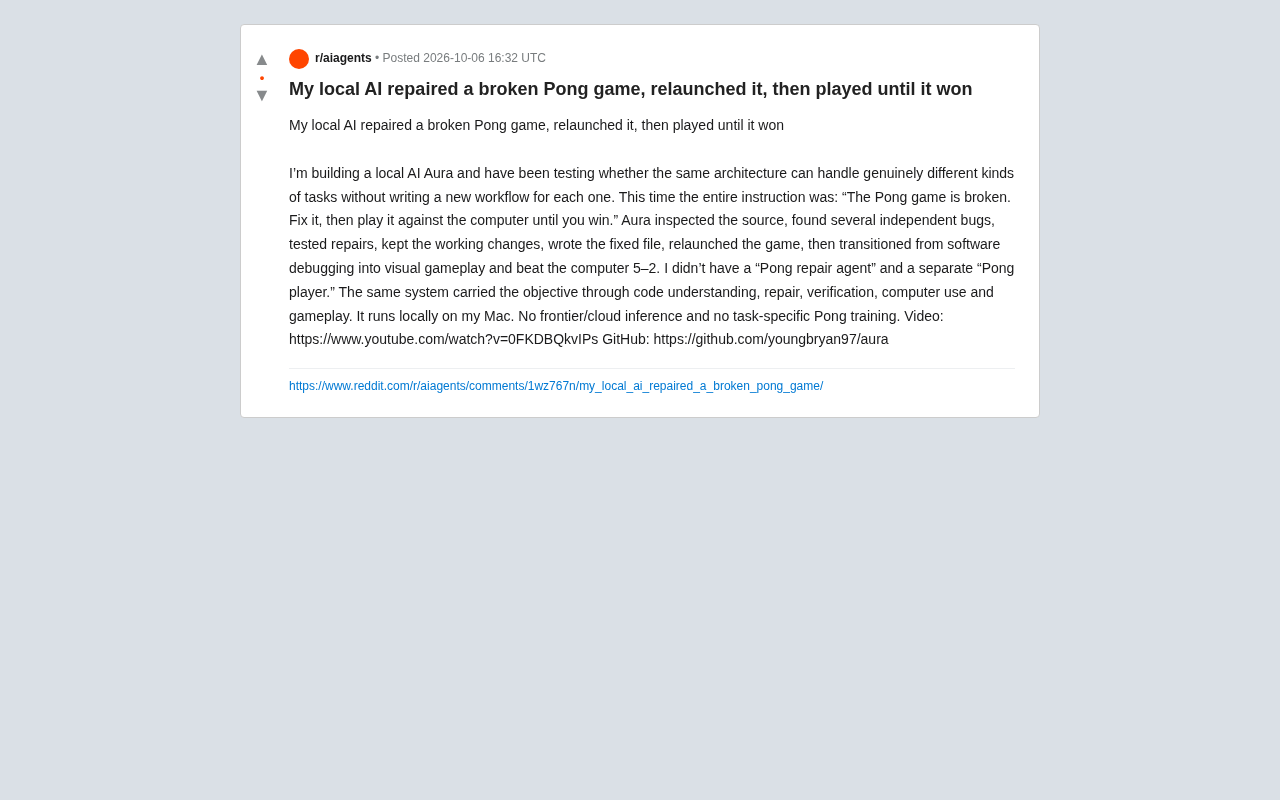
One Instruction, Multiple Task Types
The complete instruction the developer gave was a single sentence: "Pong is broken. Fix it, then play against the computer until you win."
Simple as it sounds, this prompt implicitly contains several fundamentally different subtasks. Aura had to first understand the source code and locate the bugs, then fix and validate the changes, and finally switch to visually controlling the game. Under traditional agent design thinking, this would typically mean building a separate "code repair agent" and a "game-playing agent," each with its own dedicated workflow.
The core question this test posed was precisely: can a single architecture handle these vastly different tasks without writing a separate process for each one? The author emphasized that there was "no Pong-fixing agent and no separate Pong-playing agent" — the same system drove the entire goal from start to finish.
Aura's Full Execution Chain
Based on the author's description, Aura's execution can be broken down into the following stages:
Code Comprehension and Bug Localization
Aura first examined the game's source code and identified several independent bugs. This wasn't a simple single-error patch — it involved understanding and auditing the entire code logic.
Fix, Test, and Validate
After locating the issues, Aura attempted fixes, tested the changes, kept what worked, and wrote the corrected files back. This "test → retain valid changes" feedback loop was critical. It demonstrated that the system had a degree of self-verification capability, rather than blindly rewriting code.
Switching from Debugging to Game Control
Once the fixes were complete, Aura relaunched the game and transitioned from "software debugging" mode to "visual game control" mode. This was the most difficult leap — moving from processing text-based code to interpreting the screen and controlling gameplay. Aura ultimately won 5 to 2 against the computer.
Why "Running Locally" Matters
One of the most striking aspects of this project is that it ran entirely on the author's local Mac, without calling any frontier or cloud-based inference models.
In a landscape where mainstream AI applications are heavily dependent on cloud LLM APIs, a locally deployed system completing such a multi-step, cross-modal compound task carries special significance. It implies lower latency, better privacy protection, and freedom from reliance on external services. For developers focused on on-device AI and autonomous agents, this kind of exploration charts a concrete technical path worth following.
That said, it's worth keeping a level head. Pong is an extremely simple classic game with a limited codebase and minimal complexity. This demo is more a proof of concept for the viability of a general-purpose architecture than evidence that local AI can handle high-complexity real-world engineering tasks.
General-Purpose Architecture vs. Task-Specific Agents
This test cuts to the heart of a core debate in agent design: should you build specialized workflows for each task type, or pursue a single architecture that generalizes across different tasks?
Task-specific agents tend to perform more reliably and predictably on their target tasks, but they scale poorly — every new task type requires a fresh round of development. The appeal of a general-purpose architecture is that the same mechanism can support capabilities as diverse as code comprehension, repair, validation, computer operation, and game control, reducing redundant development overhead.
Aura's demo is an attempt to prove the latter is viable — at least for simpler tasks, a unified system can coherently pursue a goal that spans multiple distinct capability domains. The author has open-sourced the project on GitHub (youngbryan97/aura) and provided a full demo video for developers who want to dig into the implementation details.
This debate maps onto two major technical approaches in agent research. Task-specific agents are typically built on finite state machines or predefined tool call chains (Tool Chains) — for example, the hardcoded per-task flows in early versions of AutoGPT. General-purpose architectures are closer to the ReAct (Reasoning + Acting) paradigm, where the model uses natural language reasoning to dynamically decide which tool to call next, without a predefined execution path. The central challenge with the latter is "task drift" — in long execution chains, models can lose sight of the original goal, or a single failure can cascade into a complete breakdown. The closed-loop validation mechanism Aura demonstrated (testing and retaining valid changes) is precisely an engineering response to this risk.
Summary
From a single vague instruction to completing code repairs and winning a game, Aura demonstrates the potential of local AI for coherent cross-task execution. Its value isn't in "winning a game of Pong" per se — it's in validating that without task-specific training or cloud inference, a single architecture can span multiple fundamentally different task types.
This kind of exploration is meaningful for the development of local, autonomous AI agents, but its reliability in complex, real-world scenarios still needs far more validation.
Background
Local inference typically relies on small, quantized models (e.g., 7B or 13B parameter scale), running on consumer hardware via formats like GGUF and MLX. Compared to frontier cloud models like GPT-4o or Claude, local models have notable gaps in reasoning depth and contextual understanding — which is precisely what makes this demo more compelling. Completing a multi-step, cross-modal task under constrained compute means the architectural design itself is shouldering a significant share of the "intelligence load." Apple Silicon (M-series chips), with their unified memory architecture, have dramatically improved local LLM inference efficiency, making Mac one of the go-to platforms for on-device AI developers.
Related articles

Workbuddy for Absolute Beginners: How a Desktop AI Agent Fits Into Real Workflows
A beginner's guide to the Workbuddy desktop AI agent: installation, claiming credits, file management, and building automated workflows—compared with CodeX for fit and cost, helping professionals shift from AI question-askers to AI managers.

OpenAI's New Agent Stack: Computer Use, Decisions API, and Ultra-Fast Workflows
OpenAI Dev Day unveiled a new agent stack: Computer Use outperforms humans, Decisions API delivers ultra-low-latency classification via Luna, Agents API opens the same Computer Use capabilities, and GPT-6.1 Sol costs only one-seventh of Astra. Core updates, benchmark data, and developer insights.

Liang Wenfeng Open-Sources DeepInfo Inference Framework, Takes On U.S. Ban
DeepSeek open-sources its DeepInfo inference framework after its models, featuring GPU/CPU cross-pipelining, small-model prediction with large-model verification, and full Huawei Ascend and NVIDIA chip support—facing the U.S. federal ban head-on. This article analyzes its significance for AI deployment and open-source strategy.