Local AI Code Review Tools: How Developers Build Their Own Alternatives to Save on Subscription Fees

Developer builds local AI code review tool to replace paid subscriptions, leveraging open-source models for privacy and cost savings.
A developer's decision to cancel a commercial AI code review subscription and build a local alternative highlights growing demand for privacy-first, cost-effective AI tools. With mature local inference stacks like Ollama and llama.cpp, plus capable open-source models, self-hosted code review is now feasible. While commercial tools retain advantages in CI/CD integration and enterprise compliance, the low barrier to replication signals that subscription-based AI wrappers must build deeper value to survive.
From Paid Subscriptions to DIY Tools
Recently, a developer posted an intriguing project (Show HN) on Hacker News: they canceled their subscription to a commercial AI code review service and built a free, locally-running alternative from scratch. While the post itself didn't gain much traction (12 points, 5 comments), it reflects a growing trend in the developer community — a strong demand for "localization" and "de-subscription" of AI tools.
Over the past two years, AI-powered code review tools have proliferated. Major players in the market include CodeRabbit, Sourcery, Codacy AI, Qodo (formerly CodiumAI), and others. These tools typically integrate deeply with GitHub/GitLab Pull Request workflows, automatically triggering reviews when developers submit code changes and providing suggestions on security vulnerabilities, performance issues, and code style via comments. In terms of pricing, CodeRabbit's Pro tier costs around $15 per user per month, with enterprise plans running higher. This market experienced rapid growth in 2023-2024 but also faces severe homogenization — most tools are essentially API calls to large models like GPT-4 combined with engineered code context processing.
These tools can automatically analyze Pull Requests, identify potential bugs, and suggest refactorings, genuinely saving teams significant effort. But what comes with them is accumulating subscription costs, code privacy concerns, and dependency on third-party cloud services. This developer's choice was a direct response to these pain points.
Why "Cancel the Subscription"
Commercial AI code review tools typically charge per seat or per repository. For individual developers or small teams, these costs can escalate rapidly as teams grow. More critically, using cloud services means source code must be uploaded to third-party servers for analysis. For projects involving sensitive business logic or strict compliance requirements, this data exfiltration itself poses a significant risk.
The author's approach was straightforward: since the core capability (calling a large language model to analyze code) isn't an insurmountable technical barrier, it's entirely feasible to build your own system. Canceling the subscription not only saves ongoing costs but also keeps the entire code analysis process under your own control.
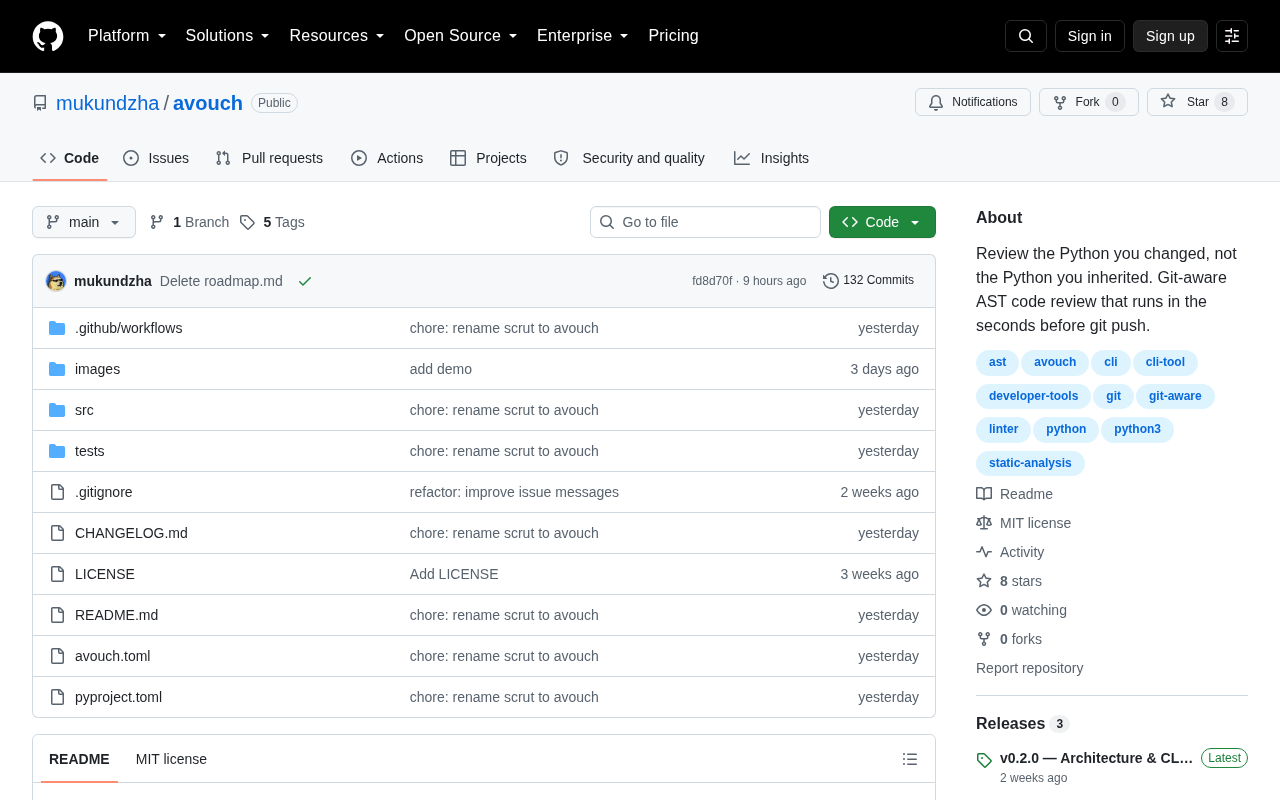
Core Value of Local AI Code Review Tools
The project's key selling point lies in the word "local." Local execution means the entire code review workflow — from reading diffs, constructing prompts, to generating review feedback — can be completed on the developer's own machine or private environment, without handing code over to external services.
Maturation of the Local Inference Tech Stack
With open-source large models like Llama, Qwen, and DeepSeekAd continuously improving, along with the maturation of local inference frameworks, running a model capable of handling code review tasks on a personal computer is no longer a pipe dream.
Specifically, the technical ecosystem for running large models locally has achieved breakthrough progress over the past year. Ollama is a command-line tool that allows users to download and run various open-source models with a single command, providing a local API interface compatible with OpenAI's format, greatly simplifying model deployment and management. llama.cpp, developed by Georgi Gerganov, is a pure C/C++ inference engine that supports the GGUF quantization format and can efficiently run large models on consumer-grade hardware. Quantization techniques (such as 4-bit and 8-bit quantization) dramatically reduce memory usage and computational requirements by lowering model parameter precision, enabling models that would otherwise require tens of gigabytes of VRAM to run on laptops with just 16GB or even 8GB of RAM — at the cost of only minor quality degradation. This combination of technologies provides a solid foundation for "building local AI tools yourself."
Actual Capabilities of Open-Source Models on Code Tasks
Measured by code comprehension and generation capabilities, current open-source models have reached remarkably high levels. DeepSeek-Coder-V2, CodeLlama-70B, Qwen2.5-Coder-32B, and similar models perform close to early GPT-4 versions on code benchmarks like HumanEval and MBPP. For code review tasks, models don't need to generate complete programs — they need to understand code intent, identify common anti-patterns, and spot potential defects. These requirements are relatively less demanding, meaning quantized models in the 7B-32B parameter range can handle most review scenarios. This means a development machine equipped with a mid-to-high-end GPU (RTX 4070 or above) can run a code review model of acceptable quality.
Dual Advantages of Privacy and Cost
Local solutions offer two obvious benefits:
First, privacy control: code never leaves your machine, fundamentally eliminating data leakage concerns — especially important for enterprise users. Second, cost control: a one-time hardware investment or reuse of existing compute resources replaces never-ending monthly subscriptions. For high-frequency usage scenarios, the marginal cost of a local solution approaches zero over time.
Trade-offs and Costs of Local Solutions
Of course, local solutions aren't without drawbacks. Compared to calling top-tier cloud models like GPT-4 or Claude, locally-run open-source models may lag in review quality and depth of context understanding. Additionally, self-built tools require developers to maintain, debug, and iterate on their own, lacking the out-of-the-box experience and technical support of commercial products. This is fundamentally a trade-off between "convenience vs. control."
Developer DIY Spirit and AI Tool Democratization
These "I built my own" posts are ubiquitous on Hacker News, reflecting a quintessential culture in the developer community: rather than complaining about unsatisfactory paid products, just build one yourself. This DIY spirit is being further amplified in the AI tools space — because the API-ification and open-sourcing of LLMs have dramatically lowered the barrier to building "intelligent tools."
The Shift from "Consumer" to "Creator"
In the past, building a decent code analysis tool required deep expertise in static analysis and compiler theory. Today, with large models, developers only need to design appropriate prompts and handle the organization and chunking of code context to assemble a usable review assistant.
In the AI code review scenario, prompt design directly determines review quality. Core challenges include: how to convert git diffs into a format the model can understand, how to provide sufficient code context (such as related files, function signatures, and project conventions) without exceeding the model's context window limit, and how to guide the model to distinguish critical bugs from code style preferences. A typical approach is to build layered prompts — system prompts define the reviewer role and review criteria, while user prompts contain the specific code changes and project context. Chunking strategies are also crucial: for large PRs, changes need to be split into logically related code blocks for separate review, then conclusions are aggregated.
The democratization of this capability is turning more and more developers from "consumers" of tools into "creators."
Implications for Commercial AI Code Review Tools
For commercial vendors in the AI code review space, projects like this are a warning signal. When core functionality can be replicated by developers at relatively low cost, a pure "AI wrapper + subscription" model will face challenges.
The differentiated value of commercial AI code review tools manifests across several dimensions: deep integration with CI/CD pipelines (such as automatically blocking non-compliant merge requests); organizational knowledge accumulation (learning team-specific coding standards and historical review patterns); unified governance across multiple repositories and languages; and enterprise security compliance certifications like SOC2 and ISO27001. Furthermore, commercial products typically use the latest top-tier models (such as GPT-4o, Claude 3.5 Sonnet) and incorporate project documentation and historical PRs as context through RAG (Retrieval-Augmented Generation) — this "fully managed + continuously optimized" experience is difficult for individual self-built solutions to fully replicate.
Commercial products must build genuine moats around review quality, team collaboration, CI/CD integration, and enterprise-grade security and compliance to continuously justify their subscription value.
Summary and Reflections
This small Show HN project, despite modest community reception, is a highly representative example. It tells us several things:
First, as open-source large models and the local inference ecosystem mature, the feasibility of "building your own AI tools" is rapidly increasing. Second, privacy and cost are becoming increasingly important factors when developers choose their tools. Finally, the low barrier to replication in the AI tools market is forcing commercial vendors to build deeper product value.
For everyday developers, this case offers a worthwhile approach to consider: before continuously paying for an AI subscription service, evaluate whether a local open-source solution can meet 80% of your needs. If the answer is yes, then building your own tool might not only save money but also yield genuine technical growth along the way.
Key Takeaways
Related articles

JobRunner MCP Server: AI Agents Can Now Fix Failed Java Jobs
JobRunner launches an open-source MCP server enabling AI agents to view cluster status, diagnose failures, and recover Java jobs—incident response from any cloud coding environment or existing agent.

MLAI Digital Launches 9 Security Agents: MCP Server Safeguards the Full Lifecycle of Agentic AI
MLAI Digital launches Security MCP Server with nine built-in specialized security agents covering vulnerability discovery, attack simulation, prompt injection detection, API and infrastructure assessment, and accelerated remediation—embedding security validation across the full Agentic AI lifecycle from development to production.

Running Isaac Lab on H100 GPUs: Exploring Better Approaches
Exploring optimization methods for running Isaac Lab on NVIDIA H100 GPUs, including MIG configuration, mixed precision, TensorRT acceleration, and community experience to improve robotics simulation and reinforcement learning efficiency.