Local AI Video Generation Workflow: The Real Challenges of Stitching Short Clips Together

Local AI video is limited to ~5-second clips — long-form content requires engineering short fragments into a coherent whole.
Local AI video generation is broadly constrained to clips of around 5 seconds due to three compounding factors: temporal consistency degradation in diffusion models, VRAM limits, and computational cost. There is no mature one-click solution for long-form video; it fundamentally requires organizing and stitching large numbers of short clips. Creators batch-generate footage in tools like ComfyUI, then use professional editing software to assemble the narrative. Advanced techniques include start/end frame bridging and building reusable scene modules via fixed LoRAs and prompts. The widespread "workflow fatigue" beginners experience reflects a structural gap between generation capability and production engineering.
What a Reddit Thread Reveals About the Real Struggles of Local AI Video Generation
A user who had just started exploring local image and video generation posted a candid question on Reddit: with so many NSFW LoRA models, workflow templates, and resources out there, why do so many tools ultimately produce nothing more than 5-second clips? They admitted to feeling completely burned out after trying to string together just 6 scenes, and wondered how other creators manage to piece these fragments into a complete video.
While the question appears focused on a specific content niche, it actually strikes at a core pain point of current local AI video generation technology — the gap between short clip length limits and long-form video production. Regardless of what you're generating, this technical bottleneck is very real.
Why AI Video Generation Usually Stops at 5 Seconds
The reason mainstream local video generation models (such as various diffusion-model-based approaches) typically cap single outputs at just a few seconds comes down to three compounding factors: VRAM usage, temporal consistency, and computational cost.
Video generation requires the model to maintain coherence across the time dimension — a character's facial features, lighting, and movement trajectory all need to stay stable from frame to frame. The longer the clip, the more accumulated errors and inconsistencies appear, leading to a "drift" phenomenon where a character's appearance gradually degrades and scene details spiral out of control. Longer sequences also mean exponentially greater VRAM demands, which consumer-grade GPUs often simply cannot handle.
As a result, clips of around 5 seconds have become a sweet spot that balances visual quality, consistency, and hardware cost. This explains why the vast majority of workflows circulating in the community treat short clips as their basic unit of production.
How Long Videos Actually Get "Stitched" Together
The original poster's intuition is actually correct: there is currently no workflow that can one-click generate a coherent 30-minute video. Long-form video is fundamentally a matter of organizing and stitching together a large number of short clips.
Segmented Generation + Post-Production Editing
The most common approach is to treat short clips as raw footage — batch-generating them in tools like ComfyUI, then importing them into professional video editing software (such as CapCut, DaVinci Resolve, or Premiere) for assembly, transitions, and color grading. The generation phase produces the raw material; the editing phase tells the coherent story. This "separation of generation and editing" philosophy is exactly the direction the original poster was hinting at when they mentioned reusing clips with a film editing tool.
Start/End Frame Bridging
To make transitions between adjacent clips feel natural, advanced creators use "start/end frame control" — taking the last frame of one clip as the first frame of the next, so the action continues seamlessly in a visual sense. This requires adding image-to-video nodes to the workflow and carefully managing how frames are passed between segments.
Modular Scene Reuse
The original poster's idea of "making clips of similar scenes and reusing them" also has real practical value. By locking in a character LoRA, seed, and prompts, you can generate multiple clips that are highly consistent in style and character appearance, building a library of reusable "scene modules" that can be rearranged as needed. This is far more efficient than rebuilding an entire workflow from scratch each time.
"Workflow Fatigue" Is a Universal Experience
The original poster feeling exhausted after linking together just 6 scenes is anything but unique. The current experience of local AI video generation is still far from foolproof:
- High learning curve for node-based workflows: Tools like ComfyUI are flexible, but adding each new scene often means extensive repetitive node configuration and parameter tuning.
- No mature long-form video orchestration solutions: Most community-shared resources are single-clip or short-pipeline templates. "Long video workflows" you can simply download and use are extremely rare — most creators have to build their own pipelines from the ground up.
- Compounding compute and time costs: Generating 30 minutes of video means producing hundreds of clips. Even if each only takes a few minutes, the cumulative wait time adds up considerably.
In other words, the disconnect between "so many resources yet only 5-second outputs" precisely reflects the mismatch between raw generation capability and the engineering required for production. Having abundant resources solves the problem of "single-clip quality." Making long-form video is a test of pipeline organization.
Practical Advice for Beginners
For creators just starting out who want to produce longer videos, here's a more sustainable path forward:
- Accept the reality of "fragmented production": Don't expect to run a single workflow and end up with a finished video. Treat generation and editing as two separate phases.
- Adopt a footage library mindset: Prioritize generating a batch of high-quality, reusable clips with a consistent style, rather than chasing scene count.
- Make use of start/end frame bridging: For scenes requiring continuous action, use frame-passing techniques to reduce jarring cuts during editing.
- Invest in editing skills: The final coherence of a good video is ultimately determined by the edit, not the generation.
Local AI video generation is still evolving rapidly. "One-click long video" may well be where things are headed — but the more realistic answer right now is: use an engineering mindset to organize short clips into a complete narrative.
Related articles
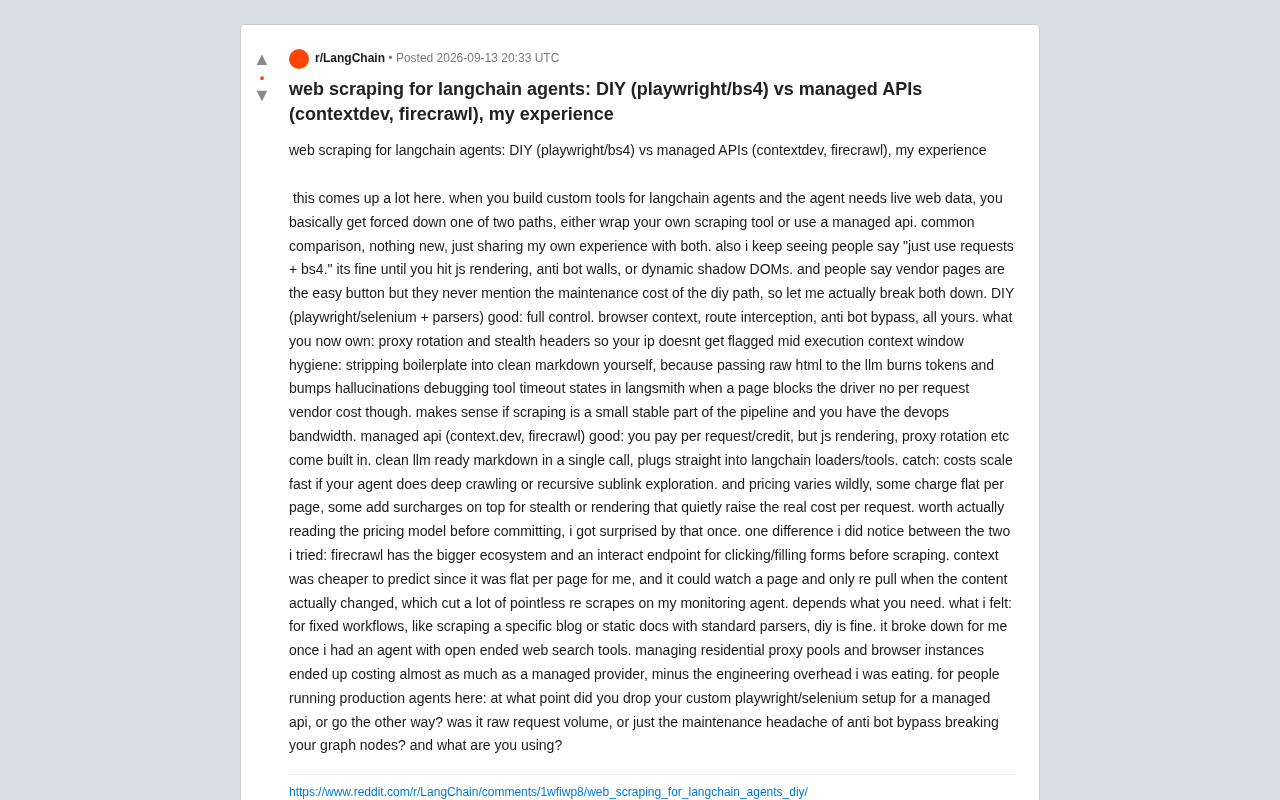
LangChain Agent Web Scraping: DIY vs. Managed API — A Practical Comparison
DIY scraping vs. managed APIs for LangChain Agents: compare Playwright/bs4 self-builds against Firecrawl and context.dev on cost, anti-bot maintenance, and when to switch.

YC's Latest Demo Day: The 9 Most Exciting Startups in VCs' Eyes
VCs spotlight 9 standout startups from YC's latest summer Demo Day, including floating reactors and brain chips — signaling a hard tech comeback in venture capital.

The Cambridge Analytica Scandal Revisited: The Privacy Questions Raised by Zuckerberg's 2017 Remarks
A retrospective on the Cambridge Analytica scandal and Zuckerberg's early remarks — tracing the data privacy controversy, platform accountability debates, and its lasting impact on tech industry governance.