Local Deployment of Qwen3-27B: The VRAM and Cost Trade-off Between Full Precision and Quantization

Qwen3-27B quantization guide: balancing VRAM, precision, and cost for local deployment at 1/50th of cloud API prices.
This article provides a deep comparison of Qwen3-27B local deployment options across quantization levels from 1Bit to 8Bit. A single RTX 4090 running 4Bit quantization achieves 49 tokens/sec with only 17GB VRAM, while dual RTX 3090s at 8Bit reach 75-80 tokens/sec with near-lossless quality. Local deployment costs approximately $2.7 per million tokens—50x cheaper than comparable cloud APIs like GPT-4.5—while keeping data fully private.
Alibaba's open-source Qwen3-27B (released in August) is a dense architecture model licensed under Apache 2.0. It supports free commercial use, custom weight modification, image and video multimodal understanding, and offers a native context length of 256K.
The term "Dense Architecture" means the model activates all 27 billion parameters during inference. In contrast, MoE (Mixture of Experts) architectures like Qwen3-235B have 235 billion total parameters but only activate about 22 billion per inference pass. Dense architectures offer more predictable model behavior, a more mature deployment toolchain, and more stable inference latency. The downside is that VRAM consumption is directly tied to parameter count — there's no way to "punch above your weight" like MoE can.
Apache 2.0 is one of the most permissive licenses in the open-source community, allowing users to freely use, modify, and distribute code and model weights — even integrating them into closed-source commercial products. The only requirement is preserving the original copyright notice and disclaimer. By choosing this license, Alibaba is essentially trading openness for community ecosystem growth and industry influence, dramatically lowering the legal barrier for enterprise adoption.
Yet the local deployment costs for the same model vary enormously — the full-precision version requires 55.6GB of VRAM, while the quantized version needs only 17GB. Is the difference really just about VRAM? This article breaks down the trade-offs between quantization levels, VRAM configurations, and operational costs.
One Model, Eight Configurations: From 8GB GPUs to Enterprise Servers
Although Qwen3-27B is a single model, its deployment options span an enormous hardware range — from consumer-grade 8GB GPUs to enterprise servers — with price differences that can reach astronomical proportions.
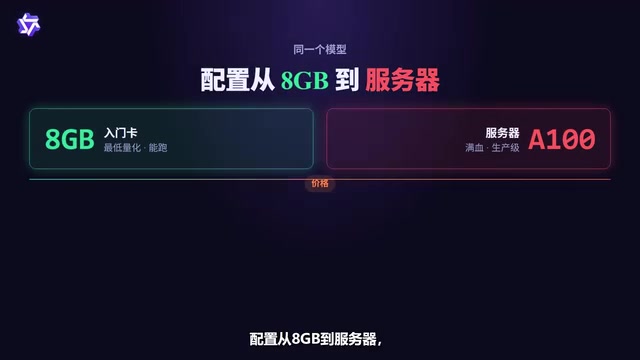
Deployment options can be roughly categorized by VRAM capacity:
- 8GB: Only enough for the lowest quantization level. It can boot but runs slowly — suitable only for experimentation;
- 16GB: Entry-level tier, just barely fits. Suitable for light usage;
- 24GB: The widely recognized "sweet spot." Running 4Bit quantization still leaves headroom. Best price-to-performance ratio;
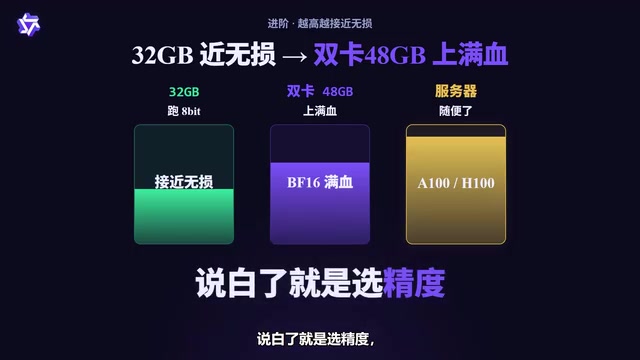
- 32GB: Can run 8Bit quantization with near-lossless quality;
- Dual-card 48GB: Can handle full-precision original weights;
- Server-grade: Deploy at will, no VRAM anxiety.
Note that the VRAM requirements discussed here primarily refer to loading the model weights themselves. In actual inference, there's another significant hidden cost — KV Cache (Key-Value Cache). The Transformer architecture needs to store Key and Value vectors for all previous tokens when generating each new token for attention computation. For a model like Qwen3-27B that supports 256K context, KV Cache can consume an additional tens of gigabytes of VRAM when processing long texts. This is why even when model weights are quantized to 17GB, you may still encounter out-of-memory issues with ultra-long contexts. Techniques like GQA (Grouped Query Attention) can effectively compress KV Cache, and the Qwen3 series employs similar optimizations.
As you can see, VRAM isn't the only variable — what truly determines the experience is how you choose to balance precision and cost.
Quantization Levels Explained: Precision and Size from 1Bit to 8Bit
Quantization is the core technology for local deployment of large models. It compresses model size by reducing the numerical precision of weights, dramatically lowering the VRAM threshold.
Technically speaking, Quantization converts neural network weights originally stored as high-precision floating-point numbers (such as FP16/BF16, 16 bits per parameter) into low-precision integer representations. With 4Bit quantization, for example, each parameter is compressed from 16 bits to 4 bits, theoretically reducing model file size to one-quarter of the original. Common quantization methods include GPTQ (layer-wise quantization based on second-order information), AWQ (Activation-aware Weight Quantization), and GGUF (the format used by llama.cpp, supporting CPU+GPU hybrid inference). The core challenge of quantization is maintaining output quality despite significant compression. Modern quantization algorithms use calibration datasets to minimize quantization error, allowing 4Bit quantized models to typically retain 90%-95% of the original precision's benchmark scores.
Qwen3-27B's quantization options come in multiple tiers, each corresponding to a different quality-resource balance point.
Mainstream Quantization Options Compared
- 1Bit quantization: Model size only 6GB, fits on an 8GB GPU. It "runs" but quality loss is significant — for experimentation only;
- 4Bit quantization: The current mainstream choice. Size shrinks to one-third of the original, VRAM threshold drops by roughly 2.5x, while inference quality loss is under 10% — this is the optimal landing point for the vast majority of individual users;
- 5Bit / 6Bit quantization: Better stability, quality further approaching original levels;
- 8Bit quantization: Near-lossless. File size around 29GB, requiring 32GB+ VRAM configurations.
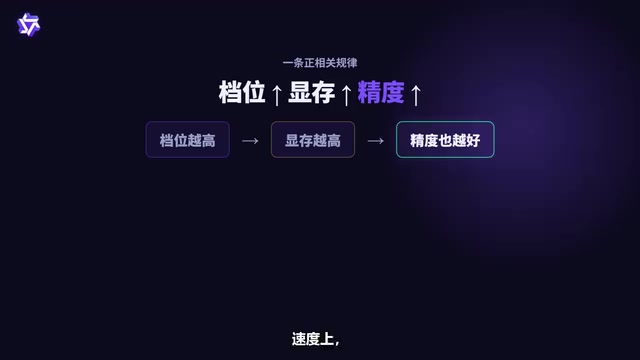
The pattern is clear: higher tiers require more VRAM and offer better precision, but may also affect speed. 4Bit has become mainstream precisely because it achieves the optimal balance among quality, VRAM, and speed.
Inference Speed Benchmarks: Single RTX 4090 vs Dual RTX 3090
Quantization affects not only VRAM and precision but also directly impacts inference speed. According to real-world benchmarks, generation speed varies significantly across hardware configurations.
- Single RTX 4090 running 4Bit: Approximately 49 tokens per second — responsive enough for both daily chat and coding tasks;
- Dual RTX 3090 running 8Bit: Approximately 75-80 tokens per second — not only near-lossless quality but actually faster.
This reveals an interesting phenomenon: higher quantization precision (8Bit) paired with stronger hardware (dual cards) can deliver both better output quality and competitive speed.
To understand this, you need to know about the performance bottleneck in large model inference. Autoregressive generation (token-by-token output) is a classic "memory-bandwidth-bound" task — generating each token requires reading all model weights from VRAM. The RTX 4090, based on the Ada Lovelace architecture, has 24GB GDDR6X VRAM with 1008 GB/s memory bandwidth. The RTX 3090, based on the Ampere architecture, also has 24GB GDDR6X with 936 GB/s bandwidth per card. Dual 3090s provide nearly double the total memory bandwidth (~1872 GB/s), far exceeding the single 4090's 1008 GB/s. Even though the 8Bit model (~29GB) is larger than the 4Bit version (~17GB), the dual-card solution's vastly superior data throughput more significantly accelerates the inference process.
For users who prioritize quality, the dual-card approach is worth considering.
Local Deployment vs Cloud API: A 50x Cost Difference
If VRAM and precision determine "can it run" and "how well does it run," then cost determines "is it worth running." This is the most fundamental distinction between local deployment and cloud APIs.
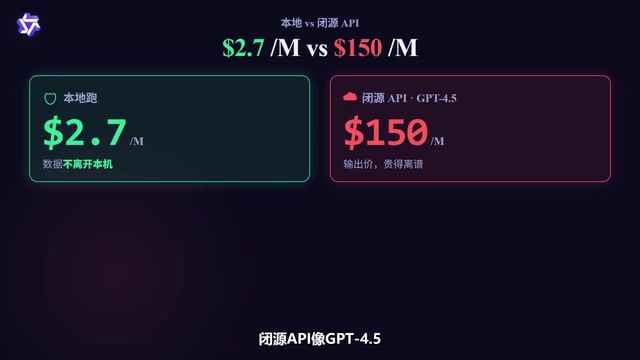
Cost Per Million Tokens Compared
- Local deployment: Approximately $2.7 per million tokens, with data never leaving your machine — extremely high privacy and security;
- Cloud API (comparable to GPT-4.5 level): Approximately $150 per million tokens.
That's a 50x difference.
Here it's worth explaining the "token economics" calculation. One token corresponds to roughly 0.7 English words or 0.5-1 Chinese characters. The local deployment cost of $2.7/million tokens primarily consists of electricity and hardware depreciation: with an RTX 4090 consuming approximately 450W, inference speed of 49 tokens/s, generating 1 million tokens takes about 5.7 hours, costing roughly $1 in electricity, plus amortized hardware cost based on 3-year depreciation. The GPT-4.5 API's $150/million tokens includes OpenAI's compute cluster, operations team, R&D investment amortization, and profit margins. For scenarios processing hundreds of thousands of tokens daily (customer service systems, content generation pipelines, code-assisted development), the cost advantage of local deployment becomes significant within months.
Additionally, data localization represents an invaluable benefit for enterprises and privacy-sensitive users that can't be measured in monetary terms. In regulated industries like finance, healthcare, and law, keeping data on-premises and off the cloud is often a hard compliance requirement.
Hardware Investment Reference
In terms of complete system costs:
- RTX 4090: Complete system under approximately 35,000 yuan (~$4,800);
- RTX 5090: Complete system in the 18,000 yuan (~$2,500) range;
- Dual-card setup: Complete system can be kept under 35,000 yuan (~$4,800).
For users with long-term, high-intensity LLM usage, this hardware investment can often pay for itself in saved API fees within a relatively short period.
How to Choose: Precision First or Budget First?
Overall, choosing a deployment configuration for Qwen3-27B is essentially a three-way trade-off between "precision, speed, and cost":
- If you pursue ultimate quality and are willing to invest more in hardware, choose 8Bit quantization or even full precision, paired with dual cards or a server;
- If you value convenience and cost-effectiveness, 24GB VRAM running 4Bit quantization is the sweet spot — perfectly adequate for daily use;
- If you just want to try it out, an 8GB GPU running 1Bit quantization can boot up, but don't set high expectations for quality.
A note on the 256K long context capability: this means the model can process approximately 200,000 Chinese characters or a medium-length novel in a single pass. It relies on RoPE (Rotary Position Embedding) and its extension methods (such as YaRN interpolation), allowing the model to train on shorter sequences while extrapolating to longer contexts during inference. Long context capability is crucial for code repository analysis, long document summarization, and complex multi-turn dialogue, but it also means KV Cache VRAM consumption grows linearly with context length — an additional factor to consider when choosing your deployment plan.
Open-source, free commercial use, customizable weights, native multimodal support, and 256K long context — Qwen3-27B provides ample freedom for local deployment. The final decision comes down to whether you value precision or saving money more. Would you spin up a server for precision, or go with 4Bit for convenience?
Related articles

Workbuddy for Absolute Beginners: How a Desktop AI Agent Fits Into Real Workflows
A beginner's guide to the Workbuddy desktop AI agent: installation, claiming credits, file management, and building automated workflows—compared with CodeX for fit and cost, helping professionals shift from AI question-askers to AI managers.

OpenAI's New Agent Stack: Computer Use, Decisions API, and Ultra-Fast Workflows
OpenAI Dev Day unveiled a new agent stack: Computer Use outperforms humans, Decisions API delivers ultra-low-latency classification via Luna, Agents API opens the same Computer Use capabilities, and GPT-6.1 Sol costs only one-seventh of Astra. Core updates, benchmark data, and developer insights.

Liang Wenfeng Open-Sources DeepInfo Inference Framework, Takes On U.S. Ban
DeepSeek open-sources its DeepInfo inference framework after its models, featuring GPU/CPU cross-pipelining, small-model prediction with large-model verification, and full Huawei Ascend and NVIDIA chip support—facing the U.S. federal ban head-on. This article analyzes its significance for AI deployment and open-source strategy.