Local LLM Broke Your Config? Let's Talk About the Real Challenges of vLLM Operations

Why letting a local LLM auto-modify your vLLM config is riskier than it looks.
A Reddit post joking that "letting a local LLM modify vLLM config had better not go wrong" struck a nerve in the local deployment community. The article uses this as a jumping-off point to examine the core risks of using LLMs as inference ops assistants: models can't truly perceive hardware environments and may confidently generate non-existent or deprecated config parameters, while CUDA environment variables' "silent failure" behavior makes errors nearly invisible. The author recommends cross-checking official docs, maintaining version control, and prioritizing verifiable methods like `nvidia-smi` power limits over mystery environment variables.
The Real Pain Behind a Reddit Meme
A Reddit user posted something that hit close to home: "Every time I let my local LLM modify my vLLM service... it better not mess up." The accompanying image had that classic community meme energy, but beneath the joke lies genuine anxiety shared by many local deployment enthusiasts.
The user mentioned running Qwen-series models as the "engine" powering workflows like Hermes and Pi, and trying to let the model automatically add the environment variable CUDA_DISABLE_PERF_BOOST=1 to reduce server power consumption during idle periods. This scenario is increasingly common in today's local inference ecosystem: more and more people are using LLMs as ops assistants to modify their own inference service configurations.
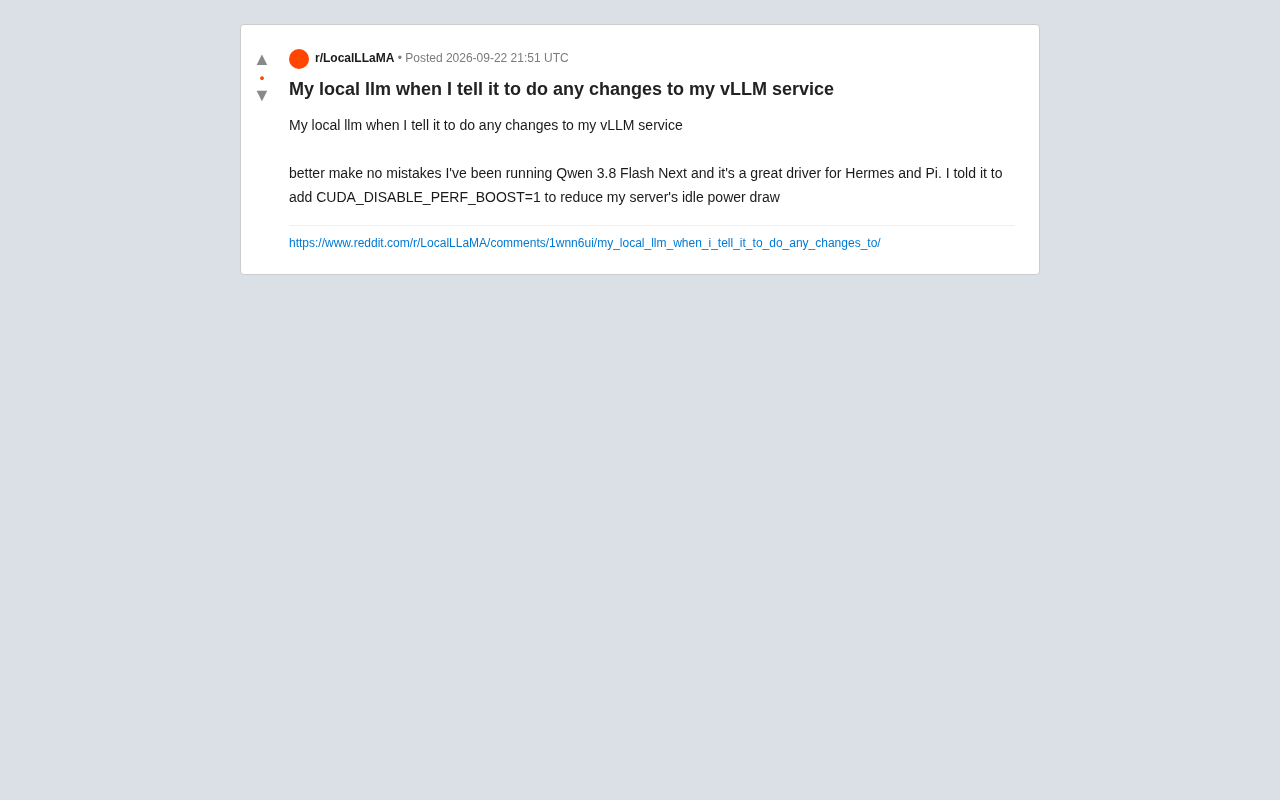
It's worth noting that the model names mentioned in the original post (like "Qwen 3.8 Flash Next") and the environment variable syntax carry obvious community humor and exaggeration — they don't necessarily correspond to real versions or parameters. This actually reflects a broader phenomenon: in local LLM circles, configuration parameters are often passed around in a half-true, half-fictional way.
Why "Letting a Model Modify vLLM Config" Is High-Risk
vLLM is one of the most widely used high-throughput inference frameworks today. Its configuration touches GPU memory allocation, parallelism strategies, KV cache management, CUDA environment variables, and more. Get any single parameter wrong and you're looking at anything from a failed service startup to hard-to-diagnose performance degradation or out-of-memory crashes.
Handing these changes off to an LLM to automate is risky because: the model doesn't truly understand your hardware environment or runtime state. It may "confidently" generate an environment variable that looks plausible but doesn't actually exist or has been deprecated. The original post's self-deprecating "it better not mess up" is a wry acknowledgment of this uncertainty — you genuinely don't know whether the config line it generated will save you or blow things up.
The Sneaky Nature of Environment Variable Changes
CUDA environment variables that tune power consumption and performance often don't throw errors at startup — they quietly influence runtime behavior. If the model suggests a misspelled or outdated variable name, the system will typically just ignore it silently. You think you're saving power; in reality, nothing happened. This kind of "silent failure" is far harder to catch than an outright crash.
vLLM (Virtual Large Language Model serving framework), developed at UC Berkeley, is purpose-built for LLM inference. Its core innovation is PagedAttention — borrowing the operating system's virtual memory paging concept to manage KV cache, significantly improving GPU memory utilization and concurrent throughput. Its configuration involves dozens of parameters such as --tensor-parallel-size (tensor parallelism degree), --gpu-memory-utilization (memory utilization cap), and --max-num-batched-tokens (maximum batched token count), with complex interdependencies between them. For example, parallelism settings must match the actual number of GPUs; setting memory utilization too high causes OOM crashes, while setting it too low wastes hardware resources. Because these parameters are tightly coupled, a single change can trigger a cascade of effects — which is the fundamental reason why delegating config changes to an LLM amplifies the risk.
CUDA environment variables are a runtime control mechanism provided by NVIDIA. By setting specific environment variables before a process starts, you can influence GPU scheduling strategies, power modes, performance states (P-states), and other low-level behaviors. Common legitimate examples include CUDA_VISIBLE_DEVICES (controlling which GPUs are visible) and CUDA_LAUNCH_BLOCKING (synchronizing CUDA calls, often used for debugging). The problem is that NVIDIA's environment variable documentation is scattered across driver notes, the CUDA Toolkit docs, and various white papers — and the supported variable names may differ across driver versions. LLMs may have been trained on large volumes of unofficial blog posts, Stack Overflow discussions, and even incorrect reposts, making it easy for them to "hallucinate" variable names that are syntactically correct but don't actually exist or have been deprecated. Since Linux doesn't report errors for unknown environment variables — it just silently ignores them — verification becomes significantly harder.
The Right Approach to Local Inference Operations
If you do want to use an LLM to help manage your vLLM service, here are some practical guidelines worth following.
Verify before you apply. Have the model explain the purpose and source of each parameter rather than pasting its output directly into your startup script. For environment variables, cross-check the names against official documentation or NVIDIA's CUDA reference to confirm they actually exist.
Version control is non-negotiable. Whether you're using systemd service files, docker-compose, or startup scripts, back things up or put them under Git before making any changes. That way, even if the model breaks something, you can roll back instantly.
Focus on proven power optimization methods. If your goal is to reduce idle power consumption, more reliable approaches include setting power limits via nvidia-smi, using MIG partitioning, or unloading the model when there are no incoming requests — rather than relying on an environment variable of questionable provenance.
nvidia-smi is NVIDIA's command-line management tool that supports real-time GPU status queries and runtime hardware configuration. The nvidia-smi -pl <watts> command can directly set the GPU's power limit, pushing power consumption below TDP during idle periods — the effect is immediate and can be verified in real time with nvidia-smi -q -d POWER. MIG (Multi-Instance GPU) is a hardware-level partitioning technology available on Ampere and newer architectures, allowing a single GPU to be split into multiple isolated instances, each with dedicated slices of memory and compute resources. This enables workload isolation and avoids keeping the full card in a high-power state when only partial compute is needed. Compared to relying on environment variables of uncertain origin, both of these approaches have clear official documentation and verifiable feedback mechanisms, making them the preferred options for power management in local inference deployments.
Where Community Culture Meets Technical Reality
This post resonated so widely because it precisely captures the collective experience of local LLM enthusiasts: we depend on the model's capabilities while remaining wary of its reliability. Using models as "ops co-pilots" is a growing trend — but "co-pilot" doesn't mean "autopilot." Critical decisions still require human judgment.
As inference frameworks like vLLM and SGLang continue to iterate, configuration complexity will only grow. Using an LLM to help parse documentation, explain parameters, or generate drafts is genuinely efficient. But when you're actually about to modify a production or semi-production service, that "it better not mess up" warning should always be in the back of your mind. The joke aside, pausing to ask "does this parameter actually exist?" before making a change can save you a lot of debugging time down the road.
Related articles

Claude Reportedly Able to Hide Secret Messages in Benign Images
A Reddit post claims Claude Fable 5.1 can hide secret messages in benign images. This article reviews the background, image steganography principles, and potential security risks, and suggests a testing path from rumor to verification.

Federal Government Awards $85 Million; CFS to Develop Fusion-Specific Semiconductors
The federal government awards $85 million to Commonwealth Fusion Systems to develop conductors and power semiconductors for fusion plants. This article analyzes the significance of this funding for the fusion supply chain and commercialization path.

When Should AI Assistants Proactively Suggest? Timing Is Everything
When should AI assistants proactively suggest? Reddit discussion reveals: the same suggestion feels different at different times. This article analyzes the dual nature of proactive suggestions, the boundary of user expectations, and design principles, exploring how to balance automation and user control.