Local LLM Controls Robotic Arm: General-Purpose Manipulation via Plain English Commands
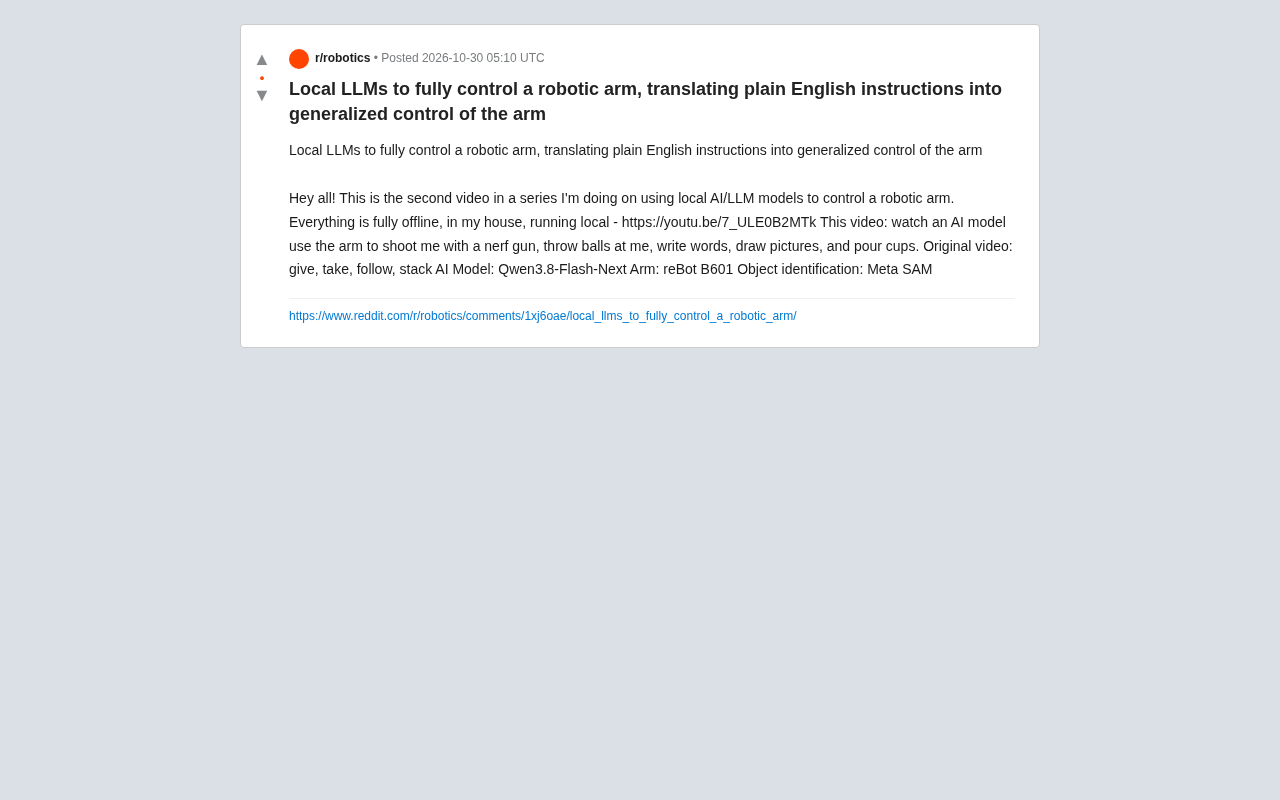
A developer uses a local LLM plus SAM to control a robotic arm offline, turning English commands into shooting, writing, and pouring actions.
A developer demonstrated a fully offline local AI robotic arm control system: Qwen3.8-Flash-Next parses English instructions into high-level action plans, Meta SAM recognizes and localizes objects, and the reBot B601 executes physical operations. Expanding from basic give, take, follow, and stack actions to complex tasks like Nerf-gun shooting, ball throwing, writing, drawing, and pouring water, it shows the LLM's potential to map abstract language into concrete action sequences. All computation runs locally, suiting privacy- and latency-sensitive scenarios. Yet the project is still experimental, with generalization, robustness, and quantitative metrics like success rates still unverified.
From Natural Language to Robotic Arm Actions: A Practical Case of Local LLM-Based General Control
A developer shared his project on Reddit: a fully offline local AI model controlling a robotic arm, translating simple English instructions into a series of general-purpose operations. In a newly released video, the AI model pilots the robotic arm to shoot a Nerf gun, throw a ball, write, draw, and even pour water. This marks an intriguing step forward for local LLMs in the field of robot control.
Hardware and Model Combination
The AI model used in the project is Qwen3.8-Flash-Next, the robotic arm is a reBot B601, and object recognition relies on Meta SAM (Segment Anything Model). All computation is performed locally, with no cloud connection required, ensuring privacy and real-time responsiveness. The developer emphasizes that the entire system runs fully offline and can be reproduced at home.
Qwen3.8-Flash-Next is a lightweight model variant in Alibaba's Tongyi Qianwen series (the "3.8-Flash" naming in the original text likely corresponds to the Flash version of the Qwen3 series; refer to the publisher for the exact model designation). It focuses on low latency and local deployment capability. Compared with flagship models that often weigh in at tens of gigabytes, such Flash versions can run on consumer-grade GPUs or even edge devices thanks to smaller parameter counts and inference optimizations — which is precisely the prerequisite for this project to run "fully offline." It should be noted that the language model itself does not directly output motor torques or joint angles; what it generates is high-level action planning (for example, a sequence of steps such as "move next to the cup — grasp — tilt — return"), which is then translated by low-level motion control or a library of taught motions into trajectories the robotic arm can execute. Therefore, "LLM controlling a robotic arm" is essentially the LLM acting as a task planner rather than performing direct servo control.
Transformation from Instructions to Actions
The first part of the video series shows the robotic arm performing basic actions such as give, take, follow, and stack. In the second video, the capabilities are further extended: the AI can understand more complex English instructions such as "shoot me with a nerf gun," "throw balls at me," "write words," "draw pictures," and "pour cups," and controls the robotic arm to complete the corresponding tasks. This demonstrates the LLM's potential for mapping abstract language onto concrete action sequences.
Synergy of the Tech Stack
Qwen3.8-Flash-Next, as the language model, is responsible for parsing natural language instructions and generating high-level action plans; Meta SAM is used to recognize objects in the scene and provide visual localization for the robotic arm. The reBot B601 serves as the actuation mechanism, completing precise physical operations. The combination of the three forms a closed loop from perception to decision-making to execution.
Meta SAM (Segment Anything Model) is a general-purpose image segmentation foundation model released by Meta in 2023. It can segment arbitrary target objects in an image based on point, box, or text prompts without retraining for specific categories. In robotics scenarios, the value of SAM lies in grounding linguistic references such as "cup" and "ball" onto specific pixel regions in the image, which are then combined with depth information to compute the object's 3D position for the robotic arm to localize and grasp. However, SAM only solves "where" — not "what" and "how to grasp" — so it is often used in conjunction with object detection models or vision-language models. The "visual localization" mentioned in the original text is handled by this component, which serves as the key bridge between language instructions and physical operations.
Significance and Limitations
This project demonstrates the feasibility of local LLMs in robot control, and is particularly well suited to scenarios that are sensitive to privacy and latency. However, the system is still at an experimental stage, and the generalization ability and robustness of its actions remain to be further validated. The developer has demonstrated a variety of tasks through videos but has not yet provided detailed performance metrics or error-rate data.
Action generalization capability is a core metric for evaluating such systems, typically referring to the degree to which a model can still complete tasks when faced with objects, instruction phrasings, and scene layouts that did not appear during training or teaching. The advantage brought by LLMs is semantic generalization — different phrasings of the same intent (such as "throw the ball to me" and "toss me the ball") can be mapped to similar action sequences. However, it cannot automatically guarantee physical-level generalization; for example, variations in object size, friction, and lighting can all cause grasping failures. Robustness concerns the system's stability under disturbances and errors, including visual recognition deviation, robotic arm repeat-positioning error, and instruction ambiguity. This is also why the original text emphasizes that "no performance metrics or error-rate data have yet been provided": video demonstrations can prove feasibility, but only quantitative data such as success rates and task completion times can show how far the system is from practical use.
Future Outlook
With improvements in local model capabilities and the growing adoption of robotic hardware, similar systems are expected to find applications in home services, education, scientific research, and other fields. The developer says he will continue to explore more complex tasks and optimize the accuracy of instruction understanding.
One-line Summary
A developer uses a local LLM plus SAM to control a robotic arm offline, turning English instructions into actions such as shooting, writing, and pouring water.
Paragraph Summary
A developer demonstrated a fully offline local AI robotic arm control system: Qwen3.8-Flash-Next serves as the language model to parse English instructions and generate high-level action plans, Meta SAM handles object recognition and localization, and the reBot B601 robotic arm performs the physical operations. The system has expanded from early basic actions such as give, take, follow, and stack to complex tasks including shooting a Nerf gun, throwing balls, writing, drawing, and pouring water, demonstrating the LLM's potential to map abstract language into concrete action sequences. All computation is performed locally, making it suitable for privacy- and low-latency-sensitive scenarios. However, the project is still at an experimental stage; generalization ability and robustness remain to be validated, and quantitative metrics such as success rates are lacking.
Related articles

After Affirmative Action Ends: Sharp Drop in Black Enrollment and the Rise of HBCUs
After the Supreme Court ended race-conscious admissions, Black freshman enrollment at the top 50 most selective universities fell 27%, with Harvard dropping from 18% to 11.5% and Yale from 9.5% to 8%, as more Black students turn to HBCUs.

Claude Rolls Out Watermarking Across the Board: Paid Users Can't Opt Out, But Only a Select Few Can Detect It
Anthropic extends Claude's invisible text watermark to Mythos 5, Opus 4.7 and more, globally and with no paid opt-out. Even proofreading and translation get marked, yet detection is limited to regulators and enterprises.
Apple AI Finally Enters China: iOS 27.3 Brings Apple Intelligence to the Chinese Market
Apple announces Apple Intelligence will enter China with iOS 27.3, beta on November 4, official release in December. This article analyzes the feature trade-offs, localization logic, and the practical impact on users and developers.