Local LLM Selection Rules: Redefining Efficiency Standards Using Human Labor Cost as a Benchmark
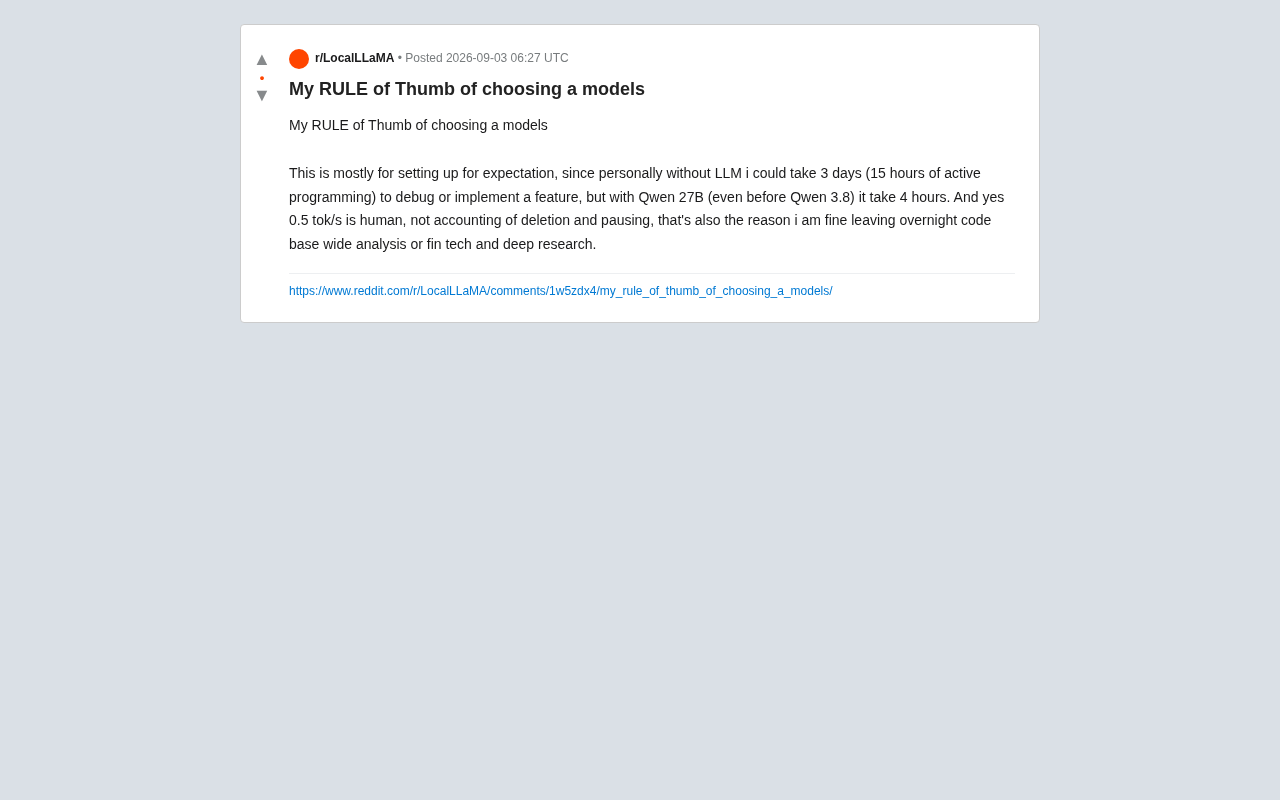
Redefine local LLM selection by benchmarking against human labor costs, not raw speed metrics.
A developer shares a pragmatic rule of thumb for local LLM selection: benchmark model efficiency against human labor costs rather than raw speed. Using Qwen 27B, a 15-hour coding task was reduced to 4 hours. By leveraging asynchronous workflows for overnight tasks like codebase analysis and deep research, slow inference speeds become a non-issue. The key insight: managing expectations and matching models to task types matters more than chasing peak performance.
Introduction: A Developer's Real-World Experience
In an era flooded with AI coding tools, choosing the right large language model (LLM) for your development workflow has become a practical challenge for many tech professionals. Recently, a Reddit developer shared his "rule of thumb for model selection," and the core insight is simple yet profoundly instructive: Model selection is fundamentally about managing efficiency expectations.
Behind this seemingly brief post lies a deeper question about the value proposition of locally deployed LLMs in real development scenarios — it's not about chasing peak performance metrics, but about finding the balance between human labor costs and machine efficiency.
Efficiency Comparison: Human Labor Cost vs. Local LLM Assistance
Quantifying the Time Cost Difference
This developer used a very specific set of numbers to illustrate the real-world value of local LLMs. Without LLM assistance, debugging or implementing a feature might require:
- 3 days of calendar time
- About 15 hours of actual coding time
After introducing Qwen 27B (even versions before Qwen 3.8), the same task could be completed in just 4 hours. That's nearly a 4x efficiency gain.
This quantitative comparison is compelling because it doesn't stop at the abstract level of "AI is useful" — it translates the time savings into concrete work scenarios. For independent developers or small teams, this time compression directly translates into faster project progress and delivery capability.
Rethinking the "0.5 tok/s" Inference Speed
The post raises an intriguing point: a generation speed of 0.5 tokens per second is actually comparable to human thinking and output speed.
This is a rarely discussed but critically important perspective. When evaluating local models, many people immediately give up because of slow inference speeds. But the author reminds us: if you compare the model's output speed to the actual speed at which humans write code (factoring in deleting, pausing, and thinking), a slow model may not be as unacceptable as it seems.
In other words, the "good enough" standard for speed should be anchored to the human labor efficiency it replaces, not to the pursuit of real-time interactive fluency.
Asynchronous Workflows: Making Slow Local Models Deliver Value
The Hidden Value of Background Tasks
Based on this reframing of speed, the author proposes a pragmatic usage strategy: make time-consuming tasks asynchronous.
He explicitly states that he's happy to leave the following types of tasks for the model to "run overnight":
- Codebase-wide analysis
- Complex fintech calculations
- Deep research tasks
This "submit before bed, collect results in the morning" workflow cleverly sidesteps the slow-speed limitation of local models. When a task doesn't require immediate feedback, having the model churn away for a few hours has virtually no impact on the developer's actual experience — because that time would have been rest time anyway.
Use Case Determines Model Selection Strategy
This implies a deeper selection logic: different tasks have fundamentally different requirements for a model.
For tasks requiring real-time interaction like code completion and quick Q&A, speed is a hard requirement. But for deep analysis tasks that can be batch-processed in the background, the model's reasoning depth and context comprehension are what matter — speed can be compromised. Understanding this is the key to building a sound local LLM selection framework.
The Core Rule of Thumb: Expectation Management Determines Selection Success
Expectation Management Is the Prerequisite for Model Selection
The author repeatedly emphasizes that his approach is "mainly about setting up for expectation." This statement cuts to the most overlooked aspect of model selection.
Many developers feel disappointed when using LLMs, not because the models aren't good enough, but because of misaligned expectations — judging a locally deployed mid-sized model by the standards of commercial API-level response speeds is a recipe for disappointment.
The right approach is:
- Clarify the task type: Does it require real-time interaction, or can it be processed asynchronously?
- Anchor to the human labor baseline: How much time does the model save compared to doing it manually?
- Accept reasonable trade-offs: Within an acceptable time cost, is the model providing effective assistance?
Qwen 27B: A Practical Choice Among Open-Source Local Models
You may have noticed that the author chose Qwen 27B, an open-source model. Mid-sized open-source LLMs like this sit right at the sweet spot of "sufficient capability, locally deployable, and cost-effective."
For developers who prioritize data privacy and want to break free from cloud API dependency, a locally running open-source model paired with a well-designed asynchronous workflow can handle a wide range of real development tasks. This is also a key reason why the local LLM ecosystem is becoming increasingly vibrant.
Conclusion: A Pragmatic Approach to Local LLM Selection
Although brief, this developer's post conveys an extremely pragmatic philosophy for using AI tools:
- Don't blindly chase the most powerful model — match the right tool to the task;
- Don't obsess over speed benchmarks — use human labor efficiency as the measuring standard;
- Leverage asynchronous workflows — turn a slow model's weakness into the advantage of "overnight work."
In an era of rapidly iterating AI coding tools, this approach — grounded in real-world needs and focused on expectation management — may be more valuable than endlessly chasing the latest and greatest models. True efficiency gains come from deeply understanding your tools' characteristics and applying them appropriately.
Related articles

Chain of Thought Isn't Just for AI: How Humans Can Use CoT to Improve Thinking Quality
Chain of Thought isn't just a prompt trick for large models. Starting from a Hacker News discussion, this article analyzes why CoT works for human thinking too, breaks down actionable ways to transfer it, and highlights the key differences between human CoT and machine CoT.
Cloudflare Teams Up with OpenAI: Closi…
Cloudflare Teams Up with OpenAI: Closing the Loop from Vulnerability Discovery to Defense with AI
Cloudflare uses OpenAI Daybreak to investigate security vulnerabilities and generate reviewable remediation plans, while developers use Codex to boost coding efficiency and quality.

Orca Multi-Agent Orchestration in Practice: A Guide to Parallel Collaboration with Claude and Codex
Orca is Stable AI's free open-source agent workbench supporting 34 agents like Claude Code and Codex in parallel. Learn its Git worktree isolation, multi-model orchestration, and mobile management.