Local Models Can Create Too: Qwen 27B Generates Motion Graphics on a 4090

Qwen 27B on a single RTX 4090 generates motion graphics to rival cloud-based Opus 5.5.
A Reddit user demonstrated that Qwen 27B, an open-source model running locally on a consumer RTX 4090, can generate motion graphics comparable to the cloud-based Anthropic Opus 5.5 that's been trending on social media. The full prompt and pipeline were open-sourced in a project called accuretta. The case highlights a core tension in AI applications: cloud models offer superior compute and stability, while local open-source solutions win on cost, privacy, and customizability. As open-source capabilities continue to improve, the gap between the two approaches is steadily closing.
Local LLM Takes on Cloud-Based Opus 5.5
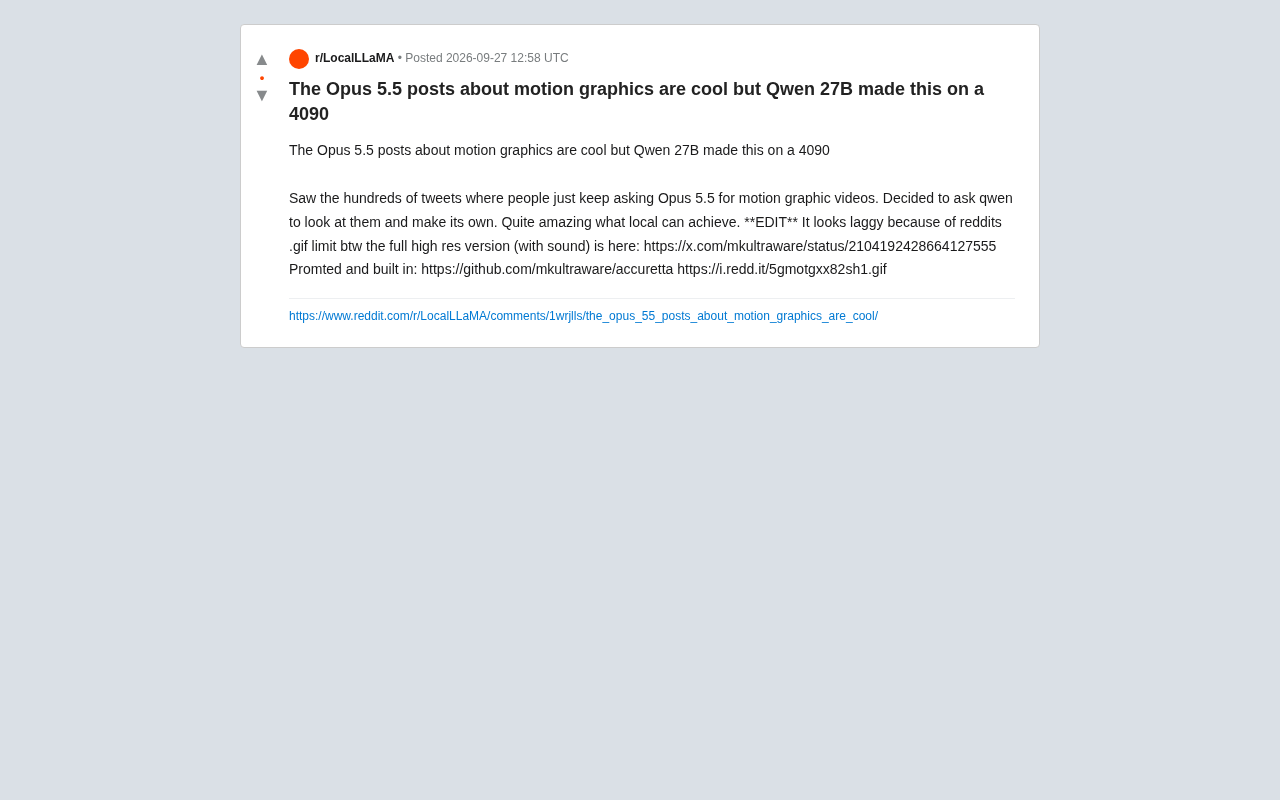
Social media has been buzzing lately with posts about Anthropic's Opus 5.5 generating motion graphics — hundreds of tweets showing off polished animations made with this cloud-hosted model. But one Reddit user decided to explore a different angle: open-source models running locally can pull off something similar.
Instead of relying on a paid cloud API, this user had Qwen 27B "observe" examples of Opus 5.5-generated work and then produce its own motion graphics independently. The entire process ran on a single consumer-grade NVIDIA RTX 4090, demonstrating that local inference has real potential for creative content generation.
What Consumer Hardware Can Actually Do
The most striking aspect of this demo is that it ran entirely on a single RTX 4090. Compared to commercial models that typically require large cloud clusters, being able to generate quality motion graphics on a single consumer GPU means more individual developers and creators can do this kind of work locally — without ongoing API costs or data privacy concerns.
The author noted that the GIF version posted on Reddit looks choppy due to format limitations and doesn't represent the actual output well. The full HD version with audio is available on an external platform and better reflects the real results. This is a useful reminder that platform-level media compression can significantly undercut perceived quality — always refer to the original source when evaluating model capabilities.
The RTX 4090, released by NVIDIA in 2022, features 24GB of GDDR6X VRAM — one of the highest VRAM capacities available on a single consumer card. For running large language models locally, VRAM is the key bottleneck. A model at Qwen 27B's parameter scale requires roughly 14–18GB of VRAM when loaded with 4-bit quantization, which fits within the RTX 4090's capacity. Higher precision (e.g., 16-bit) would exceed a single card's limits, requiring multi-GPU setups or professional hardware. This explains why the ~27B parameter range has become the sweet spot for "consumer-runnable" models — the next tier up (70B+) typically requires two 4090s or professional-grade cards even with quantization.
An Open-Source Workflow Behind the Scenes
The author published both the prompts and the full pipeline used for this generation in an open-source project called accuretta. Making the creative process transparent means the community can not only see the results but also reproduce and improve upon the entire workflow.
For developers following AI creative tooling, the value of projects like this lies in lowering the barrier to entry. Anyone with compatible hardware can download the code, tweak the prompts, and explore the limits of local models for motion graphics. This kind of openness and reproducibility is one of the defining advantages of the local AI ecosystem over closed commercial models.
Motion graphics represent a relatively complex task in AI generation — they require not only visual aesthetics but also temporally coherent animation logic. The most common local implementation path today works like this: a large language model generates code that describes the animation (using tools like Python-based Manim, Three.js, or SVG animation scripts), which is then executed by a rendering engine and output as video. This is fundamentally different from diffusion model approaches that generate pixel frames directly. The code-generation path produces cleaner, editable output, and the VRAM load is concentrated in the language model inference stage rather than image generation. Understanding this distinction helps explain why a 27B language model can accomplish what looks like "video generation."
The Ongoing Debate: Cloud vs. Local
This case reflects a persistent tension in today's AI application landscape: cloud-based commercial models offer more stable, higher-quality outputs backed by massive compute and optimization; local open-source models win on cost, privacy, and control. As open-source model capabilities continue to close the gap with commercial products, the divide is narrowing.
That said, a single community demo isn't enough to declare that local solutions have fully caught up with the cloud. Output quality, generation consistency, and scalability all need more validation. But experiments like this at least point to a clear trend — running open-source models on consumer hardware to accomplish creative tasks is moving from concept to reality.
For individual users with limited budgets who want to explore AI-driven creative generation, the local route is worth trying. For professional use cases where maximum quality and reliability are non-negotiable, cloud models still hold their ground. Which path to take ultimately comes down to your specific priorities and trade-offs.
Related articles

JobRunner MCP Server: AI Agents Can Now Fix Failed Java Jobs
JobRunner launches an open-source MCP server enabling AI agents to view cluster status, diagnose failures, and recover Java jobs—incident response from any cloud coding environment or existing agent.

MLAI Digital Launches 9 Security Agents: MCP Server Safeguards the Full Lifecycle of Agentic AI
MLAI Digital launches Security MCP Server with nine built-in specialized security agents covering vulnerability discovery, attack simulation, prompt injection detection, API and infrastructure assessment, and accelerated remediation—embedding security validation across the full Agentic AI lifecycle from development to production.

Running Isaac Lab on H100 GPUs: Exploring Better Approaches
Exploring optimization methods for running Isaac Lab on NVIDIA H100 GPUs, including MIG configuration, mixed precision, TensorRT acceleration, and community experience to improve robotics simulation and reinforcement learning efficiency.