Local Pretrained Classifiers Without a GPU: A Leaner Approach to AI Deployment

Local pretrained classifiers run on CPU alone, tackling structured classification tasks at low cost and complexity.
A project called "Local pretrained classifiers, GPU not needed" argues that structured tasks like sentiment analysis, content moderation, and intent recognition don't require generative large models — lightweight pretrained classifiers running on ordinary CPUs are sufficient. The key advantages are lower hardware costs, simpler deployment, data privacy, and stable local inference latency, making it well-suited for small teams and compliance-sensitive use cases. The trade-off is clear: fixed category schemas mean new domains may still require fine-tuning, and the approach can't replace large models for complex semantic tasks. The project reflects a growing trend of matching AI tools to task complexity rather than defaulting to the largest model available.
Why Local Classifiers Matter
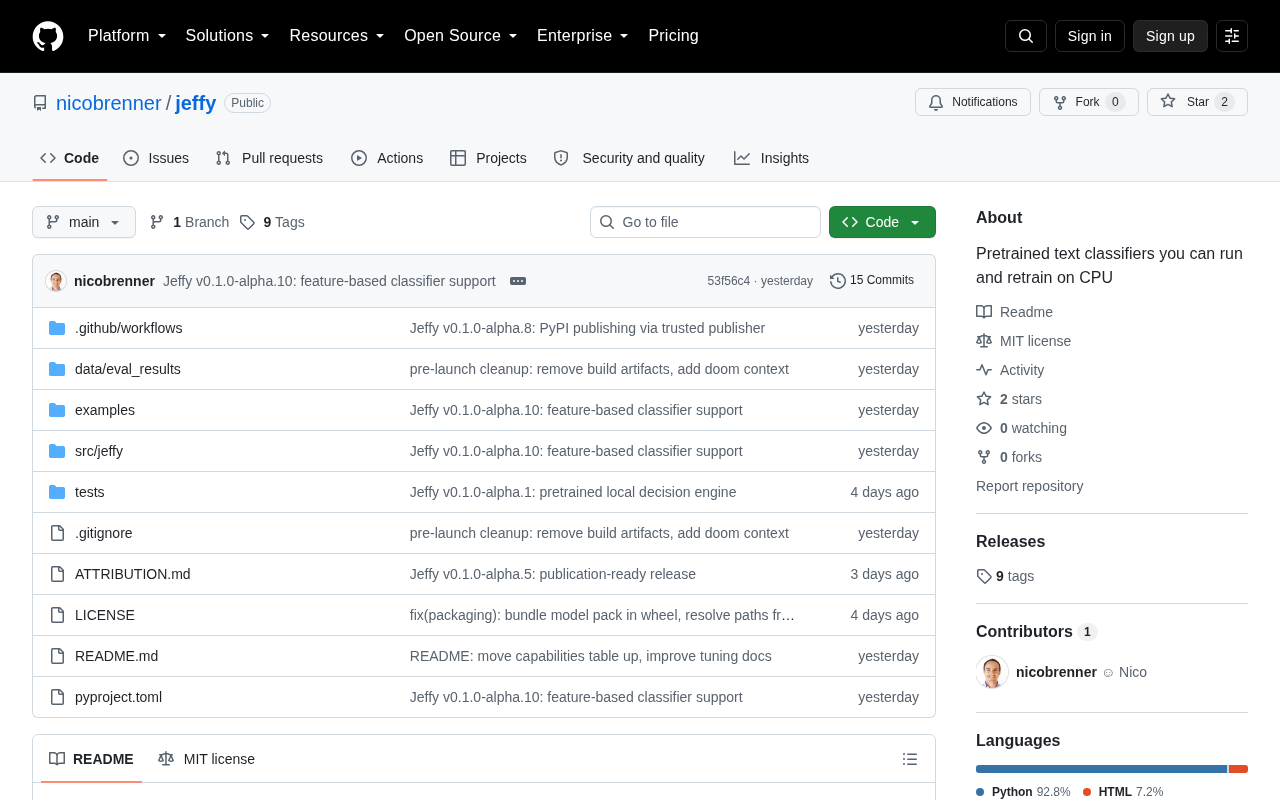
At a time when large language models dominate the conversation, a project called "Local pretrained classifiers, GPU not needed" appeared on Hacker News with a message that cuts against the grain: not every AI task requires a massive model and an expensive GPU. This Show HN project focuses on locally-run pretrained classifiers that can handle text and data classification tasks without any GPU at all.
For many real-world business scenarios, the core requirement is simply "put this input into the right category" — think sentiment analysis, spam filtering, intent recognition, or content tagging. These tasks don't need the complex reasoning capabilities of generative large models. A well-trained lightweight classifier is often more efficient and easier to control.
The Technical Value of Going GPU-Free
The project's most compelling selling point is "GPU not needed." This means developers can run classification models directly on an ordinary laptop, server, or even an edge device — no graphics card or cloud GPU instance required.
This design delivers several concrete benefits:
- Lower cost: Eliminates the high expense of GPU cloud instances; CPU inference is sufficient.
- Simpler deployment: No need to configure complex CUDA environments or driver dependencies, lowering the engineering barrier.
- Privacy control: The model runs locally, so data never needs to be sent to a third-party API — ideal for compliance-sensitive use cases.
- Stable latency: Local inference removes network round-trips, making response times more predictable.
For small-to-medium teams and independent developers, this "good enough" lightweight approach is often far more practical than chasing the biggest and newest models.
From a technical standpoint, "no GPU required" typically relies on one of two approaches. The first uses classical machine learning methods — logistic regression, SVM, Naive Bayes — combined with precomputed text features like TF-IDF or fixed word vectors. These models have extremely small parameter counts and can achieve CPU inference latency in the milliseconds. The second uses lightweight neural architectures such as DistilBERT or edge-optimized models, compressed via knowledge distillation, quantization (INT8/FP16), and similar techniques to bring parameter counts well below the tens of millions, reaching acceptable inference speeds on CPU. By contrast, GPT-series models typically have billions to hundreds of billions of parameters, making real-time CPU inference impractical even with optimization. Understanding this technical context helps set realistic expectations for what local classifiers can and cannot do.
Use Cases and Limitations
Pretrained classifiers have a clear positioning: they solve structured classification problems, not open-ended generation tasks. They're designed to be embedded into existing workflows as a plug-and-play decision module.
Typical applications include:
Content Moderation and Filtering
Rapidly classify user-submitted text to detect spam, policy violations, or specific topics — without invoking a heavy model.
Data Labeling and Categorization
Automatically tag data during preprocessing, reducing manual effort for downstream analysis or model training.
Intent Recognition
Quickly determine user intent in customer service or chatbot scenarios to drive the next step in processing logic.
That said, the limitations of this approach are equally clear. Pretrained classifiers are typically built around a fixed category schema. When facing entirely new domains or highly specialized tasks, fine-tuning or even retraining may still be necessary. They cannot replace large models for complex semantic understanding and generation — instead, they fill a complementary role, handling everyday tasks at a fraction of the cost where a large model would be overkill.
It's worth clarifying what "pretrained" means in this context: the model has already been trained on large-scale general-purpose corpora, giving it a foundational understanding of language that users can leverage out of the box. This is distinct from zero-shot classification and few-shot learning. Zero-shot classifiers (such as those based on CLIP or NLI) let users describe categories in natural language for greater flexibility, but generally require larger base models. Pretrained classifiers, by contrast, typically have a fixed output layer for predefined categories — lower barrier to use, faster inference, but requiring fine-tuning when migrating to new categories. For use cases with stable category sets and sufficient data, pretrained classifiers often offer a better cost-to-performance ratio than more general-purpose approaches.
A Rational Choice in the Era of Lightweight AI
From an industry perspective, projects like this reflect a broader trend toward layered AI engineering. Not every problem needs the largest available model — a well-designed architecture should match the right tool to the complexity of each task. Local pretrained classifiers are a natural product of this cost-versus-effectiveness thinking.
It's worth noting that this project currently has limited traction on Hacker News (only 4 points and no comments at the time of writing), and details such as model architecture, supported classification types, and accuracy benchmarks have not been fully documented. Developers interested in adopting it should run validation tests against their own tasks before committing to it.
Regardless, the philosophy it represents — local-first, no GPU required — offers a compelling alternative path for teams struggling with cloud GPU costs and deployment complexity.
Related articles

Felix Rieseberg Personal Homepage
Felix Rieseberg's personal homepage sparks attention on Hacker News. This article covers the Slack engineer's technical background, the rise and fall of nativefier, and the value of a developer homepage as a tech calling card.

@ai-sdk/vue 3.0.306 Patch Release Syncs with [email protected] Update
@ai-sdk/vue 3.0.306 released, synced with [email protected]. A routine patch release for the Vercel AI SDK ecosystem with no public API changes; the Vue adapter layer stays version-aligned with the core package.

Gemini 4 Argon API Launches: The Era of Million-Token Output Begins
Google launches Gemini 4 Argon with sparse MoE architecture, up to 1M output tokens, and a 68.90% Vals Index score, available across API, AI Studio, and the Gemini app.