LocModel: The Local AI Deployment Powerhouse — Run Open-Source Models and AI Generation with One Click
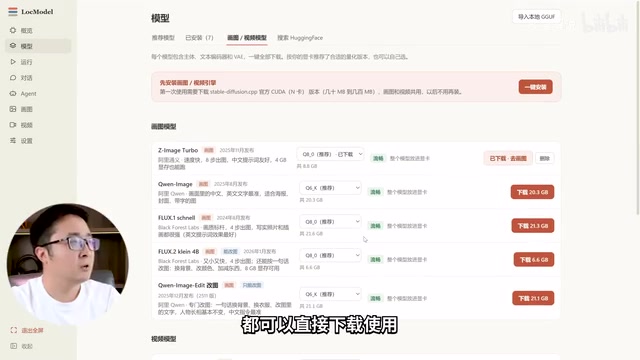
LocModel lowers the local AI barrier with hardware auto-adaptation and memory loading; image/video generation and Agents tested and usable.
This article introduces LocModel, a local AI deployment tool. It auto-detects hardware and recommends compatible open-source models from Hugging Face, supports NVIDIA/AMD/Intel GPUs and pure CPU, and uses memory/disk loading to offset insufficient VRAM. Hands-on tests show instant image generation, improved image editing with dedicated models, usable image-to-video, uncensored LLM imports, and a built-in Agent that writes webpages and games offline, significantly lowering the local AI entry barrier.
In an era where cloud AI services are everywhere, content moderation, subscription fees, and privacy concerns remain unavoidable topics. A Bilibili creator named "零度解说" (Zero Degree Commentary) recently shared a local AI deployment tool called LocModel, which claims to let ordinary users run open-source large language models, image generation, video generation, and even Agent intelligences on their own computers for free — truly achieving "AI freedom."
What Is LocModel? Hardware Adaptation Is Its Biggest Highlight
LocModel's core positioning is a "local AI deployment powerhouse." According to the video, its standout feature is the ability to automatically detect your computer's hardware configuration and recommend the most suitable AI models accordingly — the model library connects directly to Hugging Face and covers large language models, image models, and video models.
More practically, it supports memory and disk loading. This means that even if your GPU's VRAM is insufficient, users can rely on RAM or disk to "brute-force" model execution. The official claims support for NVIDIA GPUs, AMD GPUs, Intel GPUs, and pure CPU invocation — a fairly broad coverage. For users whose devices aren't top-tier but who still want to run AI locally, this design lowers the barrier to entry.
Quantization is a core concept that can't be avoided when deploying large models locally. Simply put, it compresses model weights from high precision (e.g., FP16, where each parameter takes 2 bytes) to low-precision integers (e.g., INT8, INT4), thereby greatly reducing VRAM usage and computation. The "Q8" and "Q6" mentioned in the article refer to 8-bit and 6-bit quantization; the smaller the number, the smaller and faster the model, but the greater the precision loss. Quantization allows consumer-grade GPUs and even CPUs to run large models that would otherwise require data-center-grade hardware — this is the technical foundation that enables LocModel's "hardware-adaptive recommendations."
Hugging Face is the world's largest open-source AI model community, hosting hundreds of thousands of pre-trained models, datasets, and inference tools. LocModel's model library connects directly to Hugging Face, meaning users can access various open-source models continuously updated by the community. Note that model quality on Hugging Face varies widely, and some models have commercial restrictions or safety moderation policies — you should check the license agreement and usage notes in the Model Card before downloading.
Installation and Model Recommendations: A Fully Automated Onboarding Process
The installation process demonstrated in the video is quite simple: download from the official website, extract, and install with default settings. Opening the software automatically identifies your current hardware and lists recommended models. The models users see all come from Hugging Face, including JImage, Chainwell, and video generation models like Minimax, which can be downloaded and used directly.
Before generating content, you need to install the image and video inference engines first. The creator uses an NVIDIA GPU, so the software recommended the corresponding engine; AMD or Intel GPU users just click one-click install and the system matches automatically. The entire process basically requires no manual environment configuration, which is very friendly to users unfamiliar with the command line.
Image Generation and Editing: Hands-On Test of an Uncensored Model
For image generation, the creator downloaded the Q8 quantized version of ZImage — an open-source uncensored image model. Based on VRAM size, LocModel automatically recommends the appropriate quantization version; for example, the image editing model 签问ImageEdit was recommended in its Q6 quantized version.
In the hands-on test, generating a 9:16 aspect ratio image was very fast, almost instantaneous. Image editing is also done within the dialog box: upload an image, enter a request (e.g., "change the white T-shirt to black and add glasses"), and the model attempts the modification. However, the creator pointed out that if you haven't downloaded a dedicated image editing model, the software will redraw details on top of the original image, leading to deviations; after downloading 签问ImageEdit or the smaller Flash 2.0, the editing results improved noticeably.

"Uncensored models" typically refer to open-source models that have had content safety alignment removed during training or fine-tuning (such as the refusal-to-answer strategies in RLHF). When run locally, these models are not subject to cloud service content filtering and can generate or discuss a broader range of topics. But this also means users are entirely responsible for the output, which may involve copyright, privacy, or legal risks. Moreover, uncensored does not equal high quality — some decensoring fine-tunes weaken the model's instruction-following ability and factual accuracy, so you need to judge the output yourself in practice.
Video Generation: Image-to-Video Passes the Hands-On Test
For video generation, LocModel likewise recommended five video models based on hardware. The creator chose the Q8 quantized version of WAN 2.2 Image-to-Video A14B, uploaded a portrait image, and entered the prompt "wind blows across her face, she smiles, slowly walking toward us," keeping the sampling steps at default.
After a few minutes of waiting, the generated video completed successfully, with good character consistency and good adherence to the prompt. This shows that although local video generation takes longer, it is already usable.

Image-to-Video is a relatively new direction in generative AI: the model uses a static image as the first frame or reference, combined with a text prompt, to generate consecutive video frames. The technical challenge lies in maintaining consistency of people/objects across the time dimension, avoiding flickering, deformation, and background drift. The WAN 2.2, Minimax, and others mentioned in the article are all open-source video generation models, typically using diffusion model architectures, with VRAM and compute requirements far higher than image generation — hence local runs take minutes, and quantized versions suffer some loss in image quality and motion smoothness.
Importing Uncensored Models: Memory and Disk Loading Save the Day
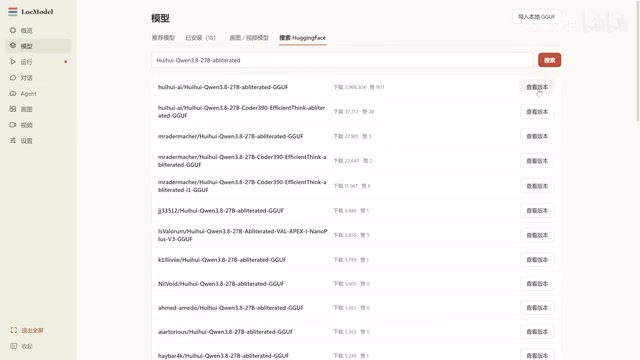
LocModel supports two ways of obtaining models: online download and manual import. The creator demonstrated downloading an uncensored language model (Q8 version) from Hugging Face and then loading it into the software via the "Import Local Model" feature. Because the software supports memory and disk loading, the model can run even with insufficient VRAM.
After importing, the model was started for a conversation test, and it was able to introduce itself normally and respond to requests. The creator also had the model write a "website CG stress test tool" on the spot, and the model directly provided a complete implementation plan, confirming the uncensored model's leniency regarding content restrictions.
Interestingly, when selecting models you don't have to copy the demonstration — users can search keywords in the model center and pick the version suited to their hardware. The creator suggests prioritizing versions marked "smooth," which produce output faster.
Agent Intelligence: Making Local AI Actually Do Work
Beyond content generation, LocModel has built-in Agent functionality. The creator demonstrated two tasks: first, having the AI write a Pomodoro timer webpage — after selecting a working folder, the AI automatically generated an HTML file that runs on double-click without any internet connection or installation; second, a more challenging "little sea riding a bicycle" platformer game, where the AI planned the game structure, sound effects, and levels, requested user authorization when executing commands that required permissions, and ultimately generated a playable game.
The entire process calls local models exclusively, and the workspace folder is customizable. This means the Agent can translate natural language requirements into actually runnable files — a practical efficiency booster for developers or content creators.
Agent (intelligent agent) refers to enabling large language models not only to generate text but also to autonomously plan steps and call tools (such as writing files, executing commands, searching) to complete complex tasks. Its typical workflow is a "think—act—observe" loop: the model first decomposes the task, then decides which tool to call, reads the tool's returned results, and continues reasoning until the task is complete. The automatic webpage and game writing demonstrated in the article belong to the "code generation + file writing" category of Agents. The advantage of local Agents is that data never leaves the device and no internet is required, but limited by the capabilities of local models, their planning stability and error recovery for complex tasks are usually weaker than cloud-based large models.
Multi-Source Cross-Validation and Usage Recommendations
It should be noted that this analysis is mainly based on the video content from 零度解说, which is a single source. However, judging from community discussions, LocModel's automatic hardware adaptation and memory loading capabilities have been mentioned multiple times, broadly consistent with the video's description. Some users also pointed out that inference speed for large models on low-spec devices remains limited, and quantized versions need to be chosen sensibly.
Overall, LocModel packages model download, inference engine installation, hardware adaptation, and Agent invocation into a graphical workflow, genuinely lowering the entry barrier to local AI. For users who want to break free from online service restrictions while experiencing AI generation capabilities for free, it's worth a try.
One-line Summary
LocModel lowers the barrier to local AI deployment with automatic hardware adaptation and memory loading; hands-on tests confirm image generation, video generation, and Agent functionality are usable.
Paragraph Summary
This article introduces LocModel, a local AI deployment tool shared by Bilibili creator "零度解说." The tool automatically detects hardware and recommends compatible open-source models; its model library connects to Hugging Face and supports NVIDIA, AMD, and Intel GPUs as well as pure CPU invocation, with memory and disk loading compensating for insufficient VRAM. In hands-on tests, image generation was almost instantaneous, and image editing improved noticeably after downloading a dedicated editing model; image-to-video produced consistent characters adhering to the prompt after a few minutes' wait. Users can also import uncensored large models for unrestricted conversation and use the built-in Agent to automatically write a Pomodoro webpage and a playable game, all offline. The article concludes that LocModel packages model download, engine installation, hardware adaptation, and Agent invocation into a graphical workflow, significantly lowering the entry barrier to local AI, though inference speed on low-spec devices remains limited.
Related articles

VERS: Editing Activation Explanations to Halve Reasoning Model Tokens
VERS guides reasoning models by editing activation explanations, cutting 45.8% of tokens on GSM8K with only a 0.82 pp accuracy drop and transferring to larger models, but losing accuracy on competition problems.

Finding Errors Is Not Enough: Selective Model Escalation for Entity-Targeted Sentiment Analysis
This study explores selective model escalation for entity-targeted sentiment analysis, comparing data collection ordering, uncertainty-driven re-examination, and model routing—finding that minority-class priority only helps at very small data volumes, the oracle upper bound far exceeds actual gains, and escalation must be tailored to each dataset.

WAS-PO: Using Whitened Advantages to Solve the Correlation Trap in Multi-Reward Reinforcement Learning
WAS-PO paper proposes whitening advantages to correct correlation bias in multi-reward RL: when rewards are correlated, naive weighted summation effectively applies Σ^{1/2}w instead of w. Experiments show training reward improves steadily, but held-out accuracy does not improve in sync, and under two rewards it actually falls behind.