Logit Laundering: A New Method for Evading LLM Data Audits

A new study proposes the Logit Laundering framework, which can manipulate outputs during inference to evade LLM watermark auditing.
Data watermarking is currently the mainstream approach for LLM data usage auditing, but the problem of attack-defense asymmetry is prominent. A new study proposes an evasion framework called Logit Laundering, revealing how non-compliant model providers can manipulate outputs during inference to evade auditing. The method suppresses watermark statistical signals through a logit reshaping module and introduces a confidence-aware scaling module to adaptively adjust suppression strength, balancing evasion effectiveness and model utility while keeping model parameters unchanged. Experiments show that the framework can successfully evade multiple advanced auditing methods and significantly attenuate detectable signals. The study calls for more robust auditing mechanisms and prompts reflection on responsibility definition and technical deterrence.
Data usage auditing is an important means of protecting data ownership, and watermarking technology is currently the mainstream approach. However, a new study proposes an evasion framework called "Logit Laundering," revealing how non-compliant model providers can manipulate outputs during the inference stage to evade auditing.
The Asymmetry of Attack and Defense in Watermark Auditing
Data usage auditing aims to determine whether specific data has been used for LLM training, thereby supporting data ownership protection. Data watermarking is the current mainstream approach: embedding traceable signals in training data and then detecting these signals in model outputs. In recent years, academia has proposed a large number of watermark-based LLM auditing methods.
However, systematic research from an adversarial perspective remains limited. In reality, there are clear profit motives: non-compliant LLM providers may use unauthorized copyrighted datasets to train models in order to improve model capabilities, while attempting to evade detection by auditors and thereby avoid legal liability. This asymmetry between attack and defense places severe demands on the robustness of auditing methods.
Logit Laundering: Tampering at the Inference Stage
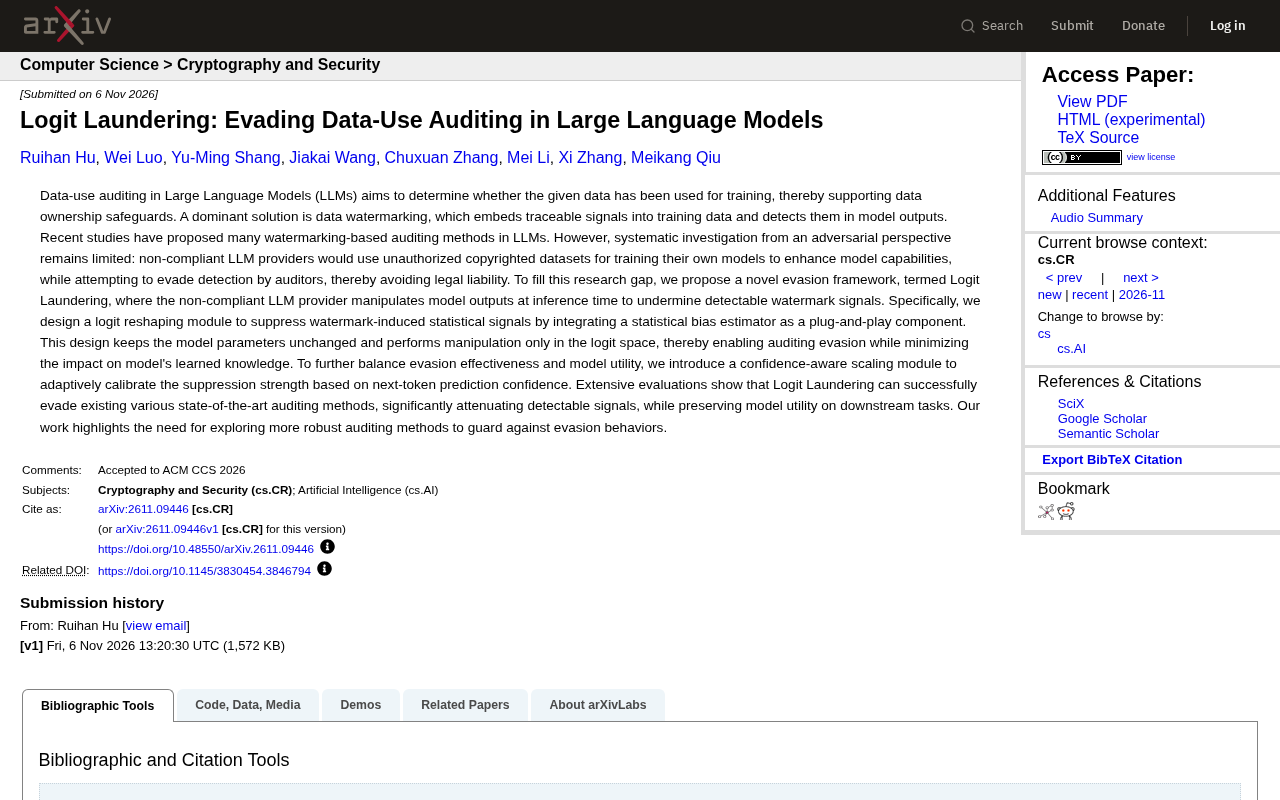
To fill this research gap, the paper proposes a novel evasion framework called Logit Laundering. Its core idea is that a non-compliant LLM provider manipulates model outputs during the inference stage to weaken detectable watermark signals.
Specifically, the researchers designed a logit reshaping module that integrates a statistical bias estimator as a plug-and-play component to suppress the statistical signals induced by watermarks. The key to this design is that model parameters remain unchanged, and manipulation occurs only in the logit space. This achieves audit evasion while minimizing the impact on the model's learned knowledge.
Confidence-Aware Adjustment of Suppression Strength
To further balance evasion effectiveness and model utility, the study also introduces a confidence-aware scaling module. This module adaptively calibrates the suppression strength based on the confidence of the next-token prediction. This means that the evasion operation is not one-size-fits-all but dynamically adjusted according to how confident the model is in its output, thereby weakening watermark signals while preserving model performance on downstream tasks as much as possible.
Logit (unnormalized score) is the raw numerical vector output by a language model when generating each token. The model typically first computes the logit for each candidate token, then converts it into a probability distribution via the softmax function, and finally generates the next word by sampling according to the probabilities or taking the maximum. Watermarking schemes often implant specific patterns in training data, causing the model to produce statistically detectable logit biases when generating certain tokens (for example, the logits of specific tokens are systematically elevated). Logit Laundering chooses to operate in the logit space because manipulation at this level does not change the model weights and only post-processes the output distribution. Therefore, it is low-cost to implement, highly covert, and can directly suppress the statistical signals on which watermarks rely.
The core of confidence-aware scaling is to use the model's confidence in the next-word prediction (usually reflected in the concentration of the probability distribution) to adjust the suppression strength. When the model is highly confident in its output, the watermark signal tends to be weaker or consistent with the model's own knowledge, and excessive suppression at this point may harm model utility; conversely, when the model's uncertainty is high, the watermark signal may be more obvious and require stronger suppression. The module dynamically calibrates accordingly, avoiding "one-size-fits-all" signal suppression. This adaptive strategy is more covert when countering auditing because it makes changes in the output distribution closer to natural generation while preserving as much semantic information as possible required for downstream tasks.
Experimental Validation and Implications
Extensive evaluations show that Logit Laundering can successfully evade a variety of existing state-of-the-art auditing methods, significantly attenuating detectable signals while maintaining the model's utility on downstream tasks. This result sends a clear signal: current watermark-based auditing schemes have obvious shortcomings when facing intentional evasion behavior.
The authors point out that this work highlights the necessity of exploring more robust auditing methods to guard against such evasion behavior. For data owners and auditors, relying solely on watermark signals may be insufficient; auditing mechanisms that can resist manipulation at the inference stage need to be designed.
Impact on the Auditing Ecosystem
The proposal of Logit Laundering advances adversarial research on LLM data auditing by one step. It reminds us that the design of auditing methods must consider not only detection performance under normal circumstances but also the adversary's active evasion strategies. In the future, auditing techniques may need to combine multiple signal sources or introduce sensitivity analysis of changes in output distributions to improve adversarial robustness.
This study also prompts reflection on the definition of responsibility: when model providers have the ability to wash away watermark signals during the inference stage, how to establish effective deterrence and verification mechanisms from both technical and legal perspectives will become an important issue in the field of data governance.
One-line Summary
A new study proposes the Logit Laundering framework, which can manipulate outputs during the inference stage to evade LLM watermark auditing.
Paragraph Summary
Data watermarking is currently the mainstream approach for LLM data usage auditing, but the problem of attack-defense asymmetry is prominent. A new study proposes an evasion framework called Logit Laundering, revealing how non-compliant model providers can manipulate outputs during the inference stage to evade auditing. This method suppresses watermark statistical signals through a logit reshaping module and introduces a confidence-aware scaling module to adaptively adjust suppression strength, balancing evasion effectiveness and model utility while keeping model parameters unchanged. Experiments show that the framework can successfully evade a variety of advanced auditing methods and significantly attenuate detectable signals. The study calls for the development of more robust auditing mechanisms and prompts reflection on the definition of responsibility and technical deterrence.
Related articles

GitHub Hit: The Proxy Solution That Gives Claude Code Unlimited Context
GitHub project Billion Context uses a reversible compression proxy to give Claude Code and DeepSeek unlimited context—58% cheaper with zero context overflow. Here's how it works, how to set it up, and its limitations.

Goldman Sachs Restricts Claude Code to Engineers Only, a Bellwether for AI Deployment in Banking
Goldman Sachs restricted Claude Code and GitHub to engineers only last October. Bloomberg's report reveals the deployment logic for AI coding tools in regulated industries. This article analyzes the compliance and security considerations behind banks' caution and provides a launch checklist for AI tools in regulated teams.

$6,000 Local AI Machine Hands-On: Is the Dell DGX Spark Worth It?
Hands-on with the $6,000 Dell DGX Spark: from Open Web UI + Ollama chat to Hermes agents running scripts, plus vLLM and dual-machine scaling — local AI's layers, engines, and hardware trade-offs explained.