Logitech Blue Yeti 2 Microphone Launches with AI Noise Cancellation and Position-Adaptive Sensing

Blue Yeti 2 launches under Logitech G with AI noise cancellation, position-adaptive sensing, and an LED display.
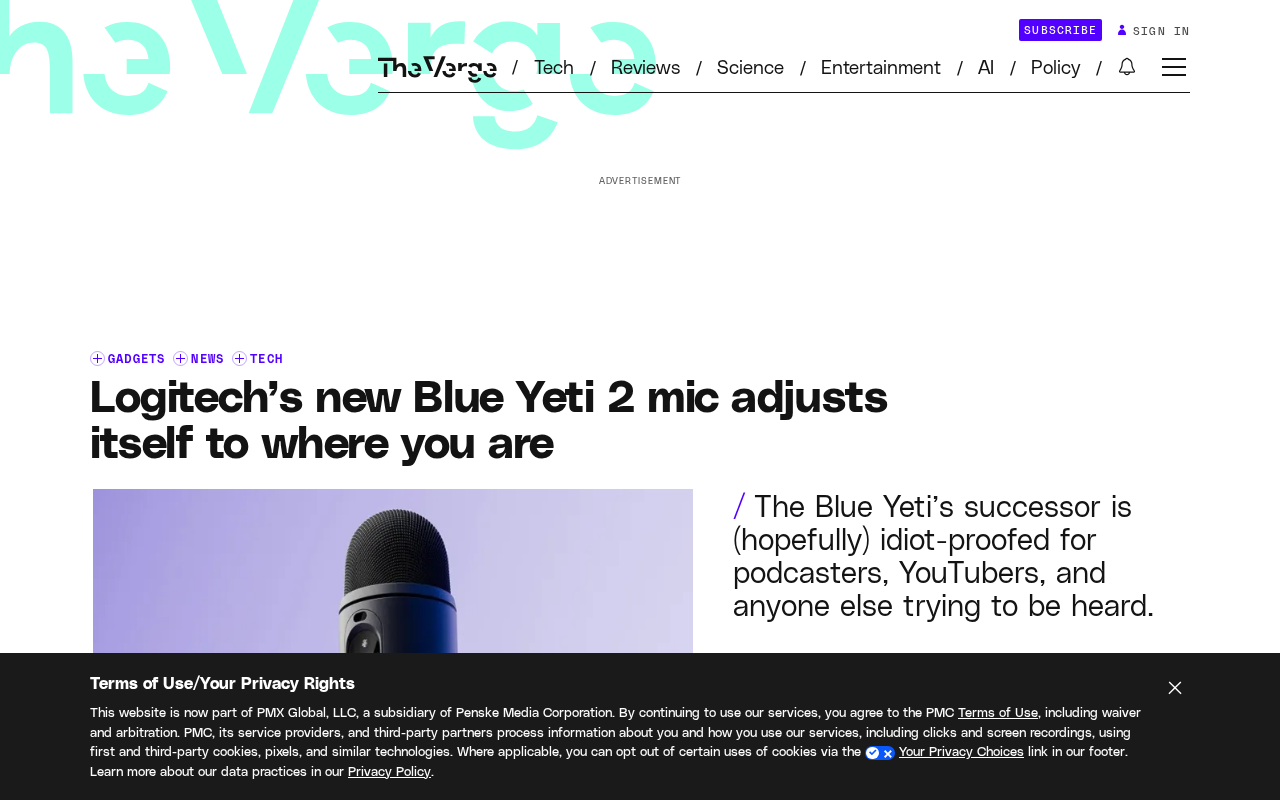
The Blue Yeti 2 is the official successor to the iconic USB microphone that launched in 2009, now released under Logitech's gaming brand, Logitech G. It focuses on three key upgrades: an interactive LED display for at-a-glance visibility of gain, mute, and pickup modes; built-in AI noise cancellation that suppresses keyboard clicks and fan noise in real time at the hardware level; and a distance-sensing position-adaptive sensor that automatically adjusts pickup parameters based on where the user is. Rather than chasing studio-grade specs, the Blue Yeti 2 uses AI and smart sensing to lower the barrier to entry — making it faster to go from unboxing to publishing.
As one of the most recognizable USB microphones in content creation, the Blue Yeti has been a perennial favorite among streamers, podcasters, and video creators since its debut in 2009. After years of waiting, the classic product finally has an official successor — the Blue Yeti 2. This time, the new release falls under Logitech's gaming brand, Logitech G, and brings a number of modern upgrades.
Three Core Upgrades
Based on publicly available information, the three most notable improvements in the Blue Yeti 2 are: an interactive LED display, AI noise cancellation, and a distance-sensing voice sensor. These three features share a common goal — lowering the barrier to entry so creators can achieve clean recordings without relying on complex software adjustments.
While the original Blue Yeti delivered excellent audio quality, newcomers often faced a learning curve around gain adjustment and pickup pattern selection. The Blue Yeti 2 aims to address these pain points through smarter hardware design.
Position-Adaptive Sensing: The Microphone Finds You
Perhaps the most imaginative feature is the distance-sensing voice sensor. Traditional microphones are highly sensitive to the user's distance and angle — even slight deviations can result in audio that's too quiet or clipped. The Blue Yeti 2 can sense the user's position and automatically adjust its pickup parameters accordingly.
For creators who frequently move during streams or recordings — talking while operating equipment, for instance — this adaptive capability can significantly reduce the need for manual adjustments, making the recording process feel more natural and fluid.
AI Noise Cancellation: Clean Vocals Through Hardware and Software Working Together
AI noise cancellation has become a standard selling point for audio devices in recent years. The Blue Yeti 2's built-in noise reduction can suppress environmental interference — such as keyboard clicks and fan noise — at the recording stage, reducing the amount of post-processing work required.
This trend aligns with the broader direction of the consumer audio market: shifting processing that once required professional software to the hardware level, where AI handles it in real time, thereby reducing the technical burden on creators.
AI noise cancellation in consumer audio devices is typically based on deep learning voice separation models, trained on large datasets of mixed speech and noise to teach the model how to distinguish the spectral characteristics of human voice from ambient sound. Early hardware noise reduction relied on fixed filters capable of eliminating only specific persistent frequencies (such as air conditioning hum), with limited effectiveness against transient noise (like keyboard clicks or chair movements). AI models, by contrast, can perform real-time, frame-by-frame analysis to identify which spectral components belong to the human voice, enabling more precise suppression of non-vocal signals. Representative underlying technologies include Recurrent Neural Networks (RNN) and lightweight Transformer variants designed for low-latency audio processing. Integrating this kind of inference into a microphone chip — at extremely low power consumption and with latency typically under 20ms — is one of the primary engineering challenges in deploying AI at the hardware level.
What the Interactive LED Display Adds
The original Blue Yeti used physical knobs and indicator lights. The Blue Yeti 2's interactive LED display lets users see at a glance their current gain level, mute status, and pickup pattern.
The value of this display goes beyond visual feedback — it makes the microphone's various states visible, allowing users to quickly confirm that the device is in the correct operating mode before and after recording. It prevents the all-too-common embarrassment of finishing a long session only to discover the mic was muted the whole time.
What Does the Move to Logitech G Mean?
Also worth noting is the change in brand affiliation. After Blue was acquired by Logitech, the Blue Yeti 2 is now launching under the Logitech G name — signaling that Logitech is further consolidating its audio and gaming peripheral product lines.
For the heavily overlapping audience of gaming streamers and content creators, bringing the Blue Yeti into the gaming brand ecosystem helps Logitech build a more complete creator ecosystem — creating synergy from keyboards and mice to headsets and microphones. It also reflects the fact that the USB microphone market is increasingly gravitating toward livestreaming and gaming content creation.
Logitech acquired Blue Microphones in 2019 for approximately $117 million. In the early post-acquisition period, the Blue brand maintained relative independence, with products continuing to sell under the "Blue" name. The fact that Blue Yeti 2 is launching under Logitech G rather than the standalone Blue brand marks a deeper phase of brand integration. From a business perspective, Logitech G has broader retail coverage and brand recognition in the gaming peripheral channel — folding the flagship microphone into that ecosystem helps reach gaming streamers who may never have been familiar with the Blue brand. This also suggests that Blue's identity as an independent consumer brand may gradually fade, subordinated to Logitech's broader creator ecosystem strategy.
Practical Value for Creators
The success of the Blue Yeti line over the years has largely stemmed from its balance of audio quality, ease of use, and price. The Blue Yeti 2 maintains this positioning while further reinforcing usability through AI and intelligent sensing technology.
For creators just starting out, these automated features can dramatically shorten the time from unboxing to publishing. For experienced users, the position-adaptive sensing and AI noise cancellation reduce repetitive manual adjustments. Overall, the Blue Yeti 2's upgrade philosophy is clear — not chasing the most extreme studio-grade specs, but making great sound easier to achieve.
As more product details and hands-on reviews emerge, whether the Blue Yeti 2 can replicate the original's market success remains to be seen. But the direction it represents — AI-assisted creative hardware — is undeniably the dominant trend in audio device evolution right now.
Technical Background
From a technical standpoint, distance sensing is typically implemented via ultrasonic, infrared, or capacitive near-field detection. Sound pressure level (SPL) captured by a microphone decays with the square of the distance — this is the so-called inverse square law: every time the speaker doubles their distance from the microphone, volume drops by approximately 6dB. The traditional solution is to have the user manually increase gain, but higher gain also amplifies background noise. The core value of a position-adaptive sensor lies in its ability to dynamically compensate for distance changes while preserving the signal-to-noise ratio — rather than simply cranking up the overall gain. This is especially useful in scenarios like multi-person podcasts or walk-and-talk unboxing videos.
Related articles

Understanding DeepSeek in 3 Minutes: The Rise from a Quant Hedge Fund to an Open-Source AI Leader
DeepSeek's history in 3 minutes: from High-Flyer Quant's compute build-up to V2's MLA inference cost cuts, V3's $5.576M training bill, R1's open-source global shock, and V4 with a $7B Series A.

Local Creative Writing Model Showdown: Fine-tuned Qwen3.8 27B Wins, DeepSeek v4.1 Underwhelms
Bilibili creator tests seven local creative writing models: Hemingway and HumanLike Chat based on Qwen3.8 27B perform best, DeepSeek v4.1 is plain, Dongfang Shuo ranks last with confused characters. Includes three test prompts, scores, and usage advice.

Liang Wenfeng's Three Big Bets: Why Did DeepSeek Open-Source Its 82% Gross Margin?
Why did DeepSeek open-source DeepInfer, its 82% gross margin inference framework, and then launch a hundred-billion funding round? An analysis of Liang Wenfeng's three big bets and the open-source strategy.