Loop Engineering Explained: A New AI Development Paradigm or Just Hype?

Loop Engineering designs AI agent systems that complete engineering tasks automatically — no repeated human prompting required.
Loop Engineering, coined by OpenAI and Claude Code contributors, adds an abstraction layer above Agent Loop: instead of humans driving tasks through repeated prompts, the system automatically discovers, schedules, executes, and validates tasks until predefined exit conditions are met. Its three-layer architecture spans LLM reasoning, agent-level tool use, and a top-level automated loop. Far from replacing Prompt Engineering, it demands higher prompt quality. Key design risks include agent hallucinations, infinite loops, and missing escalation paths.
What Is Loop Engineering?
Loop Engineering is a concept that has recently emerged in AI development circles. According to technical discussions on Bilibili, the term was coined by OpenAI's Boris Cherny and core contributors to Claude Code, and spread rapidly through the developer community within about a week of being introduced.
To understand Loop Engineering, you first need to clarify how it relates to existing concepts like Agent Loop and Prompt Engineering. It isn't a brand-new technology that appeared out of nowhere — it's more of a conceptual framework for existing development practices. If you've been doing LLM development for a while, you've likely already been applying Loop thinking without realizing it.
Starting with Agent Loop
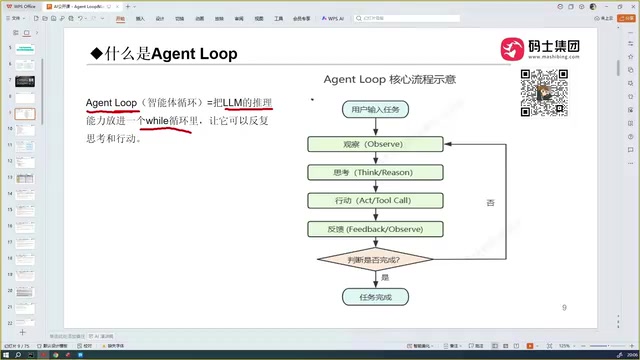
Understanding Loop Engineering requires starting with the foundational concept of the Agent Loop. The most fundamental difference between an agent and a base LLM is this: with a raw LLM, a human must manually trigger reasoning and tool calls, whereas an agent can autonomously invoke tools, retrieve information, and continue reasoning based on the results — deciding whether to call more tools or return a final answer to the user.
This back-and-forth cycle of "think → act → think → act" is the essence of the Agent Loop. In early implementations, frameworks like LangChain realized this mechanism using a while loop that continuously called the LLM: receive user input, observe output, decide whether to call a tool, check the stopping condition, and either end the conversation or keep looping.
Worth noting: this process also involves memory management — another key distinction between agents and bare LLMs. Modern versions of LangChain have evolved from while loops to graph-based flows, making the mechanism more mature.
ReAct (Reasoning + Acting) is the core paradigm for Agent Loops, introduced by Google researchers in 2022. The basic idea is to have the LLM explicitly "reason" (generate a Thought) before each action, then decide the next "action" (e.g., which tool to call and with what parameters), observe the tool's output (Observation), and then enter the next reasoning round. This alternation between reasoning chains and tool calls makes the agent's decision process interpretable, debuggable, and less prone to going off track on complex tasks. Major frameworks like LangChain and LlamaIndex use ReAct as the default agent paradigm, and Claude Code's underlying architecture follows a similar "think → act → observe" loop structure. Understanding ReAct helps clarify that Loop Engineering didn't emerge from a vacuum — it builds a higher-level task scheduling and automation orchestration layer on top of existing paradigms.
What Problem Does Loop Engineering Solve?
Most people using AI agents today — whether Claude Code or a custom-built agent — are still operating at the Agent Loop level: ask a question, get an answer, tweak the prompt if unsatisfied, and repeat across multiple exchanges to complete one piece of work.
Loop Engineering aims to change exactly that. In one sentence: to complete an engineering task, you need only one interaction — or no interaction at all. Just start the system and it runs automatically, returning results when done.
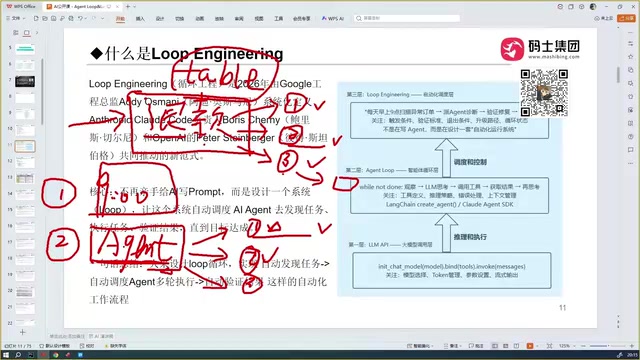
A concrete business scenario was used to illustrate this: imagine a company has a backlog of refund orders accumulating in a database every day, all needing to be processed at 9 AM. Different order statuses (shipped, delivered, pending shipment) correspond to different refund rules. The traditional approach requires human intervention. Loop Engineering's goal is to build an automated system — one that fires up an agent on schedule, reads the refund data, queries order statuses, applies the appropriate rules, calls the right tools or skills, and produces accurate results with zero human involvement.
In other words, Loop Engineering is about designing a system that automatically discovers tasks, schedules them, executes them, and validates the results — in a continuous loop. The human role shifts from "participant" to "designer."
Three-Layer Architecture: Model, Agent, and Loop System
A clear three-layer conceptual model was proposed:
Layer 1: The LLM
The bottom layer is the large language model, whose core responsibility is reasoning. This layer deals with model selection, token usage, parameter tuning, and structured output. In the early days, we used LLMs purely for conversation, with humans manually handling tool calls.
Layer 2: Agent (Agent Loop)
The middle layer is the agent — the agent loop. It can automatically call multiple tools and reason through problems, embodying the ReAct (Reasoning + Acting) philosophy. Its limitation: completing a full task still follows a "get output, re-prompt, get more output" pattern, with a human writing prompts at each step.
Layer 3: The Loop Engineering System
The top layer is the automated runtime system that Loop Engineering aims to build. It still uses agents internally — even coordinating multiple agents and calling multiple skills — but the entire process requires no repeated human interaction. Once started, it executes autonomously and makes its own decisions until a predefined condition is met.
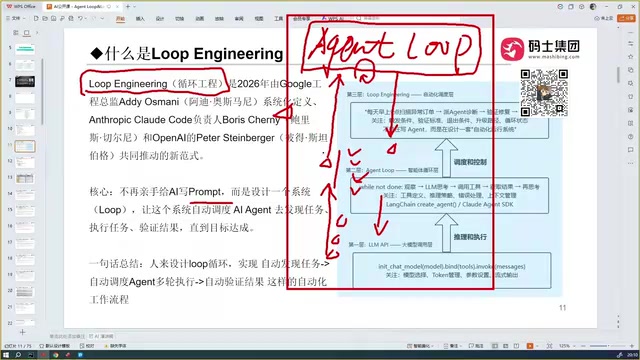
It's important to distinguish two kinds of "loops" here: the loop inside an Agent Loop refers to the small cycle of tool calls and reasoning steps; the loop at the Loop Engineering level refers to the macro-level cycle of multiple skill invocations and multi-agent coordination needed to complete an entire engineering task. These two should not be confused.
Will It Replace Prompt Engineering?
There's a claim circulating online that "Prompt Engineering is dead, replaced by Loop Engineering." The response from those who introduced the concept is clear: this is pure hype.
Loop Engineering doesn't replace Prompt Engineering — quite the opposite. Prompts remain critically important within a Loop Engineering system, and the requirements for prompt quality are actually higher in this context. Loop Engineering contains and depends on Prompt Engineering; the relationship is one of inclusion, not substitution.
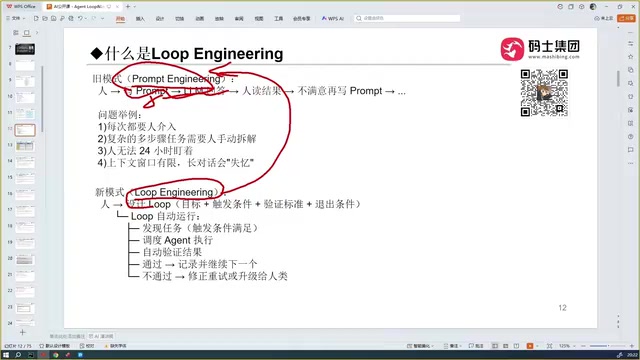
Comparing the old and new approaches:
- Old model (Prompt Engineering–driven): Human writes a prompt → LLM/agent responds → human reads the output → re-prompts if unsatisfied. Every step requires human involvement; complex tasks require manual decomposition; humans can't be on watch 24/7; early systems also struggled with limited context windows and long-conversation amnesia.
- New model (Loop Engineering): The human's job is to design the loop — define the goal, completion criteria, execution timing, validation method, and critically, the exit conditions — and then the system runs automatically.
Prompt Engineering is the methodology of carefully crafting input text to guide an LLM toward desired outputs, encompassing techniques like clear instruction writing, few-shot examples, Chain-of-Thought prompting, role assignment, and output format constraints. In Loop Engineering contexts, the stakes for prompt quality are even higher: because the system runs autonomously without supervision, a single ambiguous prompt can produce compounding errors across hundreds of loop iterations — errors that get amplified rather than caught during a human review step. This is why Loop Engineering demands greater determinism, clearer boundaries, and more robust prompts than interactive conversation — which is also the engineering rationale behind calling it an "inclusion" rather than a "replacement."
Key Risks in Loop Design
Several critical risk factors were repeatedly highlighted — ones developers should address proactively:
Agent drift and hallucination. Agents in automated systems can easily make incorrect judgments — for example, mistakenly processing a refund on an already-delivered order. Without real-time human oversight, the cost of such errors can be significant.
Infinite loop risk. If a task is impossible to complete, or if requirements are too vague, the system may get stuck in a loop it can never exit. Clear exit conditions are essential.
Escalation mechanisms. When the system can't resolve a task, there needs to be a defined path for escalating to human handling. If human intervention is frequently required, that's actually a sign the Loop system is poorly designed — it hasn't truly handled the full scope of scenarios within its intended domain.
Escalation in engineering practice is typically implemented as "Human-in-the-Loop" (HITL). Common patterns include: pausing and sending a notification when confidence falls below a threshold; automatically routing to a human queue after a maximum number of retries; requiring mandatory human confirmation for high-risk operations (like financial transactions). When designing escalation triggers, granularity matters — too sensitive and the system constantly interrupts, defeating the purpose of automation; too lenient and high-risk errors can propagate undetected. In scenarios involving actual financial flows like refund processing, it's recommended to write all escalation events to an auditable log, enabling post-hoc review of whether the system's decisions were appropriate.
A Measured Take: New Concept or Inevitable Trend?
Loop Engineering does represent a genuine directional shift in AI agent development — from "human-AI conversation" toward "automated systems." That trend is real. Whether it will prove as disruptive as some of the hype suggests remains to be seen.
For developers, the more pragmatic attitude is: don't get swept up in "new paradigm" buzzwords. Understand the substance — Loop Engineering is essentially agent automation orchestration combined with Workflow thinking. As sharp observers during the original discussion noted, "Isn't this just ReAct?" and "Feels like an agent combined with a workflow" — those instincts are actually quite accurate.
The right path to implementing Loop Engineering is to internalize the Agent Loop's mechanics, build solid Prompt Engineering skills, and then construct automated loop systems with clearly defined goals, validation criteria, exit conditions, and escalation mechanisms. That's the foundation everything else rests on.
Related articles

How Big Can Stars Really Get? The Physical Limits of the Largest Stars
Red supergiants are the largest stars by volume, with radii up to 2,000 times the Sun, engulfing the inner solar system. But there is no precise upper limit on stellar size—models predict up to 15,000 solar radii. The most massive blue stars are far smaller than red supergiants—biggest and heaviest are two different things.

Apple HomeView Smart Display Full Feature Breakdown: Wall-Mount or Desktop, $299
Apple launches HomeView, a $299 smart display with wall-mount and desktop options, 12MP camera for facial recognition, smart home control, music playback, and recipe step-by-step cooking. Full breakdown of watch faces, apps, privacy, and cooking integration.

Where Did the Promised New Studio Go? Craft Computing Answers After Five Years
Craft Computing's host responds to viewer questions: the new studio promised five years ago was shelved as construction costs soared from $30,000 to $75,000, and was replaced by a 168-square-foot garage conversion.