LoopOPD: Enabling Looped Language Models to Self-Distill for Recursive Self-Improvement

LoopOPD lets looped language models self-distill using deeper recursion as teacher, enabling dense supervision without external models.
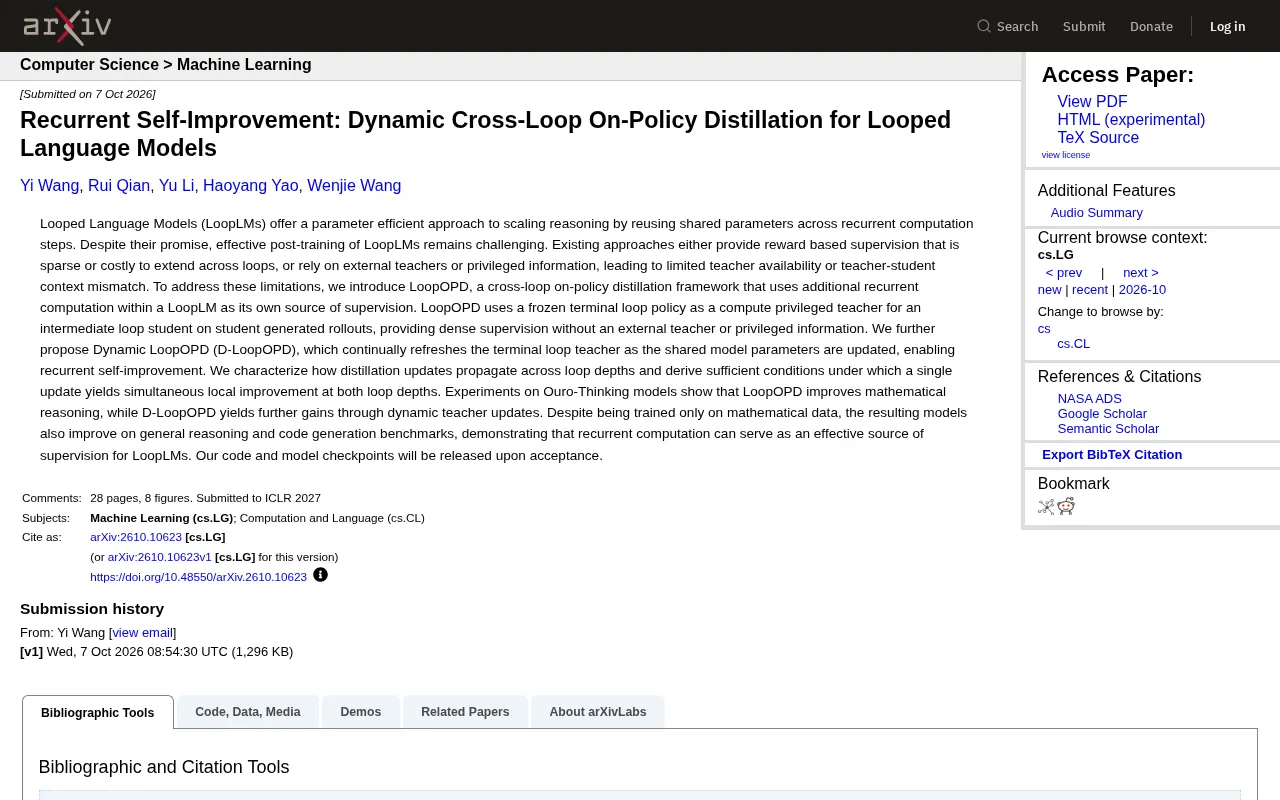
LoopLMs reuse shared parameters across recursive steps for parameter-efficient deep reasoning, but have lacked effective post-training methods. LoopOPD reframes this as a self-supervised problem: the terminal loop (more recursive steps) acts as a compute-privileged teacher guiding the intermediate loop student on its own rollouts, providing dense supervision with no external teacher. Dynamic LoopOPD (D-LoopOPD) continuously refreshes the teacher after each parameter update, forming a recursive self-improvement loop. Theoretical analysis derives sufficient conditions for single updates to improve two loop depths simultaneously. Experiments on Ouro-Thinking models show strong gains, with math-only training generalizing to general reasoning and code generation — suggesting recursive computation supervision strengthens universal reasoning mechanisms.
The Training Challenge of Looped Language Models
Looped Language Models (LoopLMs) offer a parameter-efficient approach to scaling inference: by reusing a single set of shared parameters across multiple recursive computation steps, these models can deepen their reasoning ability without significantly increasing parameter count. The appeal is clear — trade fewer parameters for greater reasoning depth.
But while the concept is compelling, the training process is fraught with difficulty. Post-training for LoopLMs has long lacked effective methods. Existing approaches fall into two broad categories, each with its own drawbacks: one relies on reward-based supervision signals, which tend to be sparse and difficult to scale across multiple loop levels; the other depends on external teacher models or privileged information, leading to limited teacher availability or context mismatch between teacher and student.
The architecture of LoopLMs draws inspiration from earlier work such as Universal Transformers and DEQ (Deep Equilibrium Models). The core idea is to apply the same set of Transformer layers repeatedly, with each iteration called a "loop step." Unlike conventional deep Transformer stacks, LoopLMs do not accumulate parameters with depth — the parameter count of 12 layers can simulate the computational depth of 48 layers, since parameters are shared and reused across each recursive pass. This naturally enables test-time compute scaling: inference depth can be increased simply by adding more recursion steps, with no need to load a larger model.
Post-training refers to the phase following pre-training, where capabilities are further aligned through instruction fine-tuning, RLHF, or distillation. For LoopLMs, post-training poses a unique challenge: shared parameters mean that gradient updates targeting any single loop depth simultaneously affect behavior at all depths. This creates an interference effect where optimizing one level can inadvertently degrade others — and that is precisely why the field has lacked effective post-training solutions for so long.
LoopOPD: Using the Model Itself as Its Own Teacher
The solution proposed in this new arXiv paper is called LoopOPD, and the core idea is elegantly simple: since a looped model can already achieve stronger capabilities by increasing the number of recursive steps, why not let the "deeper-computing" version of the model teach the "shallower-computing" version of itself?
LoopOPD is a cross-loop on-policy distillation framework. It uses a frozen terminal loop policy as a "compute-privileged teacher" to guide an intermediate loop student policy. Crucially, this distillation process takes place on rollouts generated by the student itself, not on external data.
The benefits of this design are immediate: no external teacher model is required, no privileged information is needed, and yet the framework provides dense supervision signals. Compared to the sparsity of reward signals, dense supervision leads to more stable training and more efficient use of each signal. In other words, the model's additional recursive computation itself becomes the source of supervision.
The key distinction between on-policy distillation and offline distillation lies in the data source: offline distillation uses pre-collected teacher outputs as a fixed training set, whereas in on-policy distillation, the student model generates its own rollouts on the fly, and the teacher provides real-time scoring or distributional supervision over those rollouts. This design effectively mitigates distribution shift — the data distribution the student encounters during training remains consistent with what it faces at inference time.
The "cross-loop" distillation in LoopOPD is a natural extension of this idea to looped architectures: the model running L recursive steps (the terminal loop) acts as the teacher, while the same model running k steps (k < L) acts as the student. They share parameters but differ in computational depth. The teacher's supervision is grounded in the student's own rollouts, ensuring on-policy distributional consistency while requiring no external annotations or independent teacher models.
Dynamic D-LoopOPD and Recursive Self-Improvement
Static LoopOPD still leaves room for improvement. Building on this, the paper introduces Dynamic LoopOPD (D-LoopOPD).
The key enhancement is this: as the shared model parameters are updated, the terminal loop teacher is continuously refreshed. Rather than remaining a frozen snapshot, the teacher evolves in sync with the student's progress. As the student grows stronger, so does the teacher — which in turn provides even better guidance to the student. This creates the "recursive self-improvement" loop emphasized in the paper's title.
The value of this mechanism lies in breaking through the capability ceiling imposed by a static teacher. In conventional distillation, the student's upper bound is constrained by a fixed teacher; dynamic refreshing gives the system the potential to iterate continuously.
Theoretical Analysis: How Updates Propagate Across Loop Depths
The paper goes beyond engineering insights and provides a theoretical characterization of the approach. The authors analyze how distillation updates propagate across different loop depths and derive a set of sufficient conditions under which a single parameter update can yield local improvements at two loop depths simultaneously.
This is one of the more rigorous parts of the work. It addresses a critical concern: in a shared-parameter looped architecture, can optimization targeting one level inadvertently harm another? The theoretical results show that, under certain conditions, optimization can be a "win-win" — providing a mathematical foundation for the method's effectiveness.
Experimental Results: Generalization from Math Training
Experiments are conducted on the Ouro-Thinking model family. Key findings include:
- LoopOPD significantly improves the model's mathematical reasoning ability;
- D-LoopOPD delivers further gains through dynamic teacher updates;
- Notably, although the model is trained exclusively on math data, it also achieves improvements on general reasoning and code generation benchmarks.
That last point is particularly meaningful. Generalizing to general reasoning and code tasks from math-only training suggests that recursive computation as a supervision source enhances some deeper, more universal reasoning mechanism in the model — rather than simply overfitting to a specific data distribution. This provides empirical support for the proposition that "recursive computation is supervision."
This phenomenon — math training generalizing to code and general reasoning — is not an isolated observation in recent large model research. Works like DeepSeekAd-R1 have noted similar "reasoning transfer": models reinforced on math- or logic-intensive tasks tend to see correlated improvements in code generation, scientific QA, and other tasks requiring multi-step reasoning. One prevailing explanation is that math training strengthens the model's "procedural reasoning" capability — breaking complex problems into sub-steps, maintaining intermediate state, and verifying local correctness — skills that are domain-general rather than math-specific.
For LoopOPD, this generalization result carries additional theoretical weight: it suggests that the dense supervision signal provided by recursive computation optimizes not a task-specific data distribution, but the model's more general strategy for "how to allocate computation." This provides cross-task empirical support for the design philosophy of treating recursive computation as supervision.
Implications for Parameter-Efficient Inference Scaling
This work reframes the training challenge of LoopLMs as a self-supervised problem — an approach that is conceptually innovative. It sidesteps the availability bottleneck of external teachers and the context mismatch problem, uses the model's own computational depth to construct dense supervision signals, and enables continuous iteration through dynamic refreshing.
For researchers and engineering teams focused on parameter efficiency and inference scaling, LoopOPD offers a post-training pathway worth serious consideration. The authors indicate that code and model checkpoints will be released upon paper acceptance, at which point reproducibility and practical applicability can be further evaluated.
One important caveat: current conclusions are primarily based on the Ouro-Thinking model family. The generalizability of the method to larger scales and more diverse architectures remains to be verified in follow-up work.
Related articles

Chain of Thought Isn't Just for AI: How Humans Can Use CoT to Improve Thinking Quality
Chain of Thought isn't just a prompt trick for large models. Starting from a Hacker News discussion, this article analyzes why CoT works for human thinking too, breaks down actionable ways to transfer it, and highlights the key differences between human CoT and machine CoT.
Cloudflare Teams Up with OpenAI: Closi…
Cloudflare Teams Up with OpenAI: Closing the Loop from Vulnerability Discovery to Defense with AI
Cloudflare uses OpenAI Daybreak to investigate security vulnerabilities and generate reviewable remediation plans, while developers use Codex to boost coding efficiency and quality.

Orca Multi-Agent Orchestration in Practice: A Guide to Parallel Collaboration with Claude and Codex
Orca is Stable AI's free open-source agent workbench supporting 34 agents like Claude Code and Codex in parallel. Learn its Git worktree isolation, multi-model orchestration, and mobile management.