Loss Equality ≠ Behavioral Similarity: Output-Space Analysis Reveals the Geometric Nature of Machine Unlearning

In gradient unlearning, loss values don't represent output behavior; leverage matrices reveal the output-space gap structure.
The study shows that in gradient-based machine unlearning, similar forget and retain losses do not guarantee similar output-space behavior, and a high forget loss cannot prove successful unlearning. The authors derive a closed-form output-space gap in linear regression and extend it to nonlinear models via generalized Gauss-Newton, building a unified framework of geometry, reweighting, and projection. Two leverage matrices—forget self-leverage and retain cross-leverage—drive the output gap, and precomputable diagnostics are proposed for auditing forget sets and predicting method effectiveness.
Introduction: The "Loss Trap" of Machine Unlearning
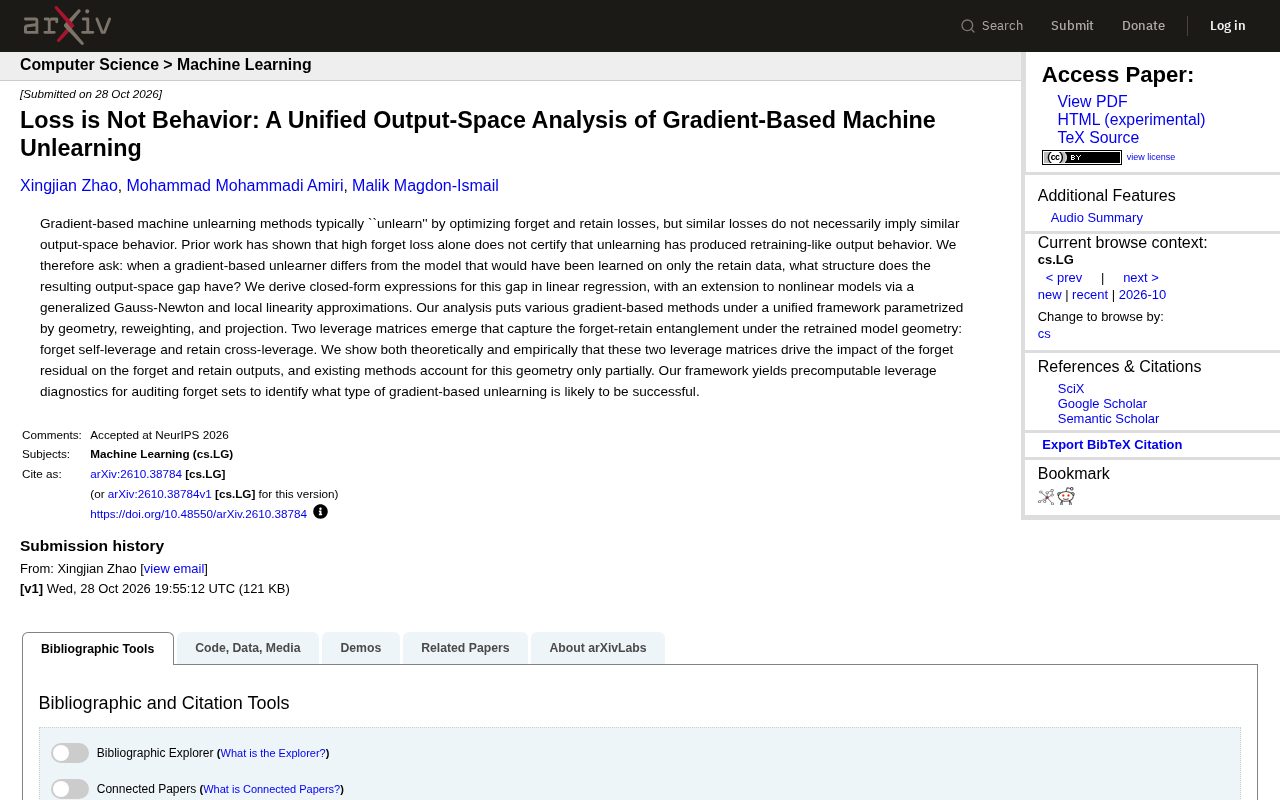
Gradient-based machine unlearning methods typically achieve "forgetting" by optimizing a forget loss and a retain loss, but similar loss values do not necessarily imply similar output-space behavior. A study titled Loss is Not Behavior: A Unified Output-Space Analysis of Gradient-Based Machine Unlearning points out that a high forget loss alone cannot prove that the unlearned model will produce output behavior similar to that of a retrained model. The study poses a core question: when a gradient-based unlearner differs from a model retrained only on the retain data, what structure does this output-space gap have?
Theoretical Framework: Closed-Form Solutions under Linear Regression and Nonlinear Extensions
The researchers first derive a closed-form expression for the output-space gap in linear regression, and then extend it to nonlinear models via the generalized Gauss-Newton method and local linear approximation. This analysis subsumes a variety of gradient-based methods into a unified framework composed of three parameterization dimensions: geometry, reweighting, and projection. Through this unified perspective, the researchers can systematically compare the behavioral differences of different methods in output space.
Two leverage matrices emerge from the framework, capturing the entanglement between forget and retain data under the geometry of the retrained model: the forget self-leverage and the retain cross-leverage. Both matrices are shown, theoretically and experimentally, to drive the influence of the forget residual on the forget output and the retain output.
The generalized Gauss-Newton method is an iterative optimization algorithm for solving nonlinear least-squares problems. By approximating the nonlinear terms in the objective with a first-order Taylor expansion, it transforms the problem into a sequence of linear least-squares subproblems, thereby avoiding the direct computation of second-order derivatives (the Hessian) and striking a balance between computational efficiency and convergence. In the context of machine unlearning, this method is used to generalize the closed-form output-space gap derived for linear regression to nonlinear models: by performing local linearization around the current parameter point, the gradients of the forget loss and retain loss can be approximated in linear form, and the generalized Gauss-Newton update is then used to estimate the difference in output space. This allows the leverage-matrix analysis, originally applicable only to linear models, to be applied approximately to nonlinear unlearners such as deep neural networks, providing a mathematical bridge for establishing the unified framework.
Leverage Matrices: The Core Structure Driving the Output Gap
The forget self-leverage and retain cross-leverage reveal a partially overlooked geometric structure in gradient-based unlearning methods. Existing methods account for this geometric relationship only partially, causing their output-space behavior to deviate significantly from that of a retrained model. Specifically, the forget residual influences the final output through these two leverage matrices, and different methods exploit the leverage matrices to different degrees, which explains why certain methods perform better on particular forget sets.
This finding has important practical implications: it shows that monitoring loss values alone is insufficient to assess unlearning quality, and the geometric relationships in output space must also be considered.
The leverage matrix originates from the concept of leverage in linear regression, which measures the influence of each training sample on model predictions. In the output-space analysis of machine unlearning, the leverage matrix is generalized into an operator that describes the geometric entanglement between forget data and retain data: the forget self-leverage characterizes the projection strength of the forget samples themselves under the geometry of the retrained model, while the retain cross-leverage captures the interaction between forget samples and retain samples. Specifically, these matrices act on the output through the forget residual (i.e., the difference between the forget-loss gradient and the retrained-model gradient), determining the structure of the output-space gap. Existing gradient-based unlearning methods typically exploit this geometric information only implicitly or partially, leading to deviations from the behavior of the retrained model. Thus, the leverage matrices provide a unified geometric perspective for understanding and comparing different unlearning algorithms.
Precomputable Leverage Diagnostics: A New Tool for Auditing Forget Sets
A direct application of the framework is to generate precomputable leverage diagnostic metrics for auditing forget sets and identifying which type of gradient-based unlearning is more likely to succeed. This means that, before actually deploying an unlearning algorithm, one can predict the method's effectiveness by analyzing the leverage structure of the forget set and the retain set, thereby avoiding blind trial and error.
The researchers validate, both theoretically and experimentally, that the leverage matrices drive the output gap, and they demonstrate the shortcomings of existing methods in accounting for geometric structure. This diagnostic tool provides a new dimension for assessing the reliability of machine unlearning.
Precomputable leverage diagnostics refer to the process of computing the leverage matrices and their related metrics before running any unlearning algorithm, using only statistical information about the forget set and the retain set (such as feature covariance or kernel matrices). Since the leverage matrices have closed-form expressions under linear regression and can be approximated via the generalized Gauss-Newton method in the nonlinear case, these diagnostic quantities do not depend on the specific unlearning optimization process and can be computed in advance, after model training is complete and before unlearning is executed. Their core value lies in the following: by analyzing the leverage structure between the forget set and the retain set, practitioners can predict which gradient-based unlearning method is more likely to succeed and identify the forget samples that most influence output-space behavior. This provides a low-cost, interpretable basis for auditing forget sets and selecting algorithms, avoiding blind trial and error.
Conclusion and Implications
This study reveals the fundamental disconnect between loss and behavior in gradient-based machine unlearning and provides a unified output-space analysis framework. Through leverage matrices and precomputable diagnostic metrics, the work offers a new theoretical foundation for understanding and improving unlearning algorithms. For practitioners, this means moving beyond loss monitoring to focus on the geometric properties of output space, ensuring that the behavior of the unlearned model truly approaches that of retraining.
One-line Summary
In gradient-based unlearning, loss values do not represent output behavior; leverage matrices reveal the structure of the output-space gap.
Paragraph Summary
This study points out that in gradient-based machine unlearning, similar forget and retain losses do not guarantee similar output-space behavior, and a high forget loss cannot prove successful unlearning. The authors derive a closed-form solution for the output-space gap in linear regression and extend it to nonlinear models via the generalized Gauss-Newton method, constructing a unified analysis framework composed of three dimensions: geometry, reweighting, and projection. The framework reveals that two leverage matrices—the forget self-leverage and the retain cross-leverage—drive the influence of the forget residual on the output, while existing methods account for this geometric structure only partially. Based on this, the study proposes precomputable leverage diagnostic tools for auditing forget sets and predicting the effectiveness of gradient-based unlearning methods, providing a new dimension for assessing the reliability of machine unlearning.
Related articles

Type-Safe Keep Rules in R8 and DEX Optimization in Practice
Google Play requires over 25% DEX optimization. This article explains the R8 configuration analyzer, Jetpack Keep type-safe annotations, and the Android CLI validation tool to help Android developers narrow keep rules, improve shrinking/optimization/obfuscation, and reduce ANRs.

Why Are Old Buildings More Beautiful Than New Ones? Pulitzer Prize-Winning Author Reveals an Overlooked Economic Truth
Pulitzer Prize-winning author Robert Caro found that poorer countries built more beautiful buildings. He reveals how cheap skilled craftsmen created the intricate details of old New York architecture, and how rising labor costs changed architectural aesthetics.

The Truth About AI Coding: Code Output Soars, So Why Is Delivery Still Hard to Speed Up?
Engineering leaders from Databricks, Uber, and Google Maps discuss AI coding's real impact: code output soars but delivery bottlenecks shift, code review faces rethinking, and enterprises begin fine-grained token governance.