Lovable Hits $600M ARR as Vibe Coding Takes Off

Lovable hits $600M ARR, validating Vibe Coding's explosive commercial potential.
AI coding platform Lovable has announced $600M in ARR alongside nearly one billion monthly app page views, validating the Vibe Coding paradigm from both a commercial and usage standpoint. Vibe Coding lets users describe intent in natural language and have AI generate full applications end-to-end, dramatically lowering the barrier to software creation. The trend is reshaping the development value chain — with AI absorbing repetitive coding work and human value shifting toward product judgment and creative direction. Challenges around security, code quality, and maintainability remain, and scaling Vibe Coding responsibly will require robust quality assurance mechanisms.
Lovable's Revenue Surge Signals a New AI Coding Paradigm
AI coding platform Lovable has hit a major milestone: its Annual Recurring Revenue (ARR) has crossed $600 million. Co-founder Fabian Hedin revealed that apps built on the platform collectively receive nearly one billion page views per month. Together, these two numbers paint a picture of a rapidly expanding market — one powered by a new software creation paradigm known as "Vibe Coding."
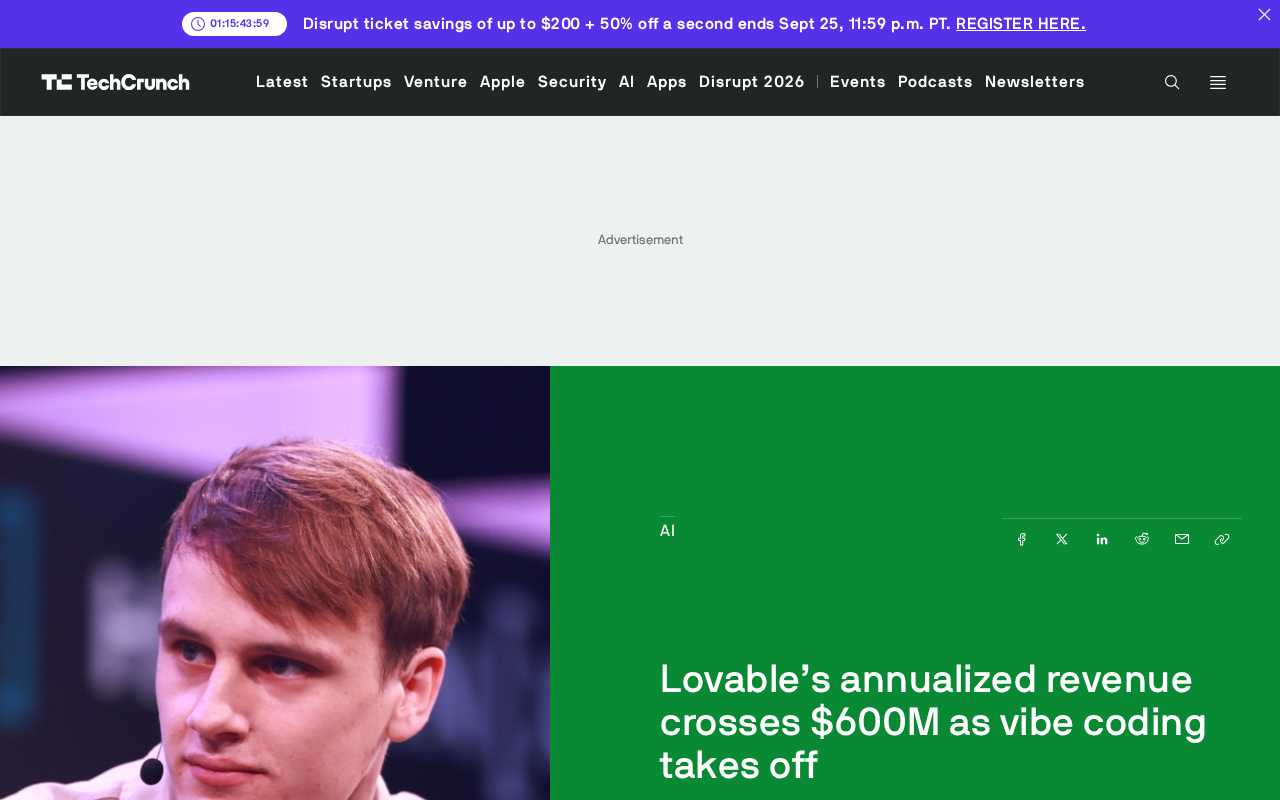
For a company still in its growth phase, $600 million ARR is a deeply meaningful milestone. It signals not only a large and engaged paying user base, but also that "building apps quickly with natural language" has moved well beyond proof-of-concept into genuine commercial value.
What Is Vibe Coding, and Why Is It Taking Off?
Vibe Coding refers to a style of software development where developers — or even non-developers — describe their intent in natural language, and AI generates, modifies, and iterates on application code accordingly. Users no longer need to write code line by line. Instead, they describe "what kind of app I want" in plain conversation, and AI handles everything from interface to logic.
The reason this paradigm has scaled so quickly comes down to one thing: it dramatically lowers the barrier to creating software. What used to require an engineering team working for weeks can now be prototyped and shipped by an individual in minutes or hours. The nearly one billion monthly page views on Lovable's platform is a direct reflection of this low-barrier, high-output dynamic — massive numbers of apps are being created and actually used by real people.
From Tool to Ecosystem
The "nearly one billion monthly page views" figure carries deeper significance. It suggests Lovable isn't just a "code generator" — it's evolving into a platform for publishing and distributing apps with real audience reach. Apps created here can reach genuine users, which creates a positive feedback loop: more creators build apps, more traffic flows in, and more traffic attracts even more creators.
The term "Vibe Coding" was coined by OpenAI co-founder Andrej Karpathy in early 2025. He used it to describe a programming experience where you're "fully immersed in the vibe, forgetting that the code even exists" — the developer expresses intent, and AI handles all implementation details. The concept quickly resonated, partly because it precisely captured the new mode of human-AI collaboration that emerged as large language models matured in their coding capabilities.
Unlike earlier "code completion" tools (such as GitHub Copilot's line-by-line suggestions), Vibe Coding emphasizes end-to-end intent expression. A user says "I want a small app to track my daily water intake," and the platform outputs a complete, runnable product — not just a completed function. Platforms like Lovable, Bolt, and Cursor are all representative practitioners of this paradigm, sharing the common thread of integrating natural language conversation with code generation, preview, and deployment into a single unified workflow.
ARR (Annual Recurring Revenue) is the core metric used in the SaaS industry to measure subscription revenue, calculated by multiplying current monthly recurring revenue by 12 or annualizing total contract value. Its significance lies in what it reflects: predictable, ongoing revenue rather than one-time transactions. Investors regard it as the preferred indicator of health and growth momentum for subscription software companies. $600 million ARR means Lovable generates roughly $50 million in monthly recurring revenue — a scale that ranks among the top tier of AI startups founded within the last few years, comparable to platforms like Midjourney and Cursor, and a strong signal that paying users are genuinely dependent on the product rather than just trying it out.
Dual Validation: Revenue and Traffic
The $600 million ARR and nearly one billion monthly page views represent a two-sided validation of the Vibe Coding model — from both the supply side and the demand side.
The revenue proves willingness to pay — people are buying into "building apps faster and more easily." The traffic proves the value of what's being built — apps created on the platform are actually being used. The two metrics reinforce each other and guard against the misreadings that any single indicator might invite (such as high revenue with low actual usage, or high traffic that can't be monetized).
This also explains why the AI coding space has attracted intense attention from investors and the developer community. When a platform can simultaneously demonstrate strong monetization and real-world usage at scale, it becomes the benchmark case for the broader Vibe Coding trend.
Implications for Developers and the Industry
For individual developers and small teams, Lovable's growth sends a clear signal: the ability to build software is being redistributed. As technical barriers fall, more people with ideas but without an engineering background can turn those ideas into working products.
For the industry at large, this trend may reshape the software development value chain. As AI takes over the repetitive "manual labor" in traditional development workflows, human value will increasingly lie in defining requirements, exercising product judgment, and generating original ideas. This is both an opportunity and a challenge to the skill sets currently held by working developers.
Of course, rapidly generated apps still face real tests around quality, security, and maintainability — and these remain ongoing challenges that the Vibe Coding model must continue to address at scale. But based on Lovable's current numbers, the market's embrace of this new paradigm is moving far faster than many expected.
The quality and security issues exposed as Vibe Coding scales deserve specifics. Rapidly generated code often lacks systematic error handling, input validation, and access control, creating security vulnerabilities such as injection attacks and data leakage. The generated code structure may also be highly coupled and hard to extend, accumulating technical debt. Additionally, questions around IP ownership of AI-generated code remain legally ambiguous. In response, some platforms are beginning to integrate static code scanning and dependency vulnerability detection directly into the generation pipeline, shifting security review earlier in the process. For production applications handling sensitive data or requiring long-term maintenance, Vibe Coding is currently better suited as a prototyping and validation tool rather than a full replacement for rigorously reviewed traditional development workflows.
Related articles

How Big Can Stars Really Get? The Physical Limits of the Largest Stars
Red supergiants are the largest stars by volume, with radii up to 2,000 times the Sun, engulfing the inner solar system. But there is no precise upper limit on stellar size—models predict up to 15,000 solar radii. The most massive blue stars are far smaller than red supergiants—biggest and heaviest are two different things.

Apple HomeView Smart Display Full Feature Breakdown: Wall-Mount or Desktop, $299
Apple launches HomeView, a $299 smart display with wall-mount and desktop options, 12MP camera for facial recognition, smart home control, music playback, and recipe step-by-step cooking. Full breakdown of watch faces, apps, privacy, and cooking integration.

Where Did the Promised New Studio Go? Craft Computing Answers After Five Years
Craft Computing's host responds to viewer questions: the new studio promised five years ago was shelved as construction costs soared from $30,000 to $75,000, and was replaced by a 168-square-foot garage conversion.