Lovable Launches Growth Tools: The Entire App Growth Workflow in One Chat Window

Lovable launches Growth Tools, bringing ads, SEO, and asset generation into one chat window as it expands into growth.
Lovable launched Lovable Growth Tools on Product Hunt, integrating ad campaigns, search discovery, and content creation into a conversational interface. Users set a growth goal, and the system generates a targeted launch playbook based on existing app builds. The tool covers Google, YouTube, Facebook, and Instagram, uses Semrush data for SEO, and reuses assets from app builds. Its differentiation is proximity to app and traffic data and user approval over spending, targeting agencies and tool stacks. This reflects AI building platforms shifting toward full lifecycle services, though results depend on SEO measurability and ad automation.
Lovable is expanding from an AI app-building tool into an integrated "build + grow" platform. Its new product, Lovable Growth Tools, launched on Product Hunt with a core selling point: everything from building an app to growing a business, all in one chat window. The tool received 60 votes on Product Hunt, ranking 14th, and is categorized under Marketing, Growth Hacking, and No-Code.
From Building to Growth: Expanding Lovable's Capabilities
Previously, developers used Lovable for app prototyping and code generation, but once an app launched, customer acquisition, ad campaigns, and SEO often required switching between multiple tools or even outsourcing to agencies. Growth Tools signals that Lovable is trying to bring the "growth" step into its own product ecosystem.
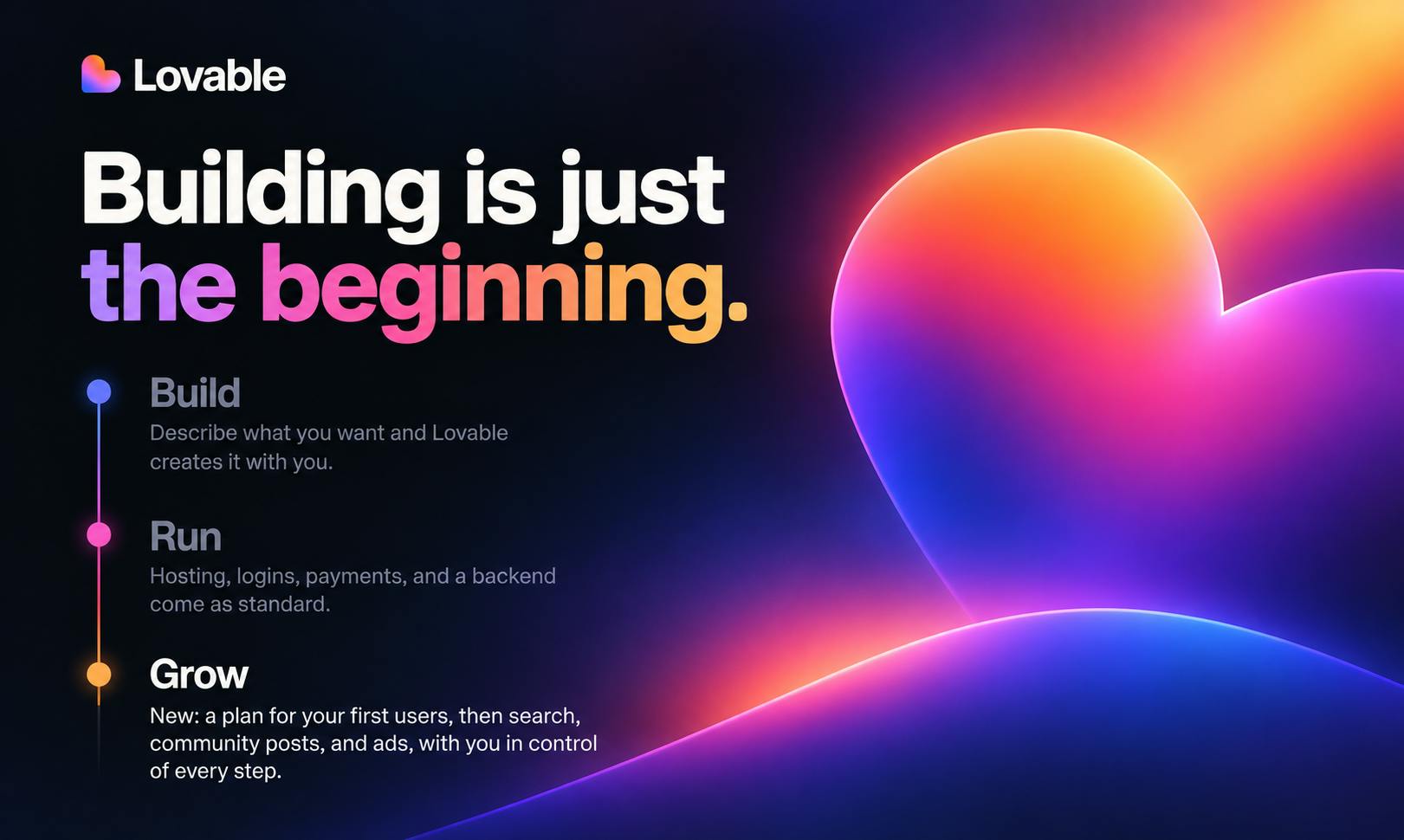
According to the official description, users simply set a goal—such as "my first 100 signups"—and Growth Tools generates a launch playbook based on the app itself. This playbook isn't a generic template; it's generated by extracting information from the user's existing app build.
This "starting from the app itself" approach differs notably from traditional growth tools, which require users to manually configure audiences, creatives, and budgets. It's closer to a growth assistant that understands your product, rather than a neutral ad management backend.
A Growth Toolkit in One Chat Window
Growth Tools integrates multiple marketing workstreams into a conversational interface. According to the official description, its capabilities include:
- Ad campaigns: covering major channels including Google Search, YouTube, Google Maps, Facebook, and Instagram
- Search discovery: leveraging Semrush data to help apps be found on Google and in AI search
- Content creation: generating images, videos, and copy directly from the user's existing app builds
These capabilities cover the three most time-consuming categories of growth work: running ads, doing SEO, and producing creative assets. Consolidating these functions into a single conversation flow reduces the cost of switching between tools and the cost of producing assets from scratch.
You may not have noticed that asset generation is based directly on the user's existing "builds" (app build outputs), which means brand tone, product screenshots, and UI style can be automatically reused rather than requiring users to re-upload and organize them.
Semrush is a leading global SEO and competitive intelligence SaaS platform, with core capabilities including keyword databases, competitor traffic analysis, backlink audits, and search ranking tracking. Its data covers hundreds of millions of keywords across multiple regional search engines, and it's used by many marketing teams as the de facto standard for SEO decision-making. Growth Tools' integration with Semrush means users can access keyword suggestions, search visibility analysis, and similar capabilities within the conversational interface without needing to purchase and configure a Semrush account themselves. This also opens a two-way channel: one end is traditional Google search ranking optimization, and the other is brand visibility in emerging AI search (such as AI Q&A engines). For indie developers unfamiliar with the SEO toolchain, this built-in integration significantly lowers the barrier to entry for search optimization—but it also means that performance evaluation will depend on the update frequency and coverage of Semrush data.
Differentiation from Agencies and Tool Stacks
In its description, Lovable explicitly contrasts two categories of alternatives: agencies and a pile of tools.
Its differentiation comes down to two points. First, location—Growth Tools "lives next to your app and your traffic," rather than being a standalone ad platform or third-party service. This physical proximity means it can directly read app data and traffic data without relying on manual imports by the user. Second, control—the official description emphasizes that "you approve before anything spends."
These two points directly address the two core doubts facing AI growth tools: Does the AI understand my product? Will the AI spend recklessly? Keeping approval authority in the user's hands while letting AI make decisions based on real app data is Lovable's answer.
Judging from the Product Hunt data, 60 votes and 1 comment indicate the product is still in an early exposure phase, with relatively low community buzz. But considering Lovable's existing user base in the AI building tool space, Growth Tools looks more like a capability extension for existing users than a standalone new product for customer acquisition.
A tool stack (a pile of tools) is a common operational setup for indie developers and growth teams: using a combination of tools to handle different steps separately—for example, Vercel or Netlify for deployment, Google Ads for campaigns, Ahrefs or Semrush for SEO, Canva or Figma for creative assets, plus several analytics tools. The hidden cost of this model lies in data fragmentation between tools—each tool only sees its own segment, and users must manually move data and align metrics. Growth Tools' differentiation targets exactly this pain point: the tool itself sits between the app and traffic, can directly read build outputs and app data, and eliminates the friction of cross-tool imports. By contrast, the agency model, while hassle-free, is expensive, slow to provide feedback, and depends on upfront communication for understanding the product. By contrasting both categories of alternatives at once, Lovable is effectively signaling that it's cheaper and faster than agencies, yet more cohesive than a tool stack.
The Growth Loop Logic of AI Building Tools
Growth Tools reflects a broader trend: AI app-building platforms are extending both upstream and downstream.
Upstream is demand and design; downstream is deployment, operations, and growth. Once the building barrier is drastically lowered by AI, the real bottleneck shifts from "can it be built?" to "will anyone use it?" By embedding growth tools directly into the building workflow, Lovable is essentially addressing this bottleneck.
For users, this means that going from an idea to acquiring the first batch of users may no longer require leaving the same interface. For the industry, it signals that the competitive focus of No-Code and AI building tools is shifting from "generation quality" to "full lifecycle service capability."
Whether growth tools can truly deliver depends on two variables: whether SEO results after Semrush data integration are quantifiable, and whether the degree of ad automation can lower the operational barrier without sacrificing performance. The answers to these questions will need to be validated after more users actually use the product.
Full lifecycle service capability refers to a platform's complete coverage from demand discovery, design, and coding to deployment and growth operations. In traditional development pipelines, these steps are handled by different roles and tools, and AI building tools initially entered at the coding and deployment stages. As generation quality becomes homogenized, differentiation between platforms is beginning to extend toward both ends: the front end is demand understanding and product ideation, and the back end is user acquisition and retention after launch. Embedding growth tools into the building workflow essentially puts "building the product" and "getting people to use the product" in the same context, allowing growth strategies to be generated based on real app structure rather than abstract market assumptions. The potential risk of this strategy lies in the blurring of capability boundaries—if a platform must ensure both code generation quality and ad ROI, its depth in each area may be constrained.
One-line Summary
Lovable launches Growth Tools, integrating ads, SEO, and asset generation into a single chat window as it extends into growth.
Paragraph Summary
Lovable launched Lovable Growth Tools on Product Hunt, integrating ad campaigns, search discovery, and content creation into a conversational interface. Users simply set a growth goal, and the system generates a targeted launch playbook based on existing app builds. The tool covers channels including Google, YouTube, Facebook, and Instagram, leverages Semrush data to optimize SEO, and reuses assets directly from app build outputs. Its differentiation lies in being close to app and traffic data and preserving user approval over spending, benchmarking against two traditional approaches: agencies and tool stacks. The move reflects how AI building platforms are shifting from competition over generation quality to full lifecycle services covering deployment and growth, though actual results still depend on how quantifiable SEO is and the level of ad automation.
Related articles

JobRunner MCP Server: AI Agents Can Now Fix Failed Java Jobs
JobRunner launches an open-source MCP server enabling AI agents to view cluster status, diagnose failures, and recover Java jobs—incident response from any cloud coding environment or existing agent.

MLAI Digital Launches 9 Security Agents: MCP Server Safeguards the Full Lifecycle of Agentic AI
MLAI Digital launches Security MCP Server with nine built-in specialized security agents covering vulnerability discovery, attack simulation, prompt injection detection, API and infrastructure assessment, and accelerated remediation—embedding security validation across the full Agentic AI lifecycle from development to production.

Running Isaac Lab on H100 GPUs: Exploring Better Approaches
Exploring optimization methods for running Isaac Lab on NVIDIA H100 GPUs, including MIG configuration, mixed precision, TensorRT acceleration, and community experience to improve robotics simulation and reinforcement learning efficiency.