LRCC: A New Approach to Improving Low-Rank Compression with Conditional Computation

LRCC adds per-token dynamic routing to low-rank compression, boosting Llama-2-7B accuracy by 7.6pp.
LRCC (Low-Rank Conditional Computation) improves on static low-rank compression by training lightweight routers for each Transformer block that dynamically route tokens through nested low-rank paths — complex tokens take higher-rank paths for stronger expressiveness, while simple tokens use lower-rank paths to save compute. Since low-rank factors remain frozen during training and only routers are optimized, adoption cost is low and LRCC can be layered on existing compressed models. Experiments on Llama and Qwen models show a 7.6 percentage point accuracy gain over static methods on Llama-2-7B under equal activation budget, with perplexity and accuracy improvements under matched real decoding latency — all without requiring custom kernels.
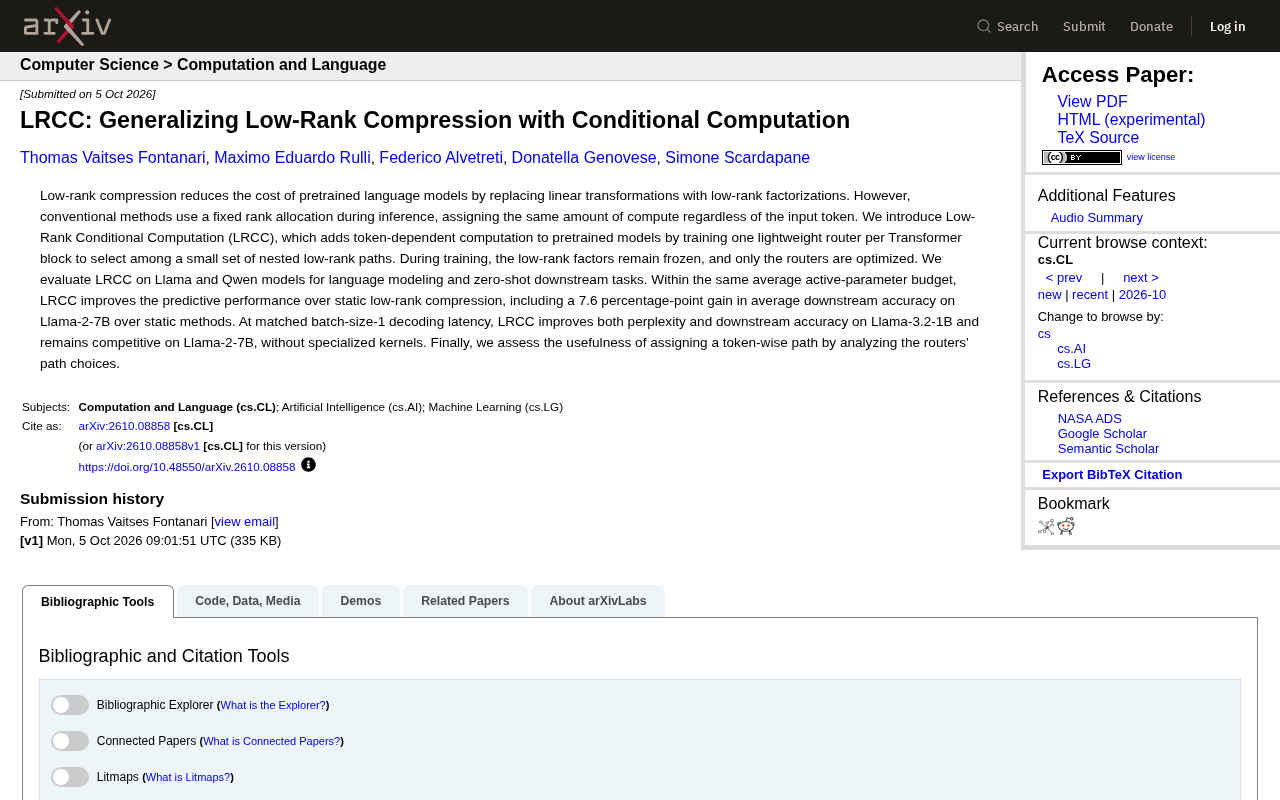
The inference cost of large language models remains high, and low-rank compression is a common technique for slimming them down: decomposing a linear layer's weight matrix into two smaller matrices to reduce computation and parameter count. However, traditional approaches have a notable weakness — they use fixed rank assignments at inference time, allocating the same computational resources regardless of whether the input token is simple or complex. A newly published arXiv paper, LRCC: Generalizing Low-Rank Compression with Conditional Computation, proposes an improvement that aims to make compressed models significantly smarter.
The Problem with Fixed Rank Assignment
The core logic of low-rank compression is that linear transformations in pretrained models often contain redundancy, and can be approximated using low-rank factorization to reduce deployment overhead. This approach has been widely validated, but its computational allocation is one-size-fits-all.
Whether the model is processing a word carrying critical semantic meaning or an insignificant function word, it allocates the same amount of computation. This is counterintuitive — different tokens should inherently require different levels of processing effort. In other words, static low-rank compression applies uniform compute to non-uniform inputs, creating a resource mismatch: wasting compute on simple tokens while potentially underserving complex ones.
Low-rank decomposition is typically implemented mathematically via Singular Value Decomposition (SVD): performing SVD on a weight matrix W (of shape m×n), retaining the top r singular values and their corresponding singular vectors to obtain an approximation W ≈ UΣVᵀ, where U is m×r, V is n×r, and r is much smaller than the original dimensions. At inference time, the original large matrix multiplication is replaced by two sequential smaller matrix multiplications, reducing parameter count from m×n to r×(m+n) with a corresponding reduction in computation. The choice of rank r is a trade-off between accuracy and efficiency: smaller r yields higher compression but greater approximation error, while larger r approaches original performance but offers limited savings. Traditional methods fix r after selection and apply the same low-rank approximation uniformly to all inputs throughout inference.
LRCC's Core Mechanism: Dynamic Per-Token Routing
LRCC (Low-Rank Conditional Computation) introduces token-dependent computation into pretrained models. The approach trains a lightweight router for each Transformer block, which selects among a set of nested low-rank paths.
These nested paths can be thought of as multiple computation channels with different rank sizes — higher rank means more thorough computation but greater overhead. The router dynamically decides which path to take based on the characteristics of the input token: complex tokens take higher-rank paths for stronger representational capacity, while simple tokens take lower-rank paths to conserve compute.
This design essentially grafts the philosophy of Conditional Computation onto low-rank compression, sharing conceptual ground with Mixture-of-Experts (MoE) models that activate parameters on demand — but operating at the granularity of low-rank factorization, making it significantly more lightweight.
Training Strategy: Freeze the Low-Rank Factors, Train Only the Router
A noteworthy engineering detail in LRCC is its training strategy: during training, the low-rank factors remain frozen, and only the routers are optimized. This substantially reduces training cost and complexity — there's no need to retrain the large weight matrices; only a small set of routing decision modules needs to be learned.
This means LRCC can serve as a relatively low-cost enhancement layered on top of existing static low-rank compressed models, without starting from scratch.
Conditional Computation refers to a class of techniques that dynamically decide which parts of a network to activate based on the input, motivated by the insight that "not all inputs require the same depth of computation." Mixture-of-Experts (MoE) is the most representative implementation: each layer contains multiple "expert" sub-networks, with a gating network selecting a small number of experts per token, controlling actual compute consumption while maintaining large overall parameter counts. Early Exit mechanisms represent another approach, allowing simple samples to produce outputs at shallower layers without traversing the full network depth. LRCC's nested low-rank paths can be viewed as a concrete instantiation of conditional computation at the weight decomposition granularity — compared to the additional expert parameters introduced by MoE, it reuses existing low-rank factors with smaller additional parameter overhead.
Experimental Results: Better Performance Under Equal Budget
The paper evaluates LRCC on Llama and Qwen series models across two settings: language modeling and zero-shot downstream tasks. Key findings include:
- Under the same average activated parameter budget, LRCC outperforms static low-rank compression in predictive performance. On Llama-2-7B specifically, average downstream task accuracy improves by 7.6 percentage points over the static method — a substantial margin.
- Under matched batch-size-1 decoding latency, LRCC improves both perplexity and downstream accuracy on Llama-3.2-1B, while remaining competitive on Llama-2-7B.
- Critically, these gains do not depend on specialized custom kernels, meaning the barrier to practical deployment is relatively low.
The latency-matching aspect is especially meaningful. Many dynamic computation methods theoretically save compute but may actually worsen real-world latency due to routing overhead and implementation complexity. LRCC achieving improvements under equal real-world latency indicates that its design accounts for engineering feasibility.
Perplexity (PPL) is the most commonly used intrinsic evaluation metric for language models, measuring the model's prediction uncertainty on test text — lower values indicate better fit to the language distribution. In compression settings, perplexity is typically used for rapid assessment of quality degradation introduced by compression. Zero-shot downstream task accuracy is an extrinsic evaluation, measuring the model's ability to perform commonsense reasoning, question answering, language understanding, and similar tasks without task-specific fine-tuning — more directly reflecting real-world utility. Improvements on both metrics simultaneously means LRCC's gains are not limited to statistical fitting improvements, but genuinely translate into enhanced task execution capability.
What the Router Actually Learns
The paper also analyzes the router's path selection behavior to assess the practical value of per-token path assignment. This kind of analysis is crucial for understanding the method's effectiveness — if the router merely selects paths randomly, performance gains might stem from other factors; but if routing choices exhibit meaningful patterns (e.g., systematically assigning higher ranks to specific types of tokens), it corroborates the foundational premise that "different tokens require different compute."
This interpretability analysis also points toward directions for future research: whether routing strategies can be further optimized and how to design the granularity of nested paths are both questions worth exploring in depth.
Implications for Model Compression
LRCC represents a trend in model efficiency research: moving from static compression toward dynamic, input-adaptive compression. It brings the concept of conditional computation — already repeatedly validated in directions such as MoE and early exit mechanisms — into the domain of low-rank compression, and reduces adoption cost with a lightweight approach of freezing factors and training only the router.
For real-world deployment scenarios that need to balance inference cost against model quality, this class of methods provides a new trade-off dimension. Of course, as a freshly published preprint, LRCC's generalizability, performance on larger-scale models, and combination effects with other compression techniques still await further validation. But its core idea — letting compressed models allocate compute on demand — undeniably points toward a valuable research direction.
Related articles

Python 3.15 New Feature: Is the sentinel Type Better Than None?
Python 3.15 adds the sentinel type, using named unique sentinel objects to replace None and bare object(), resolving confusion among missing values, explicit emptiness, and invalid input while avoiding type hint failures.

Deep Learning's Three Architectures and the Universal Approximation Theorem: A Complete Guide to MLPs, CNNs, and Transformers
Explaining the inductive bias differences among MLP, CNN, and Transformer, the existence meaning of the Universal Approximation Theorem (UAT), and the role of Taylor expansion in approximation analysis, while clearing up common misconceptions.

GitLab Emergency Patch Release: Analysis of Critical Security Fixes
GitLab releases critical patch 19.5.1, sparking 355 points of discussion on Hacker News. This article analyzes the background, upgrade steps for self-hosted instances, and verification points to help DevOps teams respond quickly to security updates.