LTX2.3 Open-Source Model Tested: Full AI Comic Drama Pipeline on Just 6GB VRAM

LTX2.3's ComfyUI bundle enables full AI comic drama production on consumer 6GB VRAM GPUs.
LTX2.3 is an open-source DiT-architecture video model by Lightricks that runs on consumer GPUs with just 6GB VRAM. Its ComfyUI bundle integrates the entire AI comic drama pipeline — character generation, image-to-video, director's-table storyboarding, motion transfer, frame interpolation, and segmentation — making local AI video narrative creation accessible without high-end hardware or complex setup.
Why LTX2.3 Deserves Attention
Amidst a steady stream of open-source video generation models, LTX2.3 has sparked genuine buzz in the creator community for two core reasons: low hardware requirements and all-in-one functionality. According to hands-on testing by Bilibili creators, this ComfyUI bundle built around LTX2.3 runs on consumer GPUs with as little as 6GB of VRAM — meaning a large number of everyday users can enjoy local AI video creation without investing in high-end hardware.
LTX2.3 is an open-source video generation model developed by Lightricks, built on the DiT (Diffusion Transformer) architecture. Compared to earlier U-Net-based video diffusion models, DiT offers structural advantages in temporal consistency and motion modeling, maintaining semantic coherence across frames more effectively. A key design goal of the LTX model series is to preserve usable generation quality at lower VRAM footprints, making it significantly more viable on consumer hardware than contemporaries like CogVideoX or Wan2.1. The 6GB VRAM baseline corresponds to cards like the NVIDIA RTX 3060 and 4060 — affordable consumer GPUs that represent a large share of the domestic creator market.
More importantly, this isn't just a simple image-to-video model. It integrates the entire workflow for AI comic drama production: character image generation, scene construction, image-to-video, director's-table storyboarding, multi-grid character interactions, motion transfer, video frame interpolation, subtitle removal, and image/video segmentation. In other words, it doesn't just solve "how to generate a nice-looking image" — it tackles the much harder challenge of "how to produce a coherent, complete comic drama series."
The Real Pain Points of AI Comic Drama Production
Many people's understanding of AI video creation stops at "enter a prompt, get a video." But anyone who has actually tried it knows the real challenges don't lie in single-frame quality.
Character Consistency and Scene Coherence Are the Real Hurdles
"The hard part of making an AI comic drama was never generating a beautiful image — it's keeping the same character looking consistent, keeping scenes logically coherent as the story progresses, making actions connect naturally, and getting the footage into post-production." This observation cuts to the heart of AI narrative content creation.
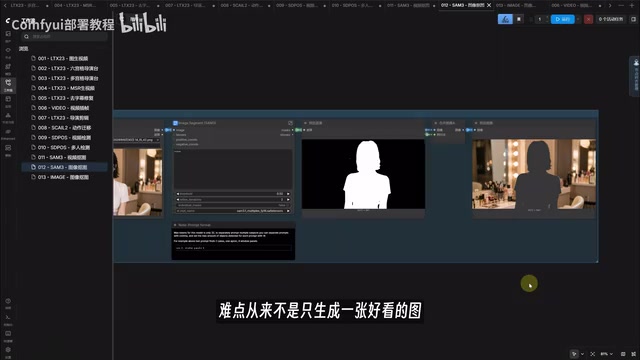
Generating a single stunning image isn't difficult. The challenge is keeping the same character's appearance consistent across dozens of shots, maintaining logical continuity in scenes as the story unfolds, and ensuring actions flow naturally from one to the next. This is precisely why so many AI creative projects deliver impressive demos but fall apart as finished productions.
From a technical standpoint, Character Consistency is one of the central unsolved problems in AI video and comic generation: diffusion models re-sample from noise with each new generation, and inherently have no "memory" of a character's appearance. The main solutions include IP-Adapter (encoding character appearance as image prompts injected into the generation process), LoRA fine-tuning (training the model to remember specific character features), and Multi-Image Reference — conditioning the output on multiple reference frames. The MSR (Multi-Image Reference) module in the LTX2.3 bundle falls into this last category, using multiple reference images to reinforce character feature stability.
Setup and Configuration Costs Have Turned Away Too Many Creators
Another frequently cited pain point is the cost of environment setup. ComfyUI, currently the most popular node-based editor in open-source AI image and video generation, uses a Directed Acyclic Graph (DAG) visual workflow design, letting users chain together steps like model loading, image preprocessing, sampling, and post-processing as connected "nodes." Its strength is high customizability, but complex node dependencies and frequent compatibility issues with custom nodes make it a steep barrier to entry. Wrong model paths, missing nodes, misconfigured parameters, workflow errors — these issues tend to consume all your valuable creative time just when you "only wanted to make a character dialogue scene."
The value of an integrated bundle is precisely that it gets users over this first and hardest hurdle: pre-configured with all dependencies and workflow files, compressing the complex setup process into "step one: download, step two: extract, step three: double-click to open."
Breaking Down the Bundle's Core Feature Modules
This ComfyUI bundle isn't a single model — it's a complete collection of workflows organized around the comic drama production pipeline.
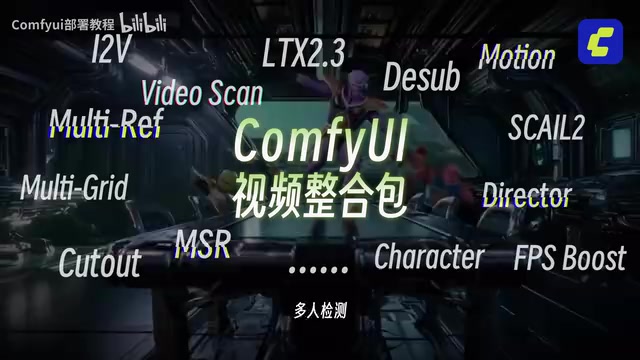
Video Generation
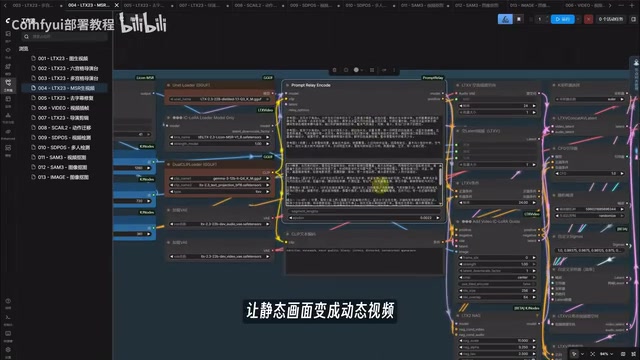
- LTX2.3 Image-to-Video: Import character and scene images, then use text prompts to control character actions, expressions, and camera movements — bringing static artwork to life. This is the core engine of the entire workflow.
- Multi-Grid / Six-Grid Director's Table: Designed specifically for comic drama shot planning. Complex scenarios — two characters having a remote conversation, a character turning around, expression changes, camera cuts — can all be orchestrated through the director's table workflow. This is one of the bundle's most distinctive modules.
- MSR Multi-Image Reference Video Generation: Supports multiple reference image inputs, using multi-frame conditioning to constrain generation results, significantly improving controllability and character consistency.
Post-Production Assistance
Finished AI comic dramas require post-processing, and the bundle covers this as well:
- Scalar Motion Transfer: Generate character movement by referencing existing motion videos, solving the problem of "actions that are nearly impossible to describe in text." The underlying approach typically involves extracting skeletal pose sequences from a source video and injecting that motion pattern as a conditioning signal into the generation process. Text can describe static features well, but is nearly powerless for continuous dynamic details like "step left while raising the right hand, with a corresponding weight shift" — a reference video carries all of that information directly.
- Frame Interpolation: Increases frame rate for smoother motion. Due to VRAM and generation length constraints, AI video models typically output at 8–16 fps. Frame interpolation improves fluidity by generating intermediate frames between existing ones. Within the ComfyUI ecosystem, RIFE has become the go-to interpolation solution thanks to its fast inference and stable results.
- Subtitle Removal and Inpainting: Cleans existing subtitles from source footage and repairs visual artifacts.
- Video and Image Segmentation (Matting): Used for compositing characters, backgrounds, and assets — a foundational capability for multi-character interaction shots.
- Multi-Person Detection / Video Detection: Assists in identifying human elements within frames.
Real-World Experience for First-Time Users
For complete newcomers to AI comic drama, the greatest value of this bundle is the dramatically reduced startup cost. The workflow is simplified to "step one: download, step two: extract, step three: double-click to open" — no need to study complex node configurations from scratch.
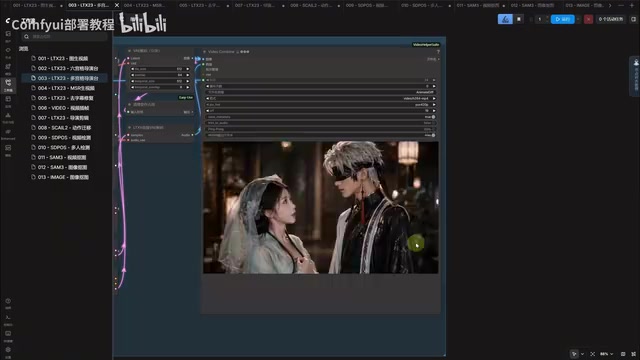
The demo videos cover multiple real generation scenarios including character dialogue, dramatic storyboarding, and multi-character interactions in a snowy forest setting. From the results, character expressions, actions, and camera choreography already demonstrate enough capability to tell simple stories. Of course, bundle demos tend to showcase the best cherry-picked results — actual character consistency, generation success rates, and render times still need to be verified by individual users.
Get the First Workflow Running, and Everything After Gets Much Easier
The creator's advice here is refreshingly pragmatic: once you've actually run your first workflow and produced your first AI comic drama clip, everything downstream — historical dramas, campus shorts, fantasy stories, or product narrative videos — becomes much easier. This aligns with a universal pattern in technical learning: the hardest step is always going from zero to one. Once a working workflow baseline is established, the cost of adapting to new styles and subjects drops dramatically.
A Clear-Eyed View of Local Deployment's "Open-Source Freedom"
Local deployment delivers three kinds of freedom: AI freedom (no dependence on cloud services), control freedom (deep parameter and workflow customization), and creative freedom (content not subject to platform moderation). This has always been the direction the open-source community pursues.
Since 2023, organizations including Stability AI, Lightricks, Zhipu AI, and StepFun have progressively open-sourced video generation model weights, rapidly building a local deployment ecosystem centered around ComfyUI, bundled packages, and shared workflows. The core logic of this ecosystem: model researchers release weights → community developers package workflows → bundle creators lower installation barriers → content creators focus on content production. Every link in this chain continuously compresses the technical barrier, steadily transforming AI video generation from a lab tool into a creative production tool.
That said, a few things deserve a realistic assessment: "runs on 6GB VRAM" typically means operating at lower resolutions, shorter durations, or with some trade-off in speed. Pursuing high-quality long-form video still requires more powerful hardware. Additionally, the real-world performance of auxiliary features like motion transfer, segmentation, and frame interpolation varies noticeably depending on the quality of input material.
For users looking to get started with AI video narrative creation, bundles like this represent a worthwhile starting point — aggregating scattered capabilities into a complete pipeline so creators can focus their energy on content itself, rather than endlessly wrestling with environment setup.
Closing Thoughts
The significance of the LTX2.3 bundle lies less in any single model's technical breakthrough and more in a victory of "engineering-level packaging." It reflects a maturation of open-source AI video creation — a shift from "playing with models" toward "making content." As technical barriers continue to flatten, what will truly differentiate creators is their storytelling ability and aesthetic judgment. For everyday users, being able to run a complete comic drama production pipeline locally on a consumer GPU is, in itself, the most tangible dividend of this open-source wave.
Related articles

Felix Rieseberg Personal Homepage
Felix Rieseberg's personal homepage sparks attention on Hacker News. This article covers the Slack engineer's technical background, the rise and fall of nativefier, and the value of a developer homepage as a tech calling card.

@ai-sdk/vue 3.0.306 Patch Release Syncs with [email protected] Update
@ai-sdk/vue 3.0.306 released, synced with [email protected]. A routine patch release for the Vercel AI SDK ecosystem with no public API changes; the Vue adapter layer stays version-aligned with the core package.

Gemini 4 Argon API Launches: The Era of Million-Token Output Begins
Google launches Gemini 4 Argon with sparse MoE architecture, up to 1M output tokens, and a 68.90% Vals Index score, available across API, AI Studio, and the Gemini app.