Lucid Train: A New Paradigm for AI Programming Driven by Architecture Diagrams

Lucid Train uses architecture diagrams as AI coding agent specifications, supporting fully offline local models.
Lucid Train is a developer tool that automatically generates architecture diagrams from codebases and uses them as execution specifications for coding agents. It supports bidirectional workflows—reverse-engineering existing projects and forward-designing new ones. With fully offline local model support, it addresses enterprise data security concerns while using structured diagrams to reduce dependence on raw model capability.
From Code to Architecture, and Back Again
In today's landscape of endless AI programming tools, most products focus on one thing: translating natural language instructions into code. But a long-overlooked problem remains—AI programming assistants often lack understanding of overall system architecture. They can write an elegant function, but struggle to make design-consistent decisions within a large, existing codebase.
The developer tool Lucid Train, which recently appeared on Product Hunt (ranking #15 on its launch day with 72 upvotes), targets exactly this pain point. Its core philosophy can be summed up in one sentence: First generate architecture diagrams from the codebase, then use those diagrams as specifications for the coding agent.
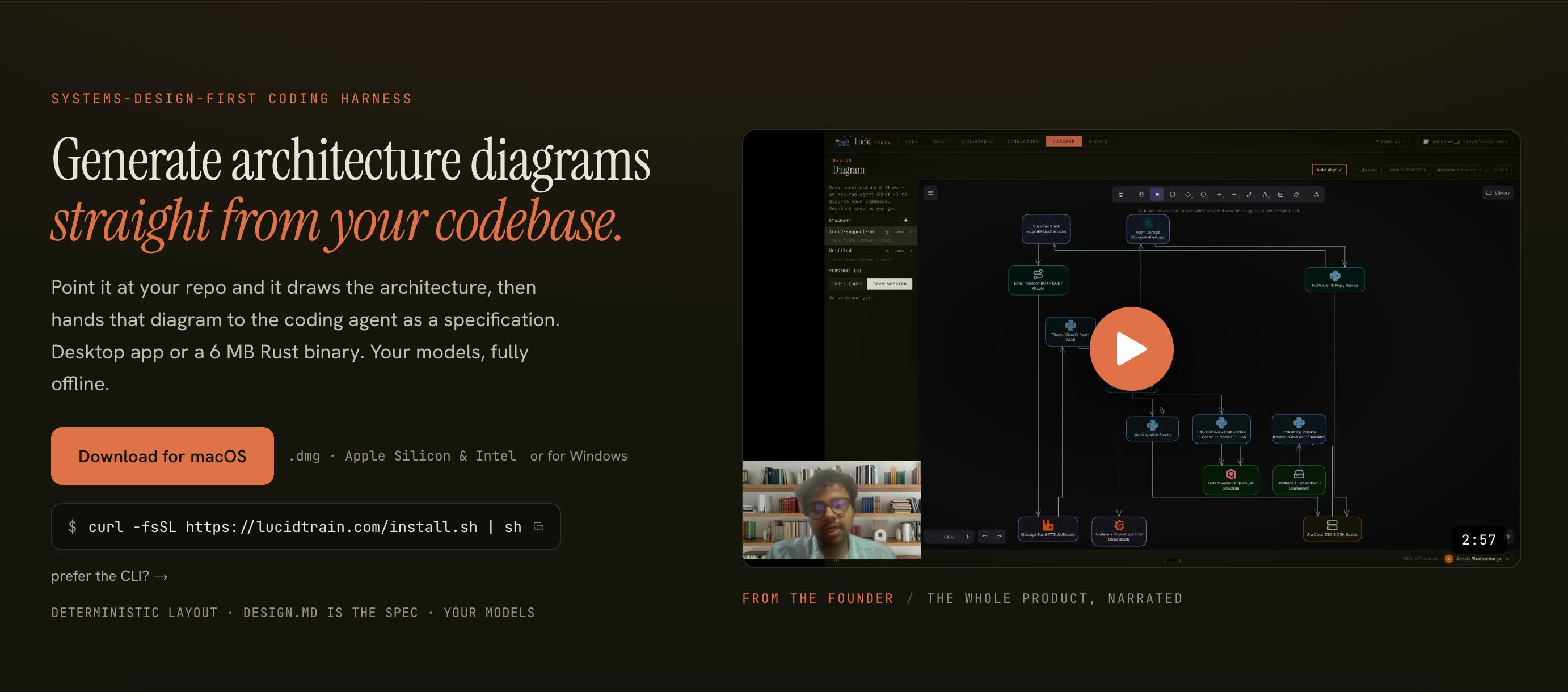
This approach stands in stark contrast to the mainstream "prompt-to-code" paradigm. Lucid Train attempts to insert a structured "design blueprint" layer between human intent and AI execution, giving the AI a clear reference for every action it takes.
Architecture Diagrams as the "Intermediate Language" for AI Programming
Why AI Programming Needs an Architecture Layer
A well-established principle in software engineering is that code is the "implementation" of system design, not the "design itself." When we directly ask AI to modify a large project, all it sees are scattered files and functions—it can barely grasp the dependency relationships between modules, data flows, and responsibility boundaries. This is why AI performs impressively on small scripts but frequently stumbles in real enterprise codebases.
Lucid Train's approach is to first perform static analysis on the codebase, automatically generating architecture diagrams that visually present the system's component divisions and interaction relationships. These diagrams serve both humans (helping developers quickly understand an unfamiliar project) and machines (acting as execution specifications for the coding agent).
Supporting Bidirectional Workflows: Reverse Analysis and Forward Design
Based on the product description, Lucid Train supports two directions of work:
- Existing codebase: Reverse-engineers architecture diagrams to help teams untangle legacy systems, onboard new team members, and support refactoring decisions.
- New codebase: Design the architecture first, then have AI implement code according to the diagram, ensuring the code aligns with design intent from the very beginning.
This "design-first" model essentially brings the mature Design-Driven Development philosophy from software engineering into the AI programming workflow. The architecture diagram plays the role of a "contract" here, constraining AI's free rein and reducing the risk of generated results going off the rails.
Local Models and Fully Offline: An Enterprise-Grade Data Security Solution
Addressing the Hard Requirements of Privacy and Compliance
One particularly noteworthy selling point of Lucid Train is: Local models, fully offline.
This is enormously significant in enterprise development scenarios. Uploading an entire codebase to cloud-based AI services is unacceptable for many financial institutions, healthcare organizations, government agencies, and large tech companies—the code itself represents core assets and trade secrets. Most mainstream AI programming tools (such as GitHub Copilot, Cursor, etc.) rely on cloud-based large models. While efficient, concerns about data leakage persist.
Lucid Train's local-first approach means that code analysis, architecture diagram generation, and the entire subsequent coding process can all be completed on internal networks or local machines, with no interaction with external servers. For teams with strict compliance requirements, this is practically a must-have feature.
Trade-offs and Clever Design of Local Execution
Of course, local models come with real-world trade-offs. Compared to cloud-based flagship models with hundreds of billions of parameters, locally runnable models typically compromise on capability. This also places demands on hardware—sufficient VRAM and compute power are needed to achieve usable inference speeds.
However, Lucid Train's architecture diagram "middle layer" design can partially compensate for this shortcoming: because the AI receives distilled, structured specifications rather than needing to understand the entire codebase from scratch, its dependence on raw model capability is reduced. This is a clever design that trades "engineering structure" for "model capability."
Industry Trends That Lucid Train Addresses
AI Programming Moving from "Code Completion" to "Architecture Understanding"
The first generation of AI programming tools centered on code completion, the second evolved into conversational generation, and the emerging third generation trend is enabling AI to truly understand the overall structure and intent of a codebase. Lucid Train's use of architecture diagrams as AI's "world model" is a concrete manifestation of this trend.
Coding Agents Need "Specifications" Not "Prompts"
As coding agents grow more capable, the industry increasingly recognizes that simply piling on prompts cannot enable Agents to reliably complete complex tasks. What Agents need are clear, verifiable specifications. Lucid Train treating architecture diagrams as the Agent's specification document effectively responds to the emerging "Spec-Driven Agent" paradigm.
As a product just getting started (with only 1 comment on launch day), Lucid Train's actual effectiveness still awaits validation from more users. The accuracy of its architecture diagram generation, adaptability to very large codebases, and the practical experience of local models all need time to prove themselves. But the idea it proposes—using architecture as a shared language between humans and AI—undoubtedly points in the right direction.
Summary: A Differentiated Path of Design-First + Local-First
Lucid Train's value isn't in being yet another "AI writes code" tool, but in redefining the AI programming workflow: transforming architecture diagrams from after-the-fact documentation into the core specification driving development. Combined with fully offline local model support, it offers a viable AI adoption path for teams highly sensitive to data security. In an era where AI programming tools are becoming increasingly homogeneous, this differentiated positioning of "design-first + local-first" is well worth continued attention.
Related articles

Chain of Thought Isn't Just for AI: How Humans Can Use CoT to Improve Thinking Quality
Chain of Thought isn't just a prompt trick for large models. Starting from a Hacker News discussion, this article analyzes why CoT works for human thinking too, breaks down actionable ways to transfer it, and highlights the key differences between human CoT and machine CoT.
Cloudflare Teams Up with OpenAI: Closi…
Cloudflare Teams Up with OpenAI: Closing the Loop from Vulnerability Discovery to Defense with AI
Cloudflare uses OpenAI Daybreak to investigate security vulnerabilities and generate reviewable remediation plans, while developers use Codex to boost coding efficiency and quality.

Orca Multi-Agent Orchestration in Practice: A Guide to Parallel Collaboration with Claude and Codex
Orca is Stable AI's free open-source agent workbench supporting 34 agents like Claude Code and Codex in parallel. Learn its Git worktree isolation, multi-model orchestration, and mobile management.