LumaFold: Turning the iPhone Foldable into a Dual-Sided Makeup Mirror

LumaFold uses foldable dual-screen zoning to turn one screen into a fill light and another into a mirror canvas, exploring a new creative tool form.
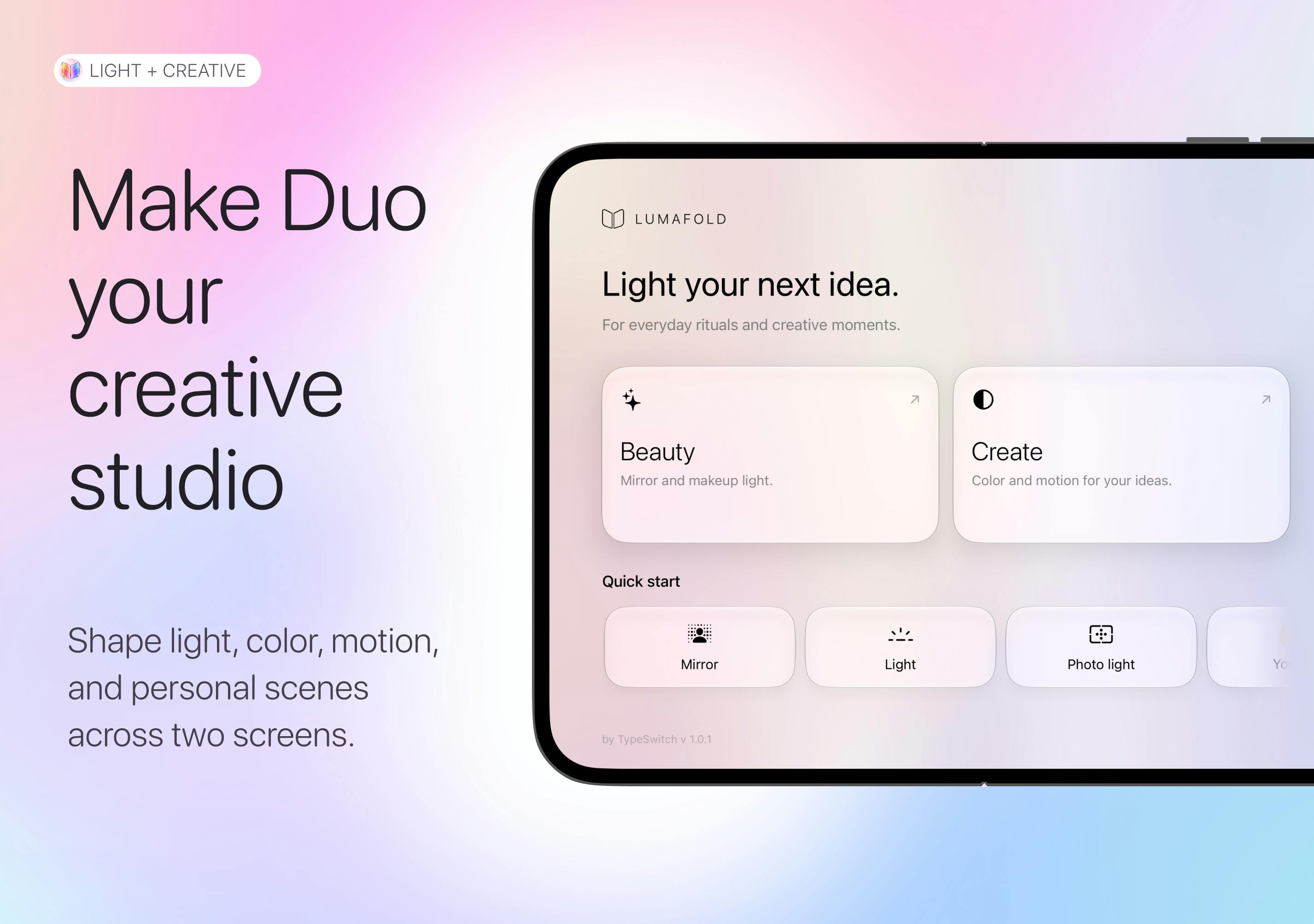
LumaFold is a creative tool app for iPhone foldable devices (iPhone Duo). Its core idea is to treat the two areas of the foldable screen as independent modules: one as a fill light with adjustable brightness and color temperature, the other showing a live camera mirror or creative content. Typical scenarios include makeup fill lighting, two-color pairing photography, and handwritten photo display. The product received 93 votes and ranked 3rd on Product Hunt, showing early user interest in foldable tool apps. The article argues its vertical strategy targeting beauty and light-creation audiences is reasonable, but key parameters like brightness range, color temperature precision, and power consumption remain undisclosed; long-term value depends on foldable device ownership and system permission limits.
From Tool to Creative Canvas: LumaFold Redefines Screen Lighting
On iPhone foldable devices, the screen is no longer just a window for displaying content—it can also become part of a creative and practical tool. LumaFold is exactly such a product: it leverages the dual-screen nature of foldables to turn one screen into an adjustable light source and the other into a real-time mirror or content display area. According to Product Hunt data, the product received 93 upvotes and 7 comments, ranking 3rd for the day, indicating that its concept has drawn considerable attention among early users.
Dual-Screen Zoning: One Side Lights, One Side Works
The core idea of LumaFold is to treat the two areas of a foldable screen as independent functional modules. The most typical scenario is makeup: users can open a live camera mirror in one area while the other area serves as a fill light with adjustable brightness and color temperature. This design sidesteps the hassle of traditional makeup mirrors needing an extra light source, and also avoids the screen glare that interferes with vision when using a phone's front camera.
This feature works because the physical form of a foldable device allows the two screens to unfold at an angle, rather than simply splitting a single screen in two. Developer Maxym Babenko emphasized on the Product Hunt page "making the iPhone Duo screen a creative studio," and from the actual demo, the zoning logic does feel more natural than a single-screen app.
The "dual-screen zoning" of foldables depends technically on the app's adaptation to Multi-Window and Split View modes. On foldable devices, iOS allows apps to treat the two screen areas as independent window scenes (UIScene), each with its own view hierarchy and lifecycle, so camera preview and solid-color fill light interfaces can be rendered separately. The fill light area glows by setting screen brightness to maximum and filling with a specific color value, while color temperature adjustment simulates different Kelvin temperatures by changing RGB combinations. The advantage of this approach is that no extra hardware is needed, but it is limited by the screen's peak brightness (typically a few hundred to a thousand nits) and the heat and battery drain from sustained high brightness—so actual fill light intensity may fall short of a professional ring light.
Color Animation and Photo Display: Beyond Fill Light
Beyond makeup scenarios, LumaFold also supports color animation and personalized photo display. Users can pair two colors to take creative photos, or combine favorite photos with handwritten messages for display. This means it is not just a practical tool but also carries a certain expressive and decorative quality.
Creative Play Beyond Fill Light
This combination of features brings to mind light painting photography and ambient light products, but LumaFold's difference is that it directly reuses the phone screen itself without additional hardware. For users who enjoy selfies or short video creation, adjustable color temperature and two-color pairing offer more controllable fill lighting, while the photo display feature suits personalized expression in social settings.
It should be noted that currently public information is mainly at the feature description level; specific metrics such as actual brightness range, color temperature adjustment precision, and battery consumption have not been disclosed. For an app whose core selling point is "light," these parameters directly affect the user experience, and follow-up reviews are worth watching.
Light Painting is a long-exposure photography technique: in low-light environments, the camera shutter is kept open while a moving light source draws patterns in the air, ultimately leaving light trails in the photo. Traditional light painting requires physical light sources like flashlights or glow sticks, whereas apps like LumaFold turn the phone screen into a programmable colored light source—users can change the screen display through color animations and two-color pairing during exposure, creating more controllable color trails in the photo. However, light painting has high demands on the camera's long-exposure capability and ambient light control; phone apps are more about providing auxiliary light sources and creative templates rather than fully replacing professional light painting tools.
An Early Explorer of the Foldable Ecosystem
LumaFold's choice to launch on iPhone Duo reflects a trend: the software ecosystem for foldable devices is still in its early stages, and developers are trying to establish differentiated experiences through dual-screen zoning interactions. Judging by its Product Hunt ranking, tool-type apps close to everyday scenarios have a chance to gain user attention.
Signals Worth Watching
From its positioning, LumaFold targets beauty, selfie, and light creative audiences rather than the general tool market. This vertical approach helps build recognition at a stage when foldable apps are scarce. But its long-term value depends on two factors: first, the installed base of foldable devices themselves; second, whether the system level will impose restrictions on third-party apps' use of screen brightness.
For domestic users, the product is currently released via Product Hunt, with the official website link pointing to the Product Hunt page; more detailed pricing and compatibility information has not yet been seen. If you are interested in foldable creative tools, keep an eye on the developer's future updates.
iPhone Duo is the codename for Apple's yet-to-be-officially-released foldable device; current public information mainly comes from supply chain and analyst predictions, and its final form, screen size, and system interaction remain uncertain. LumaFold's choice to debut on this device means the developer may have obtained test devices or simulators in advance, and also bears the risk of a mismatch between the product and the final hardware form. In addition, iOS has strict restrictions on third-party apps' permission to adjust screen brightness: apps typically can only affect the current interface through the screen brightness API and cannot control it globally like the system Control Center, and sustained high-brightness display may trigger overheating protection. These system-level constraints are key background for evaluating the feasibility of such apps.
Summary
LumaFold turns the dual-screen structure of foldables into a flexible lighting and mirror tool, finding an intersection among makeup fill lighting, color creation, and photo display. Its product thinking is commendable, but the actual experience still needs more details to verify. For the foldable ecosystem, such small and beautiful tool apps are exactly the kind of exploration needed at the current stage.
Related articles

AI Tools Quietly Altering Settings: Postman Silently Installs Plugin, Codex Sharing Option Auto-Resets
AI Daily reports: Postman silently installs a Mac plugin and self-approves startup hooks, logged as auto-existing upgrade; Hacker News developers say Codex data-sharing opt-out flips back. Plus Simon Willison's raw float weight experiment with QEN 3.8-27B.

AI Learns to Rewrite AI: MIT's "Weightspace Programming" Redraws the Path to Recursive Self-Improvement
MIT team proposes weightspace programming: GPT-6 Astra reads and edits AI model weights directly. Math scores jump several-fold, hand-written networks beat trained models. Eight experiments analyzed, plus Anthropic's same-day warning and the real boundaries of recursive self-improvement.

Running Qwen 3.8 on a Laptop to Read Raw Weights: 46 Minutes Per Answer
Simon Willison reproduced weight space programming with Qwen 3.8 27B on a laptop: a 17GB model file, 46 minutes per answer, 43,506 reasoning tokens, Pong over an hour, Freeway failed. Suited for interpretability researchers.