Luminous: A WhatsApp AI Customer Service Agent Powered by Your Own Knowledge Base

Luminous launches a WhatsApp AI Agent anchored by a knowledge base, with behaviour config and MCP tools, supporting gradual rollout and human handoff.
Luminous's WhatsApp AI Agent tackles the core pain point of enterprise bots 'not understanding the business' by starting from a company's knowledge base. It offers custom prompts, tone, and precision, connects external tools via custom APIs or MCP servers with fine-grained authorization, and supports pilot-number testing plus human handoff. The article argues the real barrier is in execution details like knowledge base update timeliness, permission clarity, and context transfer completeness—verifiable only under real traffic.
Key Points:
- Luminous launches a WhatsApp AI Agent that automatically replies to customers using a company's own knowledge base
- Supports customizable persona, tone of voice, and precision, allowing small-scale pilots before full rollout
- Connects to external tools via custom API or MCP servers, and supports handoff to human agents
1. Customer Service Automation Starting from the "Knowledge Base"
The pain point of most enterprise customer service bots isn't model capability—it's that they don't understand your business. Luminous's approach puts the "knowledge base" at the very start of the system: users must first populate it with documents, web pages, Q&A pairs, and business details, and the AI Agent answers based on this information.
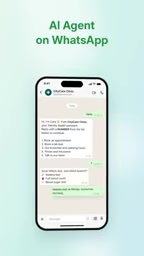
This design means replies are grounded and traceable, rather than generated out of thin air. For industries with high accuracy requirements—healthcare, legal, finance—this layer of "fact anchoring" is the key prerequisite for whether automated customer service can be trusted. In the video demo, the AI Agent answered a patient's question on WhatsApp and completed a lab test booking—all relying on pre-configured business information.
2. Behaviour Configuration: Persona, Tone, and Precision
The knowledge base determines "what to say"; the Behaviour configuration determines "how to say it." Luminous lets users start from a template, write custom prompts, and then set the tone of voice and precision.
These three dimensions map directly to common tensions in customer service: too casual feels unprofessional, too rigid lacks warmth; leaning toward precision may sacrifice flexibility, while leaning toward flexibility risks hallucination. Handing these controls to operations staff, rather than locking them into the model layer, is a pragmatic product choice. The Behaviour configuration screen in the screenshot shows the complete flow: choosing a starting point, entering a prompt, and adjusting tone/precision.

In the context of customer service AI, "precision" typically doesn't refer to the mathematical precision of model inference, but rather the strength of constraints on reply style: when raised, the Agent tends to answer strictly based on the knowledge base text, with conservative wording and less improvisation; when lowered, more rewriting and inference are allowed, yielding more natural tone but higher hallucination risk. Related sampling parameters such as temperature control the randomness of generated text. When operations staff tune these dimensions, they're really trading off between "traceability" and "conversational fluency." For high-risk content—pricing, medical advice, legal terms—it's generally advisable to lean toward high precision with human review; for common greetings and guidance dialogues, loosening up can actually improve the experience. Understanding this trade-off helps assess whether a customer service Agent truly fits your business.
3. Connectors: Custom APIs and MCP Servers
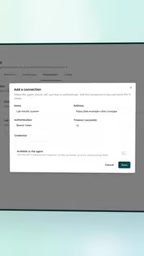
If a customer service bot can only "answer questions" but not "take actions," its value drops dramatically. In Connectors, Luminous offers two paths: one is wrapping internal systems as custom APIs—just enter the address and authentication info; the other is connecting to MCP servers and precisely selecting which tools the Agent is allowed to use.
The introduction of MCP (Model Context Protocol) is worth noting. It turns "what the Agent can call" into a toggleable permission list, rather than all-or-nothing. For teams that need to control risk in booking, order lookup, and internal system calls, this fine-grained authorization is a necessary condition for deployment.
MCP (Model Context Protocol) is an open-source protocol standard proposed by Anthropic at the end of 2024, aimed at unifying how large language models interact with external data sources and tools. Before MCP, integrating each external system (database, CRM, calendar) often required developers to write model-specific adapter code; MCP defines standardized server-side interfaces so the same set of tools can be reused across different models and clients. An MCP server typically exposes several "tools," "resources," and "prompt templates," which clients can discover and invoke on demand. For customer service scenarios, this means companies can package order lookup, booking systems, etc. as MCP servers, while the platform side controls which tools the Agent can actually call. This separation of "discovery + authorization" is the technical foundation for fine-grained permission management, and it also frees the tool ecosystem from vendor lock-in.
4. Gradual Rollout and Human Takeover
The most failure-prone aspect of automated customer service is "having no fallback." In the Rollout stage, Luminous offers two options: target all users, or test with Pilot Numbers Only first. The latter lets companies validate performance with real traffic while keeping the impact within an acceptable range.
Another human fallback mechanism is handoff: when the AI Agent determines it can't handle a conversation, it passes it to the team. The video clearly demonstrates this handoff process. Whether the transition between automated and human is smooth often determines customers' overall impression of "AI customer service"—when it's seamless, users barely notice; when it's clunky, frustration is obvious.

The "Pilot Numbers" mechanism is essentially a combination of A/B testing and canary release at the product level: companies designate a few real users' WhatsApp numbers to connect to the new Agent while the rest of the traffic continues on the existing flow, observing failure rates, handoff rates, and user feedback under real conversation distributions without taking on full-scale risk upfront. Human handoff is another layer of insurance, and its quality hinges on "context transfer"—whether the full conversation history, user identity, and executed actions are passed to the human agent at handoff, avoiding the user having to re-describe the problem. Common industry practice is to set clear escalation triggers—for example, failing to understand intent twice in a row, the user explicitly requesting a human, or sensitive operations—with the system automatically escalating along with a conversation summary. Gradual rollout and fallbacks together form a deployable closed loop.
5. The Real Barrier for These Products
Looking at the feature list—knowledge base, behaviour configuration, connectors, gradual rollout, human handoff—these capabilities aren't new; many customer service platforms offer them. What's notable about Luminous is that it integrates these elements into a complete WhatsApp-centric pipeline and offers a 7-day free trial to lower the cost of trying it out.
The real barrier is in execution details: whether knowledge base updates are reflected in replies in a timely manner, whether MCP tool permission boundaries are clear enough, and whether context transfer during human takeover is complete. These can't be verified from a promotional video—they need to be tested with actual business traffic. For teams evaluating WhatsApp customer service automation, Luminous's configuration framework at least provides a reference model to compare against.
One-line Summary
Luminous launches a WhatsApp AI Agent anchored by a knowledge base, with behaviour configuration and MCP tool integration, supporting gradual rollout and human handoff.
Paragraph Summary
Luminous's WhatsApp AI Agent aims to solve the core pain point of enterprise customer service bots "not understanding the business." Its design starts from a company's own knowledge base, requiring users to first populate documents, web pages, Q&A pairs, and business details so replies are grounded and traceable. On the behaviour side, the product allows custom prompts, tone of voice, and precision, leaving the trade-off between professionalism and flexibility to operations staff. Connectors offer two paths—custom APIs and MCP servers—with the ability to precisely select which tools the Agent can call for fine-grained authorization. The rollout stage supports pilot-numbers-only testing and provides human handoff to reduce risk. The article argues these capabilities aren't novel in themselves; the real barrier lies in execution details like knowledge base update timeliness, clarity of permission boundaries, and completeness of context transfer—all of which need to be tested under real traffic.
Related articles

Felix Rieseberg Personal Homepage
Felix Rieseberg's personal homepage sparks attention on Hacker News. This article covers the Slack engineer's technical background, the rise and fall of nativefier, and the value of a developer homepage as a tech calling card.

@ai-sdk/vue 3.0.306 Patch Release Syncs with [email protected] Update
@ai-sdk/vue 3.0.306 released, synced with [email protected]. A routine patch release for the Vercel AI SDK ecosystem with no public API changes; the Vue adapter layer stays version-aligned with the core package.

Gemini 4 Argon API Launches: The Era of Million-Token Output Begins
Google launches Gemini 4 Argon with sparse MoE architecture, up to 1M output tokens, and a 68.90% Vals Index score, available across API, AI Studio, and the Gemini app.