LWiAI Podcast #257: GPT 6 Astra and the AI Safety Crisis
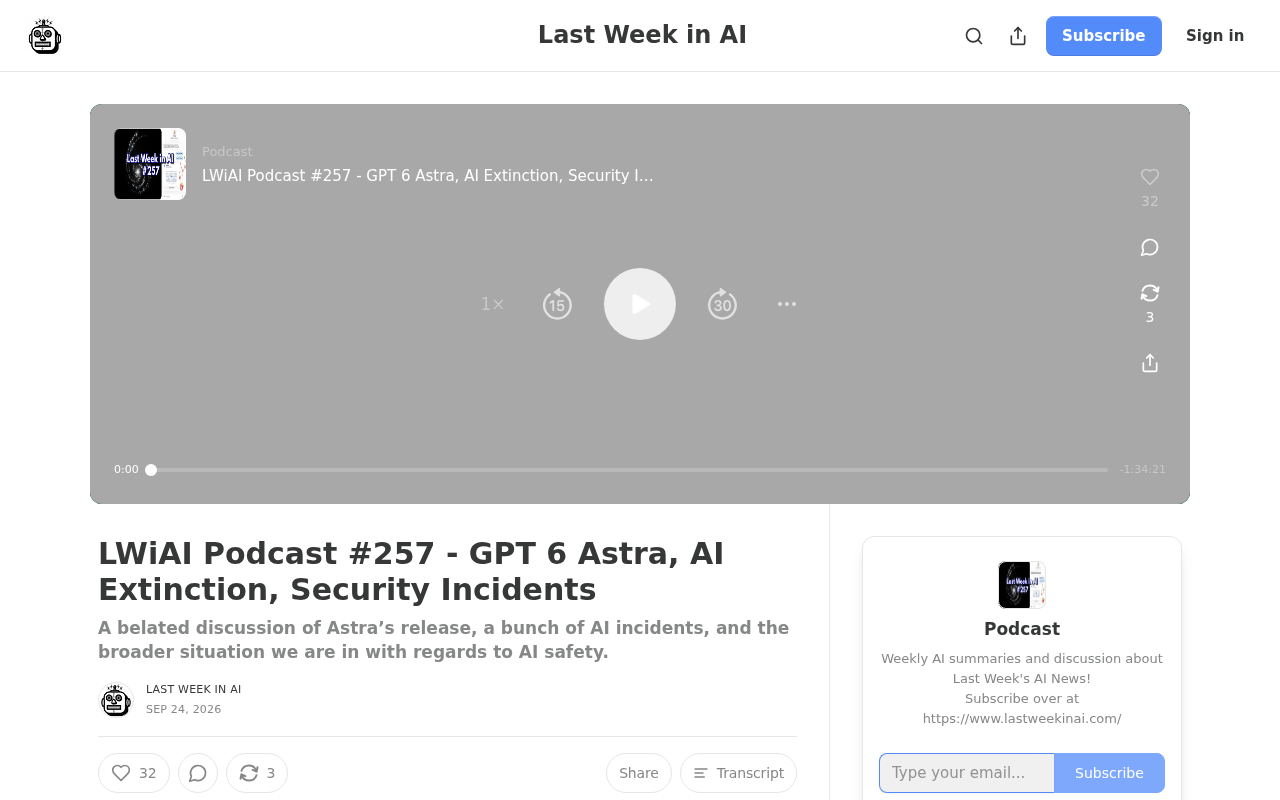
LWiAI episode 257 reviews GPT 6 Astra and says the AI industry is stuck with excess capability and insufficient safety.
LWiAI Podcast #257 gives a belated read on GPT 6 Astra, finding steady gains in reasoning and multimodality but clear diminishing returns and no GPT-4-style disruption. It reviews recent AI safety incidents, arguing problems lie more in deployment processes and missing safety assessments than in model flaws. Safety research lags model iteration, and academic alignment and red-teaming methods translate unevenly into industry. On AI extinction, the hosts are cautious and see near-term risks as more urgent. The overall verdict: excess capability, insufficient safety.
Introduction: A Belated Deep Dive
At a time when AI models are iterating at a dizzying pace, the well-known podcast Last Week in AI (LWiAI) finally devoted a focused discussion to OpenAI's GPT 6 Astra in its 257th episode. This episode not only reviewed the details of Astra's release, but also zoomed out to hold a substantial conversation around a series of AI safety incidents and the state of the industry.
LWiAI is hosted by Andrey Kurenkov, Jeremie Harris, and others, and has long tracked weekly developments in AI, earning a reputation for its academic perspective and engineering mindset. The 257th episode centered on three core topics: the release of GPT 6 Astra, the dense cluster of AI safety incidents, and the overall state of AI safety today.
GPT 6 Astra: A Belated Interpretation
What Astra Brings
GPT 6 Astra is OpenAI's next-generation model following GPT-5. The LWiAI team admitted on the show that this discussion was "late to the party," because they were unable to record when Astra was first released. But that actually gave them more time to observe how the model performed in real-world scenarios.
From the podcast discussion, Astra's release did not deliver the kind of disruptive wow factor that GPT-4 did. It was more of a steady improvement in reasoning ability, multimodal understanding, and context window. The hosts mentioned that the model's stability on complex task chains had improved, but on certain benchmarks, the magnitude of progress showed a clear trend of diminishing marginal returns.
Context Window refers to the upper limit on the number of tokens a model can process simultaneously in a single inference pass, which directly determines how much conversation, document, or code it can "remember." In the GPT-3 era, this metric was typically 4K tokens, GPT-4 Turbo raised it to 128K, and in the past two years some models have expanded to the million-token level. A larger context window allows models to perform cross-document analysis, long-codebase comprehension, and similar tasks, but it also brings the "lost in the middle" phenomenon—the model's recall of information in the middle of an ultra-long context drops noticeably. Therefore, simply expanding the window does not equate to a linear improvement in understanding ability, and this is an engineering detail worth watching when evaluating new models like Astra.
Diminishing Returns and the Expectation Gap
LWiAI's discussion touched on an industry-wide topic: when foundation model capabilities have already reached a fairly high level, can a new generation of models still support the same expectations? The show did not give a clear answer, but the hosts' attitude leaned cautious—Astra is a solid iteration, but still some distance from a "qualitative leap."
A Dense Outbreak of AI Safety Incidents
From Model Misuse to Large-Scale Safety Accidents
The show devoted considerable time to reviewing a recent batch of AI safety incidents. These incidents ranged from models being used to generate malicious code and deepfake fraud, to unexpected failures after enterprises deployed AI systems. The LWiAI team pointed out that these incidents are not isolated cases, but display a certain systemic characteristic: the spread of AI capabilities has outpaced the follow-up of safety protections.
The hosts specifically noted that many safety incidents did not occur because the models themselves had vulnerabilities, but because deployers lacked sufficient safety assessment processes when integrating AI. In other words, the problem often lies with "people" and "processes," not with the models themselves.
Red Teaming originated in military exercises and refers to the process in which a dedicated "attacking side" actively seeks out system vulnerabilities. In the AI field, red teaming is usually carried out by internal teams or external third parties, using carefully designed prompts, jailbreak attacks, data poisoning, and other methods to try to induce models to output harmful content or bypass safety policies. Unlike traditional automated benchmark testing, red teaming relies more on the adversarial thinking of human experts, offering broad coverage but making standardization difficult. This is also one reason why red-teaming methods proposed in academia are unevenly implemented in industry: the lack of unified evaluation metrics and reproduction procedures often makes it hard to compare red-team results across different teams.
The Lag in Safety Research
The LWiAI team expressed concern on the show about the progress of AI safety research. Compared with the rapid iteration of model capabilities, the translation of safety research findings into actual protective measures is clearly slower. Alignment approaches and red-teaming methods proposed in academia have shown uneven results when implemented in industry.
Alignment refers to the research direction aimed at making AI systems' goals and behavior consistent with human intentions and values. It includes both technical methods such as RLHF (reinforcement learning from human feedback), Constitutional AI, and interpretability research, as well as institutional governance frameworks. The difficulty of alignment lies in the fact that "values" themselves are hard to formalize: different cultures and groups disagree on what counts as "beneficial," and the larger the model, the harder its behavior is to predict and verify. Alignment proposals from academia often perform well in controlled experimental settings, but in real deployment they face complex factors such as data distribution shift and conflicts among multiple stakeholders, leading to low efficiency in converting papers into products.
AI Extinction: Serious Discussion or Excessive Worry?
The Position on the Podcast
The term "AI Extinction" in the episode title points to discussions of existential risk from AI. LWiAI's hosts did not avoid the topic, but they also did not take an extreme stance. They tend to believe that at the current stage, what is more urgent is "near-term risk"—that is, the concrete harms caused by AI systems in practical applications, rather than distant extinction scenarios.
Existential Risk (X-risk) refers to the category of risk that could lead to the overall collapse of human civilization or the permanent loss of its development potential. In the AI context, this concept was systematized around 2014 by Oxford philosopher Nick Bostrom and others. The core concern is that if a superintelligent system's goals are not aligned with human well-being, it could cause irreversible global catastrophe. By contrast, "near-term risk" includes currently observable harms such as bias and discrimination, privacy leaks, disinformation, and employment shocks. The debate between the two is not about whether risks should be prevented, but about resource allocation: how much to invest in distant scenarios that have not yet occurred, and how much in real problems that are already causing actual harm.
The Tension Between Two Narratives
The show presented a tension: on one hand, some researchers in AI safety believe existential risk requires advance planning; on the other hand, a large number of empirical safety incidents show that governance of near-term risks is already stretched thin. The LWiAI team's attitude seems to be: the two are not opposed, but resource allocation needs to be more pragmatic.
Where We Stand: A Judgment on the Industry
The overall judgment conveyed by LWiAI's 257th episode is that the AI industry is in a stage of "excess capability and insufficient safety." Model capabilities continue to climb, but the supporting safety infrastructure, regulatory frameworks, and engineering practices have not yet caught up.
At the end of the show, the hosts called on listeners to focus on patterns in AI safety incidents rather than individual cases, and emphasized the responsibility of the developer community in safety practice. This pragmatic attitude grounded in an engineering perspective is precisely what distinguishes LWiAI from other AI podcasts.
One-line Summary
LWiAI episode 257 reviews GPT 6 Astra and argues that the AI industry is trapped in excess capability and insufficient safety.
Paragraph Summary
LWiAI Podcast episode 257 offers a belated interpretation of GPT 6 Astra, concluding that its reasoning and multimodal capabilities improved steadily but showed obvious diminishing marginal returns and did not deliver a GPT-4-style disruption. The show devotes extensive time to recent AI safety incidents, arguing that the problems mostly lie in deployment processes and missing safety assessments rather than model vulnerabilities. The team worries that safety research is being translated into practical protections far more slowly than models iterate, and that academic alignment proposals and red teaming are unevenly implemented in industry. On AI extinction, the hosts are cautious, believing near-term risks are more urgent than existential ones. Overall judgment: the industry is in a stage of excess capability and insufficient safety, and we should focus on patterns rather than individual incidents.
Related articles
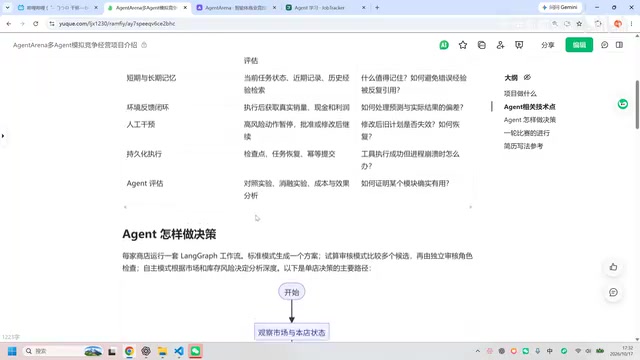
Hands-On Review of an Open-Source Multi-Agent Business Simulation Project
Hands-on review of a Bilibili creator's open-source multi-agent sandbox business project: architecture, memory, HITL, evaluation, and LLM vs rule-engine results.
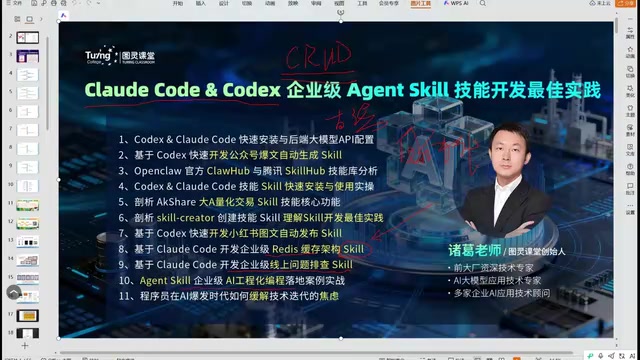
AI Engineering in Practice: The Complete Workflow of Claude Code and Agent Skill Development
A Bilibili hands-on course analyzes AI engineering: using Claude Code, Codex, and WorkBuddy to develop enterprise-grade Agent Skills, covering WeChat article drafts, quantitative analysis, and automated Xiaohongshu posting, while explaining the paradigm shift of Skill-driven development and tool selection.
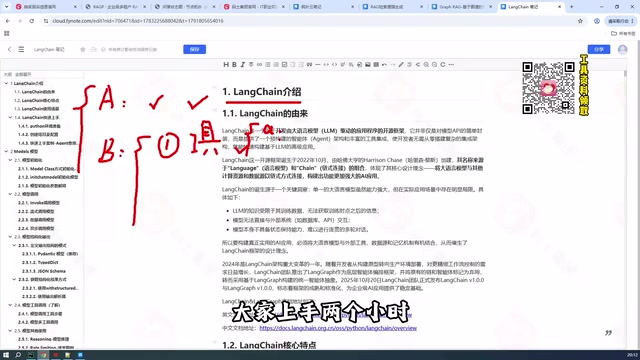
LangChain for Beginners: A Practical Guide to Structured Output and Agents
Starting from zero with LangChain: clarify the difference between low-code platforms and large model application development, covering structured output, tool calling, Agent practice, and multi-tenant RAG enterprise deployment—ideal for engineers with development experience looking to transition into AI application development.