LangChain for Beginners: A Practical Guide to Structured Output and Agents
Low-code platforms are not large model development—LangChain is the right path to controllable enterprise AI apps.
The article distinguishes between "using AI tools" and "large model application development," noting that low-code platforms like Coze and Dify carry data leakage risks and aren't real AI development. Real development uses frameworks like LangChain to build controllable, extensible systems with data kept in-house. It covers LangChain's core value, its four course modules (structured output, tool calling, Agent practice, multi-tenant RAG), and emphasizes that web coding is only an interview entry ticket while underlying understanding is the transferable skill.
Large model application development is not the same as using AI to write code, and it's certainly not the same as building a chatbot on low-code platforms like Coze or Dify. The former is about using tools; the latter is about handing your company's core data over to a third-party platform. Real AI application development means using frameworks like LangChain to build intelligent systems from the ground up that are controllable, extensible, and keep data inside your own network.
Why Low-Code Platforms Are Not AI Application Development
Many beginners conflate "having used Coze's drag-and-drop workflows" with "having done large model development." The instructor in this Bilibili course repeatedly emphasizes one distinction: using tools and developing with large models are two different things. Platforms like Coze, Dify, N8N, and Coze can indeed validate ideas quickly, but their data runs on someone else's servers. Contracts, customer information, and internal knowledge bases are core corporate assets—routing them through third-party platforms means uncontrollable leakage risk.
Web coding is a different matter. It's a must-have skill, but the barrier is lower than you'd think—anyone with basic development experience can go through the mainstream tools in two to four hours. In interviews, nearly every company asks "How do you use AI tools to assist your development?"—whether you're interviewing for a large model role, an algorithm role, or a big data role, no exceptions. But this is just a ticket to entry, not a core competency.
What Problem Does LangChain Actually Solve?
LangChain is a framework for developing AI applications, and its core value lies in two things: first, it's compatible with all model vendors, letting you quickly establish conversations through a unified interface so that switching models doesn't require rewriting business logic; second, it provides upper-layer encapsulation of the entire interaction pipeline, including context management, state management, and data security management. You focus on business logic while it builds the underlying wheels.
LangChain isn't the only framework in this space. LangGraph, AgentScope, Claude SDK, and OpenAI SDK all compete in this arena; LangChain is the most widely used because of its broadest ecosystem and most complete documentation.
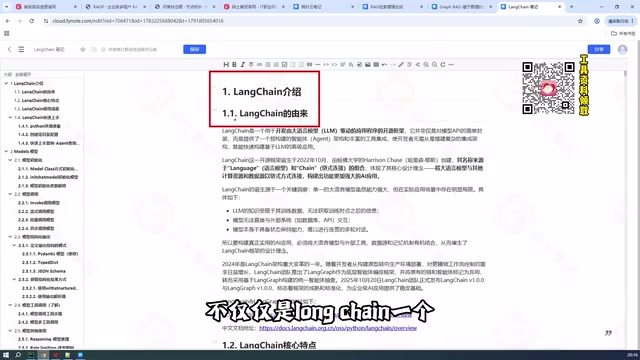
Core Abstractions of LangChain
LangChain's ability to unify multi-model interfaces rests on a set of core abstractions: the ChatModel interface unifies how different vendors' chat calls are made, PromptTemplate templatizes prompts, OutputParser parses the text returned by models into structured data, Retriever abstracts vector retrieval, and Tool defines external functions that models can call. These components are chained together using LCEL (LangChain Expression Language) with the pipe operator |, which naturally supports streaming output, batch processing, and async calls. Understanding these abstractions is more important than memorizing specific APIs—the concepts remain transferable when you switch frameworks.
The Four Core Modules Covered in the Course
The course's main thread is structured output, tool calling, Agent实战 (Agent in practice), and multi-tenant RAG enterprise project deployment. Structured output solves the problem of making models return data according to a fixed schema for easy downstream parsing; tool calling lets models query databases, call APIs, and execute code; Agents chain the first two together so models can autonomously plan steps; and multi-tenant RAG is the real test of enterprise scenarios—data isolation between tenants, permission control, and retrieval quality optimization all need to be implemented in the project.
The course also intersperses students' job-hunting questions. One student sent out seventy or eighty resumes with no response; the instructor's advice was to first figure out which stage is blocking you: the resume itself, the display page of the application channel, or the educational background threshold. Vague statements like "nobody responds to me" don't help pinpoint the problem.
Key Design of Multi-Tenant RAG
The hard part of multi-tenant RAG isn't retrieval itself—it's isolation. A common approach is to attach tenant_id metadata to each document chunk in the vector store and enforce tenant filtering during retrieval to avoid cross-tenant recall; at the same time, perform permission checks at the application layer to ensure users can only access their own tenant's knowledge base. You also need to consider retrieval quality optimization, such as chunking strategy, hybrid retrieval (vector + keyword), and reranking. These engineering details are precisely what low-code platforms struggle to cover and what you must build yourself.
Don't Overthink Framework Selection
Regarding which low-code platform or coding tool to use, the instructor's view is direct: pick whatever, just use what's convenient for you day to day. But if you're looking at industry recognition, Claude Code and Codex rank higher. Tools are consumables; the underlying understanding of the model interaction pipeline is the transferable skill.
Implementing Structured Output and Tool Calling
There are two mainstream ways to implement structured output: one is prompt constraints plus an output parser (like JSON Parser), with reliability depending on the model's ability to follow instructions; the other is using the Function Calling / JSON Mode provided by model vendors, where the model guarantees the return format. Tool calling relies on the model's Function Calling capability—developers describe tool parameters and purposes using JSON Schema, the model decides which tool to call and what parameters to pass based on user intent, and the framework handles execution and passes results back to the model for continued reasoning. An Agent is essentially letting the model autonomously complete the "think—call—observe" loop over multiple rounds.
Who Is This Course For
The course is positioned as zero-based, but "zero-based" means no prior exposure to LangChain, not no coding experience. People with development experience in any language will follow along most smoothly. If you're already using low-code platforms to build AI applications and want to understand the underlying principles and take back control of your data, that's where this course's value lies.
One-line Summary
Low-code platforms are not large model development—LangChain is the right path to building controllable enterprise-grade AI applications.
Paragraph Summary
The article distinguishes between "using AI tools" and "large model application development," pointing out that while low-code platforms like Coze and Dify can quickly validate ideas, running core enterprise data on third-party servers carries leakage risks and does not constitute real AI application development. Real development means using frameworks like LangChain to build controllable, extensible systems from the ground up that keep data inside your own network. LangChain's core value lies in unifying multi-model interfaces and encapsulating the entire interaction pipeline. The article also introduces the course's four core modules—structured output, tool calling, Agent实战, and multi-tenant RAG—and emphasizes that web coding is only an interview entry ticket rather than a core competency, that framework selection shouldn't be agonized over, and that underlying understanding is the transferable skill.
Related articles

Fine-Tuning Large Models Without Changing Weights: PEFT, Adapters, and Prefix Tuning Explained
Explaining the three main PEFT routes: LoRA, adapters, and prefix tuning. How to fine-tune large models without updating original weights, the pros and cons of each method, selection advice, and tuning and deployment considerations in practice.

EEG + Spiking Neural Networks: A New Path for Alzheimer's Diagnosis
Explore a new approach to Alzheimer's diagnosis: combining EEG with spiking neural networks and using biophysical simulations to generate training data and learn AD disease signatures, offering a possible path for low-cost early screening.

Boox Palma 2 Pro Review: The $400 E-Ink Reader That Got Me to Quit Reading on My Phone
The Boox Palma 2 Pro is a $400 phone-sized E-Ink reader built for distraction-free reading. We analyze its design logic, who it suits, and buying advice—and why dedicated reading devices are back in the spotlight.