M4 Mac Mini Drops $150 — Is It Worth Buying Now?

Best Buy's limited-time $150 price cut brings the base M4 Mac Mini to about $649, making it a strong value.
Best Buy is running a limited-time promotion on the base M4 Mac Mini (16GB RAM/256GB SSD), cutting $150 off the price from $799 to about $649. The article notes that at the usual $799, the M4 model doesn't make much sense since the faster M6 is already on the market; but the $150 discount (about 19% off) restores its competitiveness on value. For first-time Mac users, home-office setups, or budget-limited students, 16GB of memory is enough for daily office work, multimedia, and moderate creative work, and while 256GB storage is small, it can be expanded externally. Professional users doing video editing, 3D rendering, or running large language models should still prioritize the M6 version or higher configurations.
Apple's Mac Mini has long been the benchmark in the mini desktop market, and with the launch of newer-generation chips, the previous M4 models are starting to see tempting discounts. According to an RSS tech news report, Best Buy is running a limited-time promotion on the base M4 Mac Mini — configured with 16GB of memory and a 256GB SSD — at $150 off. This price change has many on-the-fence buyers reconsidering: with the M6 version already on the market, is the M4 Mac Mini still worth buying?
Promotion Details and Price Analysis
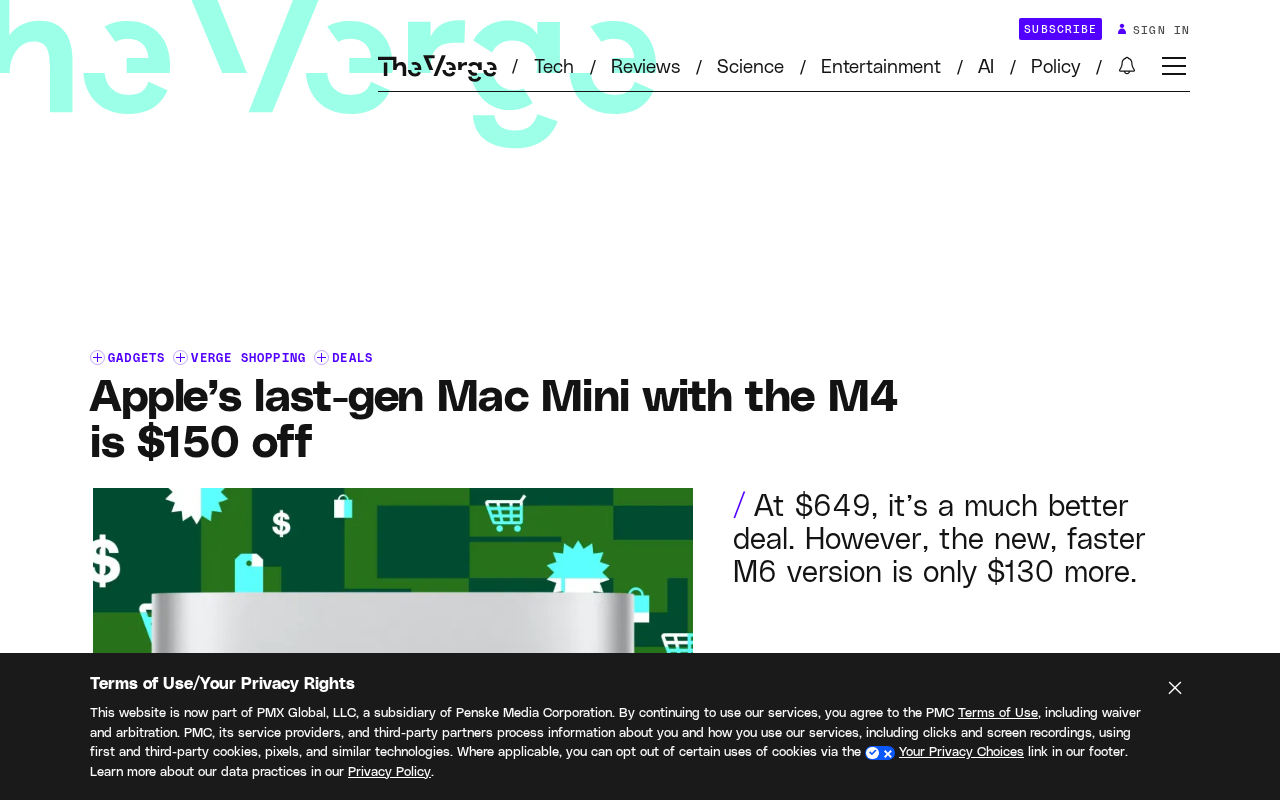
According to the original report, the base M4 Mac Mini normally sells for $799, and Best Buy's deal of the day lets consumers save $150. That brings the actual purchase price down to around $649 — a price point that's quite rare in Apple's lineup for a mini desktop powered by Apple's own M4 chip with 16GB of unified memory.
The report also notes that at the usual $799 price, the M4 model doesn't make much sense, since the newer, faster M6 version is already available. This reveals a typical tech product generational logic: once a new generation launches, the value proposition of the old model needs to be reassessed. The $150 discount is exactly what breaks the deadlock, restoring the M4 Mac Mini's competitiveness on the value-for-money dimension.
Generational Differences Between M4 and M6
For ordinary users, the M4 chip still offers plenty of performance. 16GB of memory is enough for everyday office work, multimedia consumption, and moderate-intensity creative work, and while 256GB of storage is on the small side, the Mac Mini supports external storage expansion. The M6 version's advantages mainly come down to faster processing speeds and potentially better energy efficiency, but for users who aren't chasing peak performance, these improvements aren't very noticeable in daily use.
What's worth noting is that Apple's product line is refreshing at an accelerating pace. The M4-to-M6 jump shows that chip iteration cycles are shortening, which both makes older models drop in price faster and means the cost of chasing the latest is higher. For budget-conscious consumers, choosing the previous generation and enjoying the discount is often the more practical choice.
Unified Memory Architecture is the design Apple has used since the M1 chip, sharing a single high-bandwidth memory pool across the CPU, GPU, and Neural Engine, rather than allocating separate VRAM for CPU and GPU as traditional PCs do. The benefit is that data doesn't need to be copied back and forth between processors, resulting in lower latency and higher energy efficiency — especially beneficial for graphics and machine learning tasks. But it also means memory capacity can't be upgraded later; the configuration at purchase is the configuration for life. That's why the article's emphasis on 16GB as a "comfortable starting line" isn't an exaggeration — it has to carry system, application, and VRAM demands simultaneously, and the 8GB version can easily become a bottleneck in multitasking or creative software.
The impact of shortening chip iteration cycles: Apple's span from M1 to M6 reflects that its in-house chips have entered a denser update rhythm, with a new generation roughly every 12–18 months. This has two knock-on effects: first, older models drop in price faster and by larger margins; second, the depreciation cost of "chasing the latest" is higher. For consumers, this means there's no need to upgrade every generation — instead, buy when the previous generation sees a significant discount, covering two to three years of use at a lower price. That's exactly the underlying logic behind the article's recommendation of the discounted M4.
Who Should Consider This Promotion?
This discount is best suited to a few groups: users trying the Mac ecosystem for the first time, consumers who need a quiet, compact desktop for home office work, and students on a budget who want Apple chip performance. The 16GB memory configuration is a comfortable starting line under current software conditions, avoiding the bottlenecks the 8GB version might encounter.
Conversely, if you do video editing, 3D rendering, or need to run large language models, the M6 version or higher-spec models remain the more suitable choice. The 256GB of storage also looks tight for professional users, requiring extra budget for an external drive.
Core Considerations for the Purchase Decision
The limited-time nature of this promotion (same-day only) adds pressure to the decision, but consumers should stay rational. The $150 price cut is indeed substantial — nearly 19% off the original price. Before deciding, it's worth comparing prices of official refurbished units, education discount channels, and actual performance review data for the M6 version.
From a product lifecycle perspective, the M4 Mac Mini at the discounted price still has two to three years of useful life, enough to cover most users' need cycles. There's never a perfect answer to when to buy tech products, but when the discount is big enough, the previous generation often offers the highest performance per dollar.
Overall, this limited-time Best Buy promotion offers budget-conscious Apple users a window worth seriously considering. The key is to clarify your own needs: if your performance requirements fall within the M4's coverage, the $150 savings is a real gain; if you have hard requirements for the latest chip, then waiting or choosing the M6 is the right path.
Related articles

Chain of Thought Isn't Just for AI: How Humans Can Use CoT to Improve Thinking Quality
Chain of Thought isn't just a prompt trick for large models. Starting from a Hacker News discussion, this article analyzes why CoT works for human thinking too, breaks down actionable ways to transfer it, and highlights the key differences between human CoT and machine CoT.
Cloudflare Teams Up with OpenAI: Closi…
Cloudflare Teams Up with OpenAI: Closing the Loop from Vulnerability Discovery to Defense with AI
Cloudflare uses OpenAI Daybreak to investigate security vulnerabilities and generate reviewable remediation plans, while developers use Codex to boost coding efficiency and quality.

Orca Multi-Agent Orchestration in Practice: A Guide to Parallel Collaboration with Claude and Codex
Orca is Stable AI's free open-source agent workbench supporting 34 agents like Claude Code and Codex in parallel. Learn its Git worktree isolation, multi-model orchestration, and mobile management.