Mac at Any Scale: How Namespace Is Reshaping Mac Cloud Services

Namespace turns Macs into elastically scalable cloud instances for iOS builds, facing multiple challenges.
Namespace's "Mac at Any Scale" drew attention on Hacker News by packaging Mac minis into cloud macOS instances, letting developers get build and test environments on demand without hardware procurement or ops burden. The article analyzes scaling challenges such as macOS's lack of native virtualization, image management, network isolation, and storage persistence. Community feedback focuses on startup speed, performance consistency, pricing, and vendor lock-in. Target users range from indie developers and startups to enterprises needing cross-regional collaboration, but adoption still hinges on cost, performance, and compliance.
When Mac Becomes Cloud Infrastructure
On Hacker News, a blog post from Namespace titled "Mac at Any Scale" sparked widespread discussion, garnering 255 points and 140 comments. The title is straightforward: treat Macs as a compute resource that can scale arbitrarily. For Mac developers who have long been constrained by hardware procurement, configuration, and operations, this clearly strikes a real pain point.
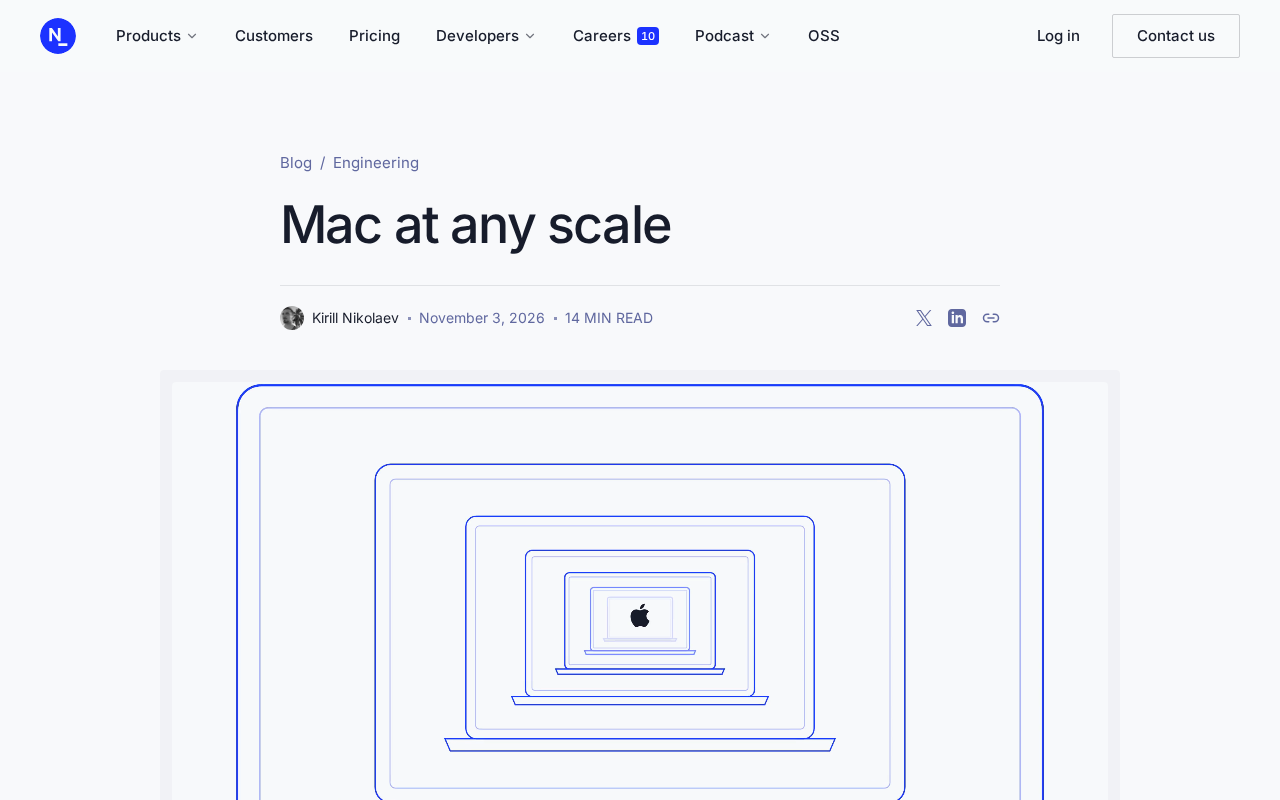
The service Namespace offers essentially packages Mac minis and similar devices into cloud-based development and build environments. Users don't need to buy machines, set up racks, or handle network configuration themselves—they can get macOS instances on demand. This model has natural appeal for scenarios like iOS app continuous integration and cross-platform development testing.
The Technical Challenges of Scaling
Putting a single Mac in a data center isn't hard; the hard part is getting hundreds or thousands of Macs to work together stably and efficiently. macOS wasn't designed for server environments and lacks native virtualization support and remote management capabilities. Namespace needs to solve a whole series of problems: hardware orchestration, image management, network isolation, and storage persistence.
Judging from the article title and community discussion, Namespace's focus is on "any scale"—not just providing a few machines, but building infrastructure that can elastically scale. This means users can quickly expand capacity when needed and release resources when idle, without bearing the cost of holding hardware long-term.
The limitation that macOS lacks native virtualization support has specific technical implications. Apple's Virtualization.framework wasn't officially available until macOS 11, and it primarily targets running Linux or lightweight macOS guests on Apple Silicon; in the Intel era, macOS virtualization long relied on third-party solutions and was constrained by Apple's licensing terms. Genuine large-scale solutions typically don't take the approach of "running multiple macOS VMs on one physical machine"—instead, each Mac mini serves as an independent physical node, with an orchestration layer handling task scheduling, device resets, and image reinstallation. This also explains why Mac cloud services tend to scale in units of whole machines rather than container-level fine-grained resources, and why boot times and cost structures differ fundamentally from ordinary Linux cloud hosts.
The "environment consistency" problem in iOS continuous integration is closely tied to the particularities of Apple's toolchain. Xcode versions, iOS SDKs, simulator runtimes, and signing certificates are tightly coupled—different Xcode versions may not coexist or may interfere with each other, and Apple imposes compatibility requirements on Xcode and macOS version combinations. As a result, Mac CI environments often need separate images prepared per Xcode version and clean reinstallation between builds, which is precisely why image management and storage persistence become scaling pain points. Compared with the disposable containerized builds common in Linux CI, this is far more expensive and cumbersome on macOS.
Real Developer Feedback
The Hacker News comment section is often the touchstone for testing a product's mettle. Among the 140 comments, there's both recognition of the convenience of Mac cloud services and skepticism about performance consistency, pricing models, and vendor lock-in. Some developers pointed out that for CI/CD pipelines, Mac instance startup speed and stability are critical; others argued that the remote Mac experience still has limitations when it comes to network latency.
These discussions reflect a reality: Mac cloud services are no panacea—they're better suited to scenarios that depend less on local hardware but demand high environment consistency. Whether Namespace can find a balance between scale and user experience is the key to its long-term value.
In the context of Mac cloud services, vendor lock-in has two dimensions. The first is the infrastructure layer: once CI configurations, caching strategies, and build scripts are deeply bound to a particular cloud Mac provider's APIs and image system, migration costs rise significantly. The second is the toolchain layer: the Apple ecosystem itself exercises strong control over Xcode and the signing system, leaving developers already in a relatively closed environment—and adding a cloud service provider further reduces substitutability. Common countermeasures discussed in the community include adopting Fastlane, building in-house signing management, and abstracting build descriptions into vendor-neutral configuration files to preserve the option to switch.
Who Needs "Mac at Any Scale"
Looking at application scenarios, the most obvious beneficiaries include independent developers, small startup teams, and engineering organizations that need cross-regional collaboration. They may not have the budget to maintain their own Mac server rooms, yet they need to run iOS builds and tests frequently. Cloud-based Mac resources let them obtain compute in a more flexible way.
On the other hand, large enterprises are also paying attention to these services. Provided security and compliance permit it, outsourcing Mac build environments to specialized vendors can reduce operational complexity and hardware depreciation risk. The "any scale" that Namespace emphasizes is precisely aimed at this elastic demand ranging from individuals to enterprises.
From a compliance and legal perspective, moving Macs to the cloud also involves Apple's software license agreement. macOS licensing terms place explicit restrictions on virtualization—for example, permitting a limited number of macOS VMs to run on Apple-branded hardware, while strictly prohibiting running on non-Apple hardware. Cloud service providers must therefore use genuine Apple hardware, which is one of the structural reasons why Mac cloud pricing is higher than Linux instances of equivalent compute. When enterprises outsource their build environments, beyond security and compliance, they also need to confirm whether the provider's Apple licensing and hardware sourcing are compliant—otherwise they may face licensing risks.
Conclusion: The Boundaries and Possibilities of Cloud Macs
What Mac at Any Scale depicts is a development world where hardware is no longer a bottleneck. Namespace's attempt is worth watching, but the adoption of cloud Macs still depends on multiple factors including cost, performance, and legal compliance. For developers, having one more option is always a good thing; for the industry, such services are pushing development infrastructure toward greater flexibility and specialization.
Related articles

Glasshand: Giving AI Agents a Real iPhone and Mac
Glasshand lets AI agents rent real iPhones and Macs, supporting Claude Code, Codex, and more to post, book services, and test iOS apps on real devices. This article explains how it works, its use cases, and potential boundaries.

ChatGPT Images 2.6 Released: GIF Generation, Reference Image Reuse, and 50% Speed Boost
ChatGPT Images 2.6 released: prompt-to-GIF animation with frame-by-frame editing, reusable reference images for yourself, pets, or characters, 50% faster generation, plus Flare and Sunburst API model variants and SVG export for developers.

Rerun: Turn Your AI Subscription into an AI Coworker Team
Rerun, #3 on Product Hunt, turns your ChatGPT or Claude subscription into a team of AI coworkers that run on schedules or triggers, each with tools, a computer, and a shared workspace. It asks before risky actions, is open source (AGPL v3), and supports self-hosting.