Machine Learning Self-Study Roadmap: A Guide to Choosing Systematic Learning Resources When You Feel Lost

A systematic guide to overcoming confusion and building an effective machine learning self-study path.
This article analyzes why machine learning self-learners often feel lost — typically due to fragmented knowledge, weak math foundations, and frequent instructor switching. It offers a structured learning roadmap: build math prerequisites, choose one main course (Andrew Ng, fast.ai, or Hands-On ML), and use project-based learning on Kaggle to solidify understanding.
Starting from a Real Sense of Confusion
I recently came across a very typical question on Reddit — the kind of dilemma that almost every self-taught machine learning learner encounters. A beginner who had just finished learning Python and its related libraries asked: he was following the YouTube channel CampusX to learn machine learning, but kept feeling like "something was off" — he couldn't understand "why things are done this way" or "what the fundamentals really are." On top of that, the tutorials frequently switched instructors, making the whole learning process extremely difficult. He hoped the community could recommend a better learning source.
This seemingly simple question of "which resource is better" actually hides the core pain point for self-learners: fragmented knowledge and a lack of systematic structure. Today, we're not just answering "which one to pick" — we're diving deep into why things "feel off" and how to build a truly solid machine learning study path.
Why Does Self-Studying Machine Learning Always "Feel Off"?
The Problem Usually Isn't the Resource — It's the Approach
Many beginners blame poor learning outcomes on "choosing the wrong tutorial," but in reality, CampusX is a well-regarded machine learning teaching channel with decent content quality. The real reasons behind "not understanding why things are done this way" usually come down to the following:
First, a lack of mathematical and statistical foundations. Machine learning is fundamentally applied mathematics. Without an intuitive understanding of basic concepts in linear algebra, probability theory, and calculus, the "why" behind algorithms simply can't take root. Every step feels like "copying a magic spell" rather than a natural derivation.
Specifically, these three branches of mathematics each play an irreplaceable role in machine learning. Linear algebra is the "language" of machine learning — nearly all data exists in the form of matrices and vectors. From the most basic linear regression to weight updates in deep learning, operations like matrix multiplication, eigenvalue decomposition, and singular value decomposition (SVD) are everywhere. For example, the core of Principal Component Analysis (PCA) is performing eigenvalue decomposition on the covariance matrix to achieve dimensionality reduction. Probability and statistics are key to understanding model uncertainty — Bayesian classifiers are built directly on Bayes' theorem, logistic regression outputs are essentially probability values, and model evaluation concepts like cross-validation and confidence intervals are rooted in statistical inference. Calculus is the "engine" of model training — gradient descent computes the partial derivatives of the loss function with respect to each parameter to determine the direction and magnitude of parameter updates. Without understanding derivatives and the chain rule, you can't truly grasp how a model "learns." If you lack this mathematical intuition, when you see a tutorial complete training with a single line of model.fit(), it just feels like black-box magic rather than a clear mathematical optimization process.
Second, skipping the "problem definition" step. Many tutorials jump straight from "import dataset → train model → output accuracy" without explaining why this particular method solves this problem, or why the data needs to be preprocessed in a certain way. Without understanding the essence of the problem, learning becomes mechanical imitation.
In real-world machine learning workflows in both industry and academia, "problem definition" often occupies the first and most critical 20%-30% of an entire project's time. This step involves several layers: First, identifying the problem type — are you dealing with a classification problem (predicting discrete labels, like spam detection), a regression problem (predicting continuous values, like house price prediction), a clustering problem (discovering natural groupings in data), or a ranking problem (like search engine result ordering)? Different problem types directly determine the range of applicable algorithms. Second, choosing evaluation metrics — even within classification problems, in medical diagnosis you care more about Recall (not missing true positive cases), while in spam filtering you might prioritize Precision (not flagging legitimate emails as spam). If tutorials never discuss the business logic behind these choices, learners can't build the mental framework of "methods serve problems" and instead fall into the trap of "I've learned algorithms but don't know when to use them."
The Hidden Cost of Frequently Switching Instructors
The poster specifically mentioned that "continuously change in mentors" made learning harder — a point well worth noting. Different instructors have different phrasing habits, notation systems, and teaching paces. Frequent switching disrupts cognitive continuity. For beginners, maintaining a stable narrative thread is far more important than pursuing "the most comprehensive content." This is also why systematic single courses or textbooks are often better suited for getting started than a patchwork of scattered videos.
This phenomenon has strong theoretical support in cognitive science. Educational psychologist John Sweller's Cognitive Load Theory states that working memory capacity is limited. When learning new knowledge, the brain must simultaneously handle "intrinsic cognitive load" (the inherent complexity of the knowledge) and "extraneous cognitive load" (the additional processing cost from how information is presented). When instructors switch frequently, learners not only need to understand new concepts themselves but also expend extra cognitive resources adapting to new terminology habits (for example, instructor A uses θ for parameters while instructor B uses w), teaching styles, and knowledge organization. This accumulation of "extraneous cognitive load" significantly reduces learning efficiency and can even create false comprehension barriers — you think you don't understand a concept, but you're actually just not adapted to the new instructor's way of expressing it. Additionally, Schema Theory in cognitive science shows that stable, coherent narratives help learners build structured knowledge frameworks (schemas) in their minds, while fragmented information input leaves knowledge points isolated and difficult to systematize.
Machine Learning Study Path: How to Go from Basics to Advanced?
Fill in the Prerequisite Math Foundations First
Before diving into machine learning algorithms, it's worth investing time in building three foundational pillars:
- Math fundamentals: You don't need to become a mathematician, but you should understand core concepts like vectors, matrix operations, derivatives and gradients, and probability distributions. 3Blue1Brown's linear algebra and calculus video series provide an excellent intuitive understanding.
3Blue1Brown is a math visualization YouTube channel created by Grant Sanderson. Its standout feature is using Manim, a self-developed animation engine, to transform abstract mathematical concepts into beautiful, intuitive geometric animations. Unlike traditional teaching, 3Blue1Brown doesn't pursue completeness of formula derivations but instead focuses on helping viewers build "mathematical intuition" — for example, his "Essence of Linear Algebra" series doesn't start from definitions but lets you visually "see" that matrix multiplication is actually a spatial transformation, and "see" that the determinant is the scaling factor of area after transformation. This geometry-first approach to understanding is especially critical for machine learning learners, as it helps you build spatial-level intuition when you later encounter high-dimensional data processing, gradient descent visualization, and similar topics.
For math preparation in machine learning, here's a concrete checklist of topics for self-assessment: In linear algebra — vector addition and scalar multiplication, dot products and projections, the geometric meaning of matrix multiplication, transpose and inverse matrices, eigenvalues and eigenvectors. In calculus — the intuitive meaning of derivatives (rate of change), partial derivatives and gradient vectors, the chain rule (the mathematical foundation of backpropagation). In probability — conditional probability and Bayes' theorem, common distributions (normal distribution, Bernoulli distribution), expectation and variance. You don't need to go deep enough to prove each topic, but you should be able to explain "what each concept does" and "why it's useful."
-
Python data processing: The poster has already finished learning Python and its libraries — that's a great starting point. Make sure you have a solid command of NumPy, Pandas, and Matplotlib, as they are the foundational tools for everything that follows.
-
Statistical thinking: Understand mean, variance, correlation, hypothesis testing, etc. — these are key to understanding model evaluation. The core of statistical thinking lies not in memorizing formulas but in building the habit of "letting data speak." For example, when you see a model achieve 95% accuracy on a test set, statistical thinking prompts you to ask: What's the confidence interval for that 95%? Is the sample size large enough? Is there class imbalance in the dataset (if 95% of samples are already positive, then a model that does nothing but output "positive" can also achieve 95% accuracy)? This kind of critical thinking ability is exactly what separates a "hyperparameter tuner" from someone who truly understands models.
Choose One Main Course and Stick with It
Rather than bouncing between multiple resources, it's better to choose one main course and complete it fully. Here are several widely recommended beginner machine learning resources worth considering:
- Andrew Ng's Machine Learning Course (Coursera): A true classic among classics, with step-by-step explanations that are especially good for building intuition. The updated version has replaced the old MATLAB with Python, making it more practical.
Andrew Ng is one of the most influential educators in machine learning. He is a professor of computer science at Stanford University, co-founder of the Google Brain project, former Chief Scientist at Baidu, and co-founder of the online education platform Coursera. His free online machine learning course, first offered at Stanford in 2011, attracted over 100,000 student registrations — an event widely regarded as a landmark moment in the "MOOC revolution" (Massive Open Online Courses). His teaching style is known for "starting from intuition" — when explaining gradient descent, he uses the analogy of "finding the lowest point on a hill" so that even zero-background students can understand the essence of optimization; when explaining regularization, he first illustrates the phenomenon of overfitting before introducing the solution. The updated 2022 version (Machine Learning Specialization) rewrote all programming assignments using Python and TensorFlow. The course is divided into three sub-courses covering supervised learning, advanced learning algorithms, and unsupervised learning, making it ideal for learners starting from scratch.
- "Hands-On Machine Learning with Scikit-Learn and TensorFlow": This book balances theory and code equally, and is a desk essential for many practitioners.
Written by Aurélien Géron, this book is now in its third edition, with the subtitle updated to include Keras and TensorFlow 2. Its greatest strength is "just enough theory, immediate hands-on coding" — each chapter first explains algorithm principles with clear, concise text (usually including a few key formulas), immediately followed by complete Python code examples that readers can run directly in Jupyter Notebook. The first half covers classical machine learning using Scikit-Learn (linear models, decision trees, ensemble methods, dimensionality reduction, clustering, etc.), while the second half covers deep learning using TensorFlow/Keras (convolutional neural networks, recurrent neural networks, generative adversarial networks, reinforcement learning, etc.). This "dual-framework" structure makes it suitable both for beginners starting with classical algorithms and for intermediate learners transitioning to deep learning.
- fast.ai courses: Using a "top-down" teaching approach, these courses let you run a complete project first and then gradually dig into the underlying principles — very friendly for learners who dislike dry theory.
fast.ai was founded by Jeremy Howard and Rachel Thomas in 2016, and its teaching philosophy is the opposite of the traditional "bottom-up" path (learn math first → then theory → finally write code). fast.ai advocates "use it first, understand the principles later" — the very first lesson has you train a deep learning model that can recognize cat and dog images, and then subsequent lessons progressively peel back the mathematical and engineering principles behind it. This approach draws from the "immersive teaching method" in language learning: just as children learn to speak before learning grammar, fast.ai believes that building a holistic sense of the complete workflow first, then filling in the underlying details, better aligns with how humans naturally learn. Additionally, fast.ai provides a high-level Python library of the same name (fastai), built on top of PyTorch, which can complete model training and evaluation with minimal code, greatly lowering the barrier to entry. These three paths — Ng's course leans toward "systematic, gradual explanation," Géron's book leans toward "theory-code parallel practical guide," and fast.ai leans toward "project-driven quick start" — suit different types of learners: those who prefer step-by-step progression, those who like to read and practice simultaneously, and those who prefer to see the big picture before diving into details. Understanding your own learning preference matters more than blindly following trends.
Use Projects to Drive Learning
The real way to make knowledge "come alive" is to get hands-on with projects. After learning each algorithm, immediately find a real dataset (such as beginner competitions on Kaggle) to apply it. In practice, you'll naturally start asking "why does this method work here" — this problem-driven understanding is far deeper than passive listening.
This learning method is known in education as Project-Based Learning (PBL), and extensive research has shown it to be significantly more effective than pure lecture-based teaching in STEM fields. The core mechanism is this: when you face a real problem, learning shifts from "passive reception" to "active retrieval" — you need to judge which algorithm to use, how the data needs to be cleaned, and what to adjust when model performance is poor. This process forces you to build connections between knowledge points rather than storing them as isolated pieces of information.
Kaggle is the world's largest data science competition and community platform (now owned by Google), with over 15 million registered users. For beginners, Kaggle's value lies not only in providing clean datasets and competition leaderboards but also in its rich Notebooks (complete analysis code and thought processes shared by community members) and Discussions (Q&A forums). Here's a recommended path for beginners: First, complete Kaggle's built-in "Intro to Machine Learning" micro-course (free and interactive), then try classic beginner competitions like Titanic survival prediction (classification) or House Prices prediction (regression). When working on these projects, don't just chase leaderboard scores — focus on the complete workflow instead: exploratory data analysis (EDA), feature engineering, model selection, cross-validation, and result interpretation. These are the core transferable skills that actually matter in real-world work.
The Final Answer to "Which Resource Is Better"
Coming back to the original question — there's no absolutely "best" resource, only the one that's "best suited for your current stage." For a learner who has just finished Python and is confused about "not understanding the underlying logic," here's my advice:
- Stop searching for new resources and honestly assess whether your math foundations need reinforcement.
- Pick one systematic course with a complete narrative (Andrew Ng or fast.ai) and avoid switching between multiple instructors and sources.
- Pair every concept you learn with a small hands-on exercise — use code and projects to ground abstract theory.
- Accept that "early confusion is normal" — many "aha moments" in machine learning only emerge after repeated practice.
Choosing the right learning resource matters, but what matters even more is adjusting your learning approach. When you shift from "mechanical imitation" to "exploring with questions in mind," and from "collecting resources everywhere" to "going deep on one main path," that nagging sense that "something feels off" will naturally fade away.
Key Takeaways
Related articles

The Complete Codex Guide: A Hands-On Manual from Basics to Advanced
A complete guide to the new Codex: project folders, office file processing, multi-agent collaboration, image annotation, agents.md, Skills, automation workflows, and advanced AI programming features.
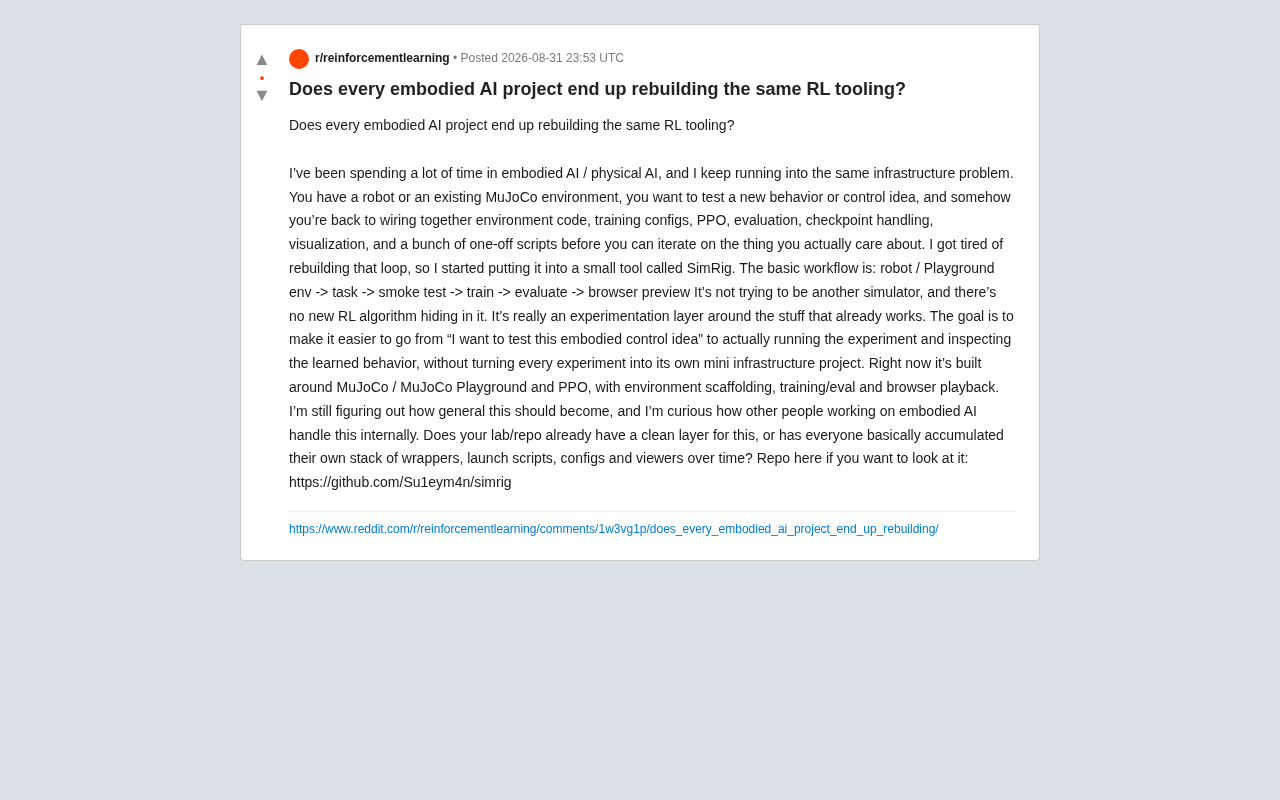
SimRig: Building a Unified Experimentation Layer for Embodied AI — Stop Reinventing the Wheel
SimRig builds a lightweight experimentation layer on MuJoCo and PPO, offering standardized workflows from environment setup to browser preview, cutting engineering friction for Embodied AI research.

AI Security 101: A Complete Guide from Prompt Injection to Agent-Based Attack and Defense
A systematic guide to AI security fundamentals covering LLM principles, prompt injection attacks, AI code auditing, CTF applications, and Agent attack-defense evolution.