macOS 15.8.2 Update Breaks OpenGL, Developer Community Races to Investigate

macOS 15.8.2 update causes OpenGL app crashes, prompting urgent community investigation and reflection on tech stack migration.
Apple's macOS 15.8.2 update has sparked widespread discussion in the developer community, with multiple users reporting OpenGL context creation failures or rendering abnormalities after upgrading, causing crashes and errors in professional software, game engines, and scientific visualization tools that depend on the API. Since Apple has marked OpenGL as deprecated since macOS 10.14 and promotes Metal, the failure is widely believed to be related to underlying graphics framework adjustments and accidental breakage of the legacy compatibility layer. Impact varies by hardware, with more concentrated feedback from Intel-based Macs. The community has proposed temporary solutions such as rolling back the system, running older macOS in virtual machines, and using MoltenVK, but none are long-term fixes. The incident is prompting developers to reassess their graphics technology stacks and weigh the costs and risks of migrating to Metal or switching to cross-platform solutions.
macOS 15.8.2 Update Breaks OpenGL, Developer Community Races to Investigate
Apple's recent macOS 15.8.2 system update has caused a stir in the developer community. Multiple users have reported on Hacker News that OpenGL-related functionality is severely broken after the upgrade, with some applications that rely on the graphics API unable to run properly. The incident has once again thrust Apple's long-standing lukewarm attitude toward OpenGL into the spotlight.
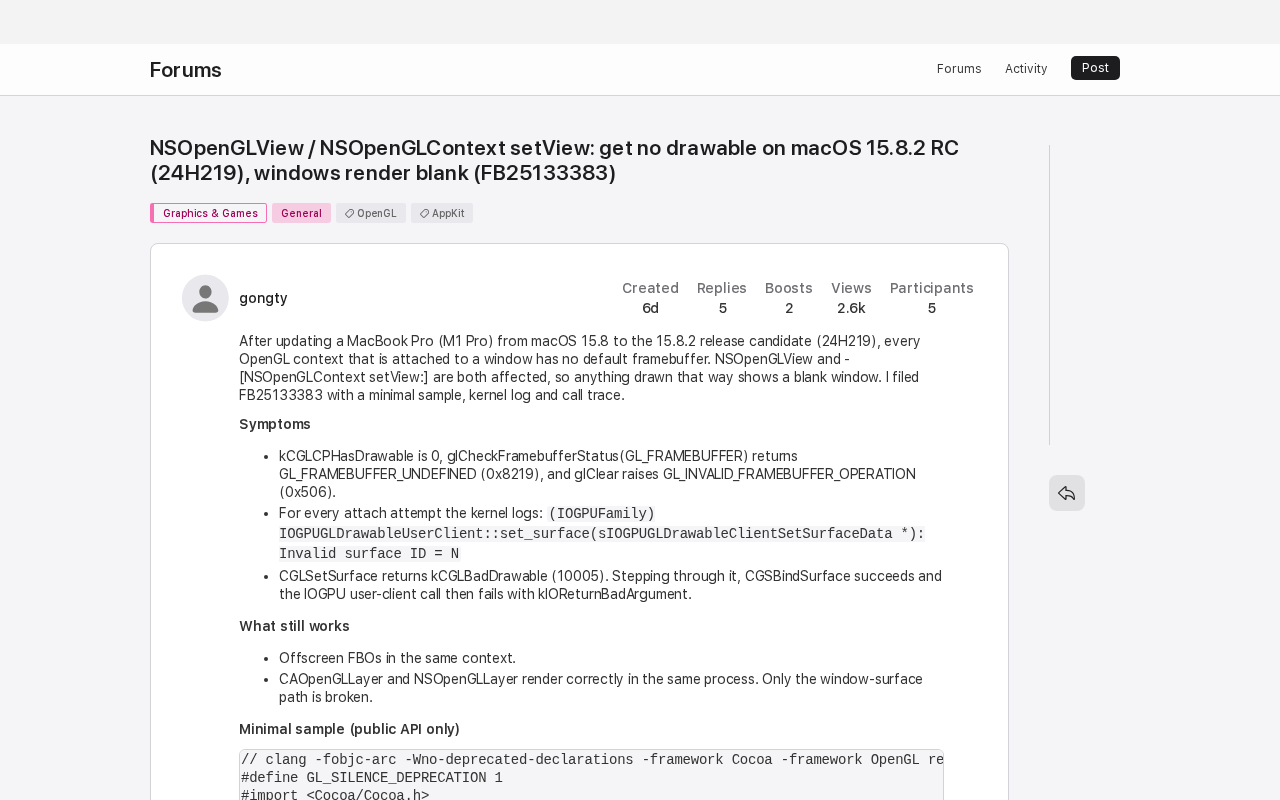
Overview: OpenGL "Goes on Strike" on macOS 15.8.2
According to the discussion on Hacker News (news.ycombinator.com/item?id=50141909), multiple developers have confirmed that after updating to macOS 15.8.2, OpenGL context creation fails or rendering becomes abnormal. Some users describe professional software and games that previously ran fine crashing immediately after the upgrade, with error logs pointing to the OpenGL driver layer. Since Apple has long marked OpenGL as deprecated, whether this failure is "intentional" has become a point of contention.
Although Apple has not yet released a detailed explanation, the community widely believes this is related to adjustments in the system's underlying graphics framework. OpenGL support on macOS has been stuck at version 4.1 for years without updates, while Apple's preferred Metal graphics API continues to be iterated on. This update may have accidentally broken the legacy compatibility layer, causing applications that depend on OpenGL to collectively suffer.
Scope of Impact: Who Is Affected?
Based on the discussion, the affected groups mainly include users of professional software that depends on OpenGL and indie game players. For example, some older versions of video editing tools, 3D modeling software, and cross-platform game engines (such as early versions of Unity and Unreal) show rendering errors after upgrading. In addition, some research tools that use OpenGL for scientific visualization have not been spared either.
Interestingly, not all users encounter the same problems. The failures appear to be related to specific hardware models and driver versions. Some newer Apple Silicon devices report fewer issues, while feedback from Intel-based Mac users is more concentrated. This uncertainty has intensified user anxiety, with many calling on social media for Apple to provide a fix patch or rollback solution as soon as possible.
Technical Background: OpenGL's "Outcast" Status on macOS
To understand this incident, it is necessary to review Apple's attitude toward OpenGL. Since macOS 10.14 Mojave, Apple has officially marked OpenGL and OpenCL as deprecated and encouraged developers to migrate to Metal. Since then, although system updates have not completely removed OpenGL, its maintenance has clearly weakened. The macOS 15.8.2 failure is very likely due to negligence regarding legacy code during internal refactoring.
From a technical perspective, the OpenGL driver layer is deeply coupled with the system graphics stack, and Apple may have inadvertently changed the interface behavior of shared components while optimizing Metal performance. For developers still using OpenGL, this is undoubtedly a warning: relying on a deprecated technology stack will carry increasingly high risks. However, migrating to Metal is not easy, especially for teams maintaining old codebases, as rewriting the graphics layer requires substantial resources.
The essential difference between OpenGL and Metal lies in their design levels and goals. OpenGL is a cross-platform open graphics API specification maintained by the Khronos Group, with drivers implemented separately by graphics card vendors and operating systems, so the same call may behave differently on different platforms. Metal is a low-overhead graphics and compute API deeply customized by Apple for its own hardware and systems, optimized directly for GPU architectures, eliminating a large number of historical compatibility layers, and significantly reducing CPU overhead while improving predictability. The two also differ in their level of abstraction: Metal requires developers to explicitly manage command buffers, resource states, and synchronization, offering greater control but requiring more code; OpenGL hides more details, and migration often requires redesigning the rendering architecture rather than simply replacing function names. This also explains why many teams, despite knowing OpenGL is deprecated, are still reluctant to migrate.
Community Reaction and Temporary Solutions
The atmosphere of the discussion on Hacker News is both angry and resigned. One developer joked: "Apple is reminding you in this way that it's time to switch to Metal." Other users shared temporary solutions, such as rolling back the system update, running older versions of macOS in a virtual machine, or using third-party compatibility layers (such as MoltenVK) to convert OpenGL calls to Metal. But these solutions are either complicated to implement or come with obvious performance losses, making them difficult to use as long-term countermeasures.
Some developers have begun jointly submitting feedback to Apple, demanding official clarification of the cause and a repair timeline. As of press time, Apple has not mentioned this issue in its developer documentation or system status page. Given that Apple usually stays silent about failures involving deprecated technologies, the community worries that a fix may be a long time coming.
MoltenVK is an open-source compatibility layer that maps the Vulkan API onto Apple's Metal, part of the Vulkan portability implementation in the Khronos ecosystem. It does not directly translate OpenGL into Metal; instead, it allows applications and engines originally targeting Vulkan to run on macOS and iOS, thereby bypassing Apple's dependence on OpenGL. For old projects still using OpenGL, a common approach is to first convert OpenGL calls to Vulkan using solutions such as Zink, and then route them to Metal through MoltenVK, forming a multi-stage conversion chain. Although this chain can extend the lifespan of old applications, it introduces additional CPU overhead and potential compatibility deviations, and debugging becomes noticeably more difficult, so it is more suitable as a transitional measure than a long-term architecture.
Implications for Developers: Migrate or Stay?
This incident is a wake-up call for all macOS developers who depend on OpenGL. Judging from the trend, Apple is accelerating the promotion of the Metal ecosystem, and OpenGL support will only become more marginalized. For commercial projects, it is wise to evaluate migration costs as early as possible; for personal projects or academic tools, cross-platform graphics libraries (such as Vulkan with MoltenVK) can be considered to reduce dependence on a single platform.
However, migration is not a panacea. Metal's ecosystem is relatively closed, its cross-platform compatibility is inferior to OpenGL, and its learning curve is steep. When making decisions, developers need to weigh maintenance costs, target user groups, and long-term technical roadmaps. In any case, the macOS 15.8.2 failure reminds us: in Apple's ecosystem, the deprecated label is never just for show.
Conclusion
Currently, the issue is still developing, and the community expects Apple to give a responsible response. For ordinary users, if they rely on OpenGL applications, it is advisable to hold off upgrading to macOS 15.8.2 and keep an eye on subsequent patches. For developers, this may be an opportunity to re-examine their graphics technology stack—in today's rapidly evolving technology landscape, while embracing change, it is also important to leave a way out for legacy systems.
Related articles

Chain of Thought Isn't Just for AI: How Humans Can Use CoT to Improve Thinking Quality
Chain of Thought isn't just a prompt trick for large models. Starting from a Hacker News discussion, this article analyzes why CoT works for human thinking too, breaks down actionable ways to transfer it, and highlights the key differences between human CoT and machine CoT.
Cloudflare Teams Up with OpenAI: Closi…
Cloudflare Teams Up with OpenAI: Closing the Loop from Vulnerability Discovery to Defense with AI
Cloudflare uses OpenAI Daybreak to investigate security vulnerabilities and generate reviewable remediation plans, while developers use Codex to boost coding efficiency and quality.

Orca Multi-Agent Orchestration in Practice: A Guide to Parallel Collaboration with Claude and Codex
Orca is Stable AI's free open-source agent workbench supporting 34 agents like Claude Code and Codex in parallel. Learn its Git worktree isolation, multi-model orchestration, and mobile management.