Macro Open Source Project: Building an All-in-One Team Collaboration Platform with Shared AI Memory

Macro is an open-source Rust-based All-in-One workspace using shared AI memory to unify team collaboration.
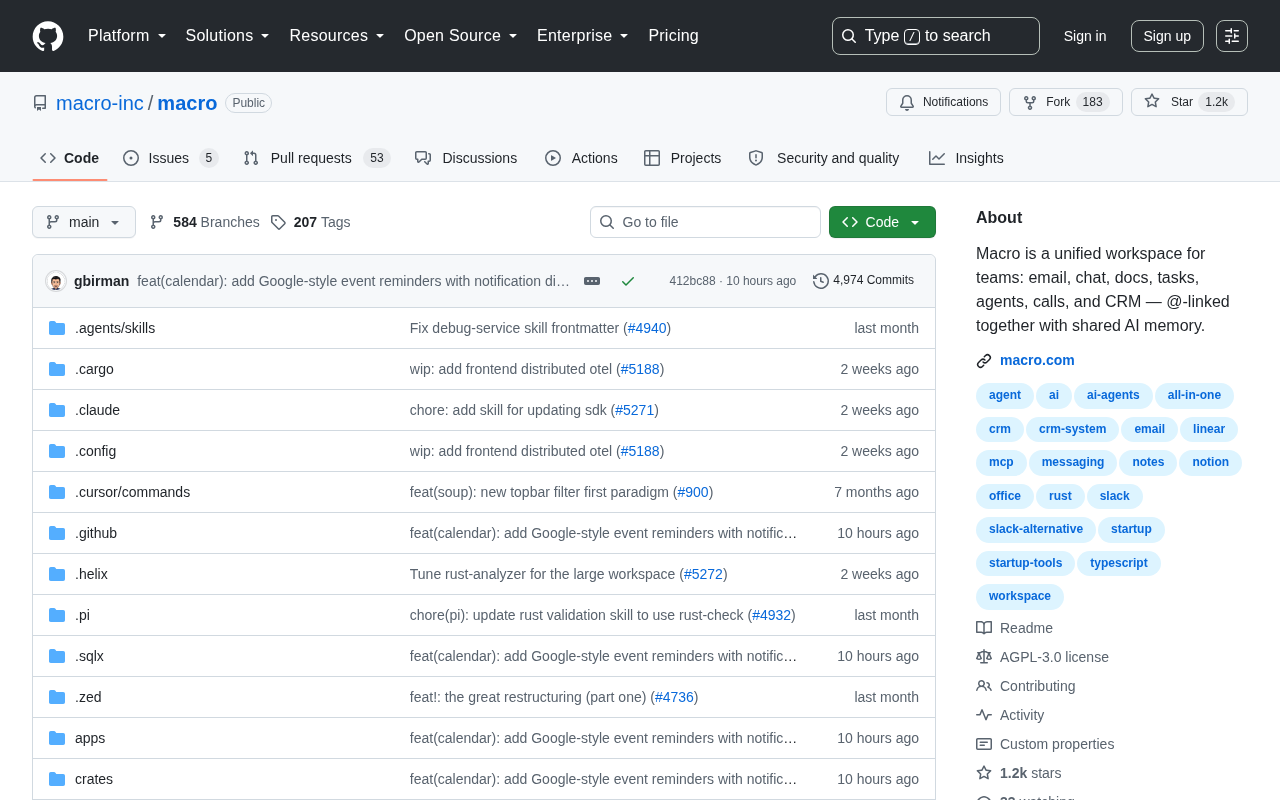
Macro is a rapidly growing open-source project that aims to replace fragmented collaboration tools like Slack, Gmail, Notion, and Jira with a unified workspace. Built in Rust for performance and reliability, it connects emails, chats, documents, tasks, calls, and CRM through an @-linking mechanism and shared AI memory powered by RAG architecture, enabling AI agents to understand full workspace context across all modules.
An Ambitious Unified Collaboration Workspace
Recently, an open source project called Macro has been rapidly gaining traction on GitHub, earning 248 new stars in a single day and accumulating 1,118 stars and 178 forks to date. Developed by the macro-inc team, the project summarizes its ambition in one sentence: build a unified workspace for teams — integrating email, chat, docs, tasks, agents, calls, and CRM all in one place, interconnected via @ links, and powered by shared AI memory that ties all information together.
In today's highly fragmented enterprise collaboration landscape, teams often need to constantly switch between a sprawling array of tools like Slack, Gmail, Notion, Jira, and Salesforce. Information is scattered across isolated silos, and context is continuously lost. According to Okta's 2023 report, large enterprises use an average of 187 SaaS applications, while even small and medium businesses use over 100. Employees can switch between different apps hundreds of times per day, and research from Harvard Business School shows that each instance of "context switching" consumes 9-23 minutes of recovery time. This fragmentation not only reduces individual productivity but also creates organizational information silos — customer insights recorded by the sales team in CRM may be completely invisible to the product team in their project management tool. This is exactly the pain point Macro aims to solve: consolidate all workflows into a single platform and give AI unified memory across all modules.
Core Philosophy: How @-Linking and Shared AI Memory Work
Everything Can Be @-Linked
Macro's most distinctive design feature is its @-linked mechanism. In traditional tools, an email, a document, and a task are typically independent entities. In Macro, you can @ a document in chat, @ an email in a task, or @ a call recording in a CRM record. This deep linking creates an interconnected network of different information types, rather than isolated fragments.
From a technical implementation perspective, @-linking is essentially a user interface expression of an Entity Relationship Graph. Under the hood, every email, document, task, and contact is treated as a node in a graph database, and the @ operation creates directed edges between nodes. This aligns with the logic of Knowledge Graph construction — after Google launched its Knowledge Graph in 2012, the concept gradually extended from search into enterprise knowledge management. The difference is that Macro embeds graph construction into daily workflows, allowing users to complete knowledge structuring through natural collaboration rather than relying on dedicated knowledge management processes.
The core value of this design lies in preserving context. When a team member views a task, they can trace related email threads, chat discussions, and reference documents without jumping back and forth between multiple apps or copy-pasting links.
AI Memory Pervades Everything
Taking it a step further, Macro emphasizes shared AI memory. This means the platform's AI agents can understand the full picture of the entire workspace — they know what you discussed with a client in email, the progress of tasks, and the decisions recorded in documents. Based on this global memory, AI can truly become an intelligent team assistant, rather than a chatbot that only sees partial information.
Shared AI memory implementation typically relies on RAG (Retrieval-Augmented Generation) architecture. The system vectorizes all workspace data (embedding) and stores it in a vector database. When AI needs to respond to a user request, it first retrieves relevant context from global memory based on semantic similarity, then injects it into the large language model's prompt to generate answers. Compared to traditional full fine-tuning, this architecture offers advantages in real-time capability, lower cost, and zero delay in data updates. The recent popularity of frameworks like LangChain and LlamaIndex has also made the engineering implementation of such memory systems more standardized.

Compared to most current AI collaboration tools, whose AI capabilities are typically confined within a single application — the AI in a document editor only understands documents, the AI in a customer service system only understands tickets — Macro's approach of breaking down module barriers and building a unified memory layer represents an important direction for next-generation AI-native collaboration platforms.
Technology Choice: Why Rust
Notably, Macro chose Rust as its primary development language. This choice alone reveals the team's emphasis on performance and reliability.
Rust is known for memory safety, high performance, and zero garbage collection, making it ideal for building system-level applications that need to run stably for extended periods while handling large amounts of concurrent data. For a unified workspace that simultaneously carries email, chat, calls, documents, and other real-time data streams, Rust delivers runtime efficiency while avoiding common memory leaks and crashes.
Specifically, Rust's Ownership System and Borrow Checker eliminate data races and memory-unsafe issues at compile time, which is crucial for applications that need to simultaneously manage WebSocket long connections (chat), IMAP/SMTP connections (email), WebRTC streams (calls), and other concurrent I/O. In contrast, Electron apps (like Slack's desktop client) typically consume 500MB-1GB or more of memory due to their underlying Chromium rendering engine. Applications built with Tauri (a Rust desktop framework) can reduce installation package size by 90% and memory usage by 50-70%. Rust's async/await ecosystem (tokio runtime) also provides near C/C++ performance for high-concurrency message processing while maintaining a modern development experience.
Furthermore, the Rust ecosystem has matured significantly in recent years for cross-platform desktop applications (such as Tauri) and high-performance backend services, providing a solid technical foundation for building heavyweight client applications. Choosing Rust over the more common Electron/TypeScript combination positions Macro to achieve significant advantages in resource usage and response speed — precisely the shortcomings that users frequently criticize in existing collaboration tools.
What Tools Does Macro Aim to Replace
Macro's feature list is ambitious, covering virtually all modern team collaboration scenarios:
- Email: replacing Gmail, Outlook
- Chat: replacing Slack, Teams
- Docs: replacing Notion, Google Docs
- Tasks: replacing Jira, Asana
- Agents: AI automation assistants
- Calls: replacing Zoom, Meet
- CRM: replacing Salesforce, HubSpot
This is a classic "All-in-One" product positioning. Historically, products that simultaneously challenge this many categories have faced enormous challenges — each individual function has powerful specialized competitors.
Looking back at the history of All-in-One collaboration tools, we see mixed results. In the early 2010s, Google Wave attempted to unify communication and collaboration but ultimately failed; Workplace by Meta integrated social, chat, and video but shut down in 2025. Relatively successful examples include Feishu/Lark (ByteDance), which achieved significant growth in the Asian market through deep integration of instant messaging, docs, calendar, and OKR. Microsoft 365, using Teams as an entry point to integrate the entire Office suite, also represents this direction. History shows that success doesn't depend on the number of features, but on the "chemistry" of integration — whether information flow between modules can produce a 1+1>2 effect.
But Macro's differentiation isn't about "perfecting every feature" — it's about organically stitching these features together through @-linking and shared AI memory, creating holistic value that no single tool can provide. This is its core bet that distinguishes it from predecessors: in 2024-2025, with AI capabilities maturing, can a unified memory layer serve as the "glue" connecting all modules and produce unprecedented synergistic effects?
Challenges and Future Outlook
As an open source project, Macro's growth rate of 248 stars per day reflects the developer community's strong interest in the concept of an "AI-native collaboration platform." It hits two of today's hottest trends: tool consolidation and deep AI integration.
However, there's still a gap between vision and execution. The core challenges facing an all-in-one workspace are threefold:
- Feature depth: Can each module reach a usable or even excellent standard, rather than a superficial "barely functional" state?
- Data migration: Can existing team workflows and historical data be smoothly imported?
- Privacy and security of AI memory: When AI possesses global memory spanning email, calls, and CRM, how to safeguard the security boundaries of sensitive enterprise data will be the key factor determining whether it can enter the enterprise market.
The privacy and security challenges are particularly complex. Traditional RBAC (Role-Based Access Control) works well within a single application, but when AI needs to retrieve information across email, CRM, and documents, how do you ensure AI-generated responses don't leak data that users aren't authorized to access? This requires implementing "Permission-aware RAG." Additionally, GDPR grants users the "right to be forgotten," but whether embeddings in vector databases constitute personal data and how deletion requests should be executed in embedding space remain unresolved legal and technical challenges. Enterprise security certifications like SOC 2 and ISO 27001 impose strict requirements on data storage and processing, and open source projects need to architect compliance capabilities from the ground up — this will directly impact their ability to enter the mid-to-large enterprise market.
Regardless, Macro represents an exploration direction in the collaboration software space worth continued attention. It no longer treats AI as an add-on feature but positions AI memory as the central nervous system of the entire platform at the architectural level. This "AI-first" design philosophy may well be the prototype for next-generation team collaboration tools.
Interested developers can visit the GitHub repository to learn more and try it out.
Related articles

RAG Getting Started in Practice: From Principles to Building an Enterprise Knowledge Base
Bilibili RAG course highlights: from retrieval-augmented generation principles, document chunking and vectorization, to five accuracy factors and enterprise knowledge base boundaries, with fine-tuning vs RAG selection advice.

AI Model Selection Guide: DeepSeek vs. Qwen3 in Practice
How should AI developers choose models? Based on a Bilibili tutorial, this article breaks down the Function Calling differences between DeepSeek V3 and R1, Qwen3's programmatic thinking mode switching and agent capabilities, and outlines a multi-model learning path and practical selection logic.

Anchoring, Loss Aversion, and Nudges: 5 Psychological Tactics Retailers Use to Make You Spend
Behavioral economics reveals how retailers use anchoring, framing, loss aversion, and nudge theory to manipulate your spending decisions. This article breaks down 5 common psychological tactics and offers counterstrategies like slowing down decisions and setting your own anchors to see through the pricing design behind discounts.