MacWages Index: Measuring the Economic Value of AI Tasks in Human Wages

MacWages Index measures AI task value by converting it into human wage equivalents.
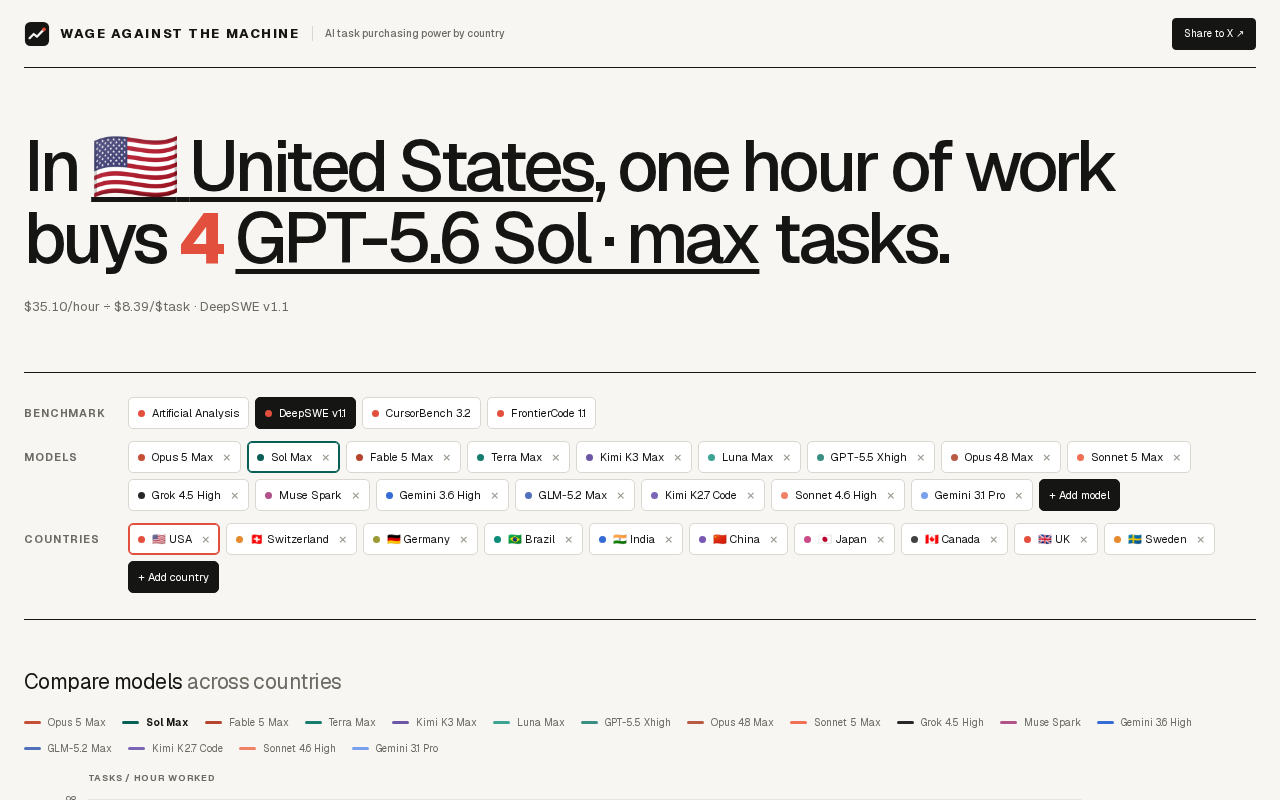
The MacWages Index, from the project Wage Against the Machine, borrows the Big Mac Index concept to quantify AI's economic value in terms of human wages saved. While still an early-stage experiment with limited traction, it highlights a critical shift from measuring AI through technical benchmarks to business-oriented metrics. The approach faces methodological challenges including task boundary definition, regional wage disparities, and hidden human-in-the-loop costs, but signals a growing need for intuitive AI value frameworks.
When AI Starts "Working," How Much Is It Worth?
As large language models and various AI tools penetrate deeper into everyday workflows, an increasingly practical question emerges: when we hand off a task to AI, exactly how much cost does it save us? A project called Wage Against the Machine (a play on the rock band Rage Against the Machine), showcased on Hacker News's Show HN section, offers an intriguing approach — it introduces a metric system called the MacWages Index that attempts to estimate the "human wage equivalent" for various AI tasks.
Show HN is a dedicated section within Y Combinator's tech community Hacker News where developers showcase personal projects. Unlike regular news link sharing, Show HN requires posters to be the project's creator or core contributor, and the project must be something others can experience or test. This section has birthed many projects that later grew into well-known products (Dropbox's earliest demo once appeared here, for example), though many projects remain at the proof-of-concept stage. The community's voting and commenting mechanisms serve both as an early validation channel for projects and an important source of feedback and iteration direction for developers.
The project's core idea is straightforward: if a task originally required a salaried human to complete, and AI can now do it instead, then we can quantify AI's economic value for that specific task through the lens of "wages saved."
From the "Big Mac Index" to the "AI Wage Index": The Analogy
The "MacWages" in the project name naturally evokes The Economist's famous Big Mac Index. The latter uses a globally available product (the McDonald's Big Mac) to compare purchasing power across currencies — a classic approach to simplifying complex economic concepts through everyday reference points.
The Big Mac Index was first published by The Economist in 1986, based on Purchasing Power Parity (PPP) theory — the idea that in a free market, identical goods should have the same price across countries (when measured in a common currency). The Big Mac was chosen because it's produced and sold in a nearly standardized way across 120+ countries, with ingredients spanning bread, meat, vegetables, rent, and labor, roughly reflecting a nation's overall price level. However, the index has clear limitations: it ignores different tax policies, tariff barriers, brand positioning differences, and the fact that McDonald's pricing in different markets may be influenced by competitive dynamics. Nonetheless, as an intuition-friendly economic comparison tool, it has been widely cited for nearly 40 years.
The MacWages Index borrows the same logic: rather than measuring AI's value through abstract token prices, API call fees, or compute costs, why not convert it into a unit everyone understands — human wages. This way, "having AI write a weekly report" or "having AI process a batch of customer service emails" gains a tangible value anchor.
Token Pricing: The Fundamental Billing Unit of AI Commercialization
In the commercialization of large language models, the token is the most fundamental billing unit. One token corresponds to roughly 4 characters in English or 1-2 characters in Chinese. Taking OpenAI's GPT-4o as an example, input pricing is approximately $2.5 per million tokens and output pricing around $10 per million tokens. This pricing model resembles cloud computing's pay-as-you-go approach but adds unique complexity: the same task might consume vastly different token quantities depending on prompt engineering quality; model selection (e.g., using a cheaper smaller model for simple tasks) also dramatically affects costs. For decision-makers without technical backgrounds, token cost is an unfamiliar and unintuitive concept — precisely the pain point MacWages attempts to address by substituting "human wages."
Why Wages Are a Good Reference Point for Measuring AI Value
Using wages as a unit for measuring AI's economic value has several intuitive advantages:
- Strong comparability: Business owners and managers naturally think in terms of labor costs when making decisions; wage equivalents directly connect to their budget mindset.
- Cross-task universality: Whether it's writing, coding, data analysis, or customer service, everything can be converted into "X hours of work at a given position."
- Decision-friendly: When AI's operating cost is far below the corresponding wage, the economic case for adoption becomes immediately obvious.
Current State of MacWages: An Early-Stage Exploration
It's important to recognize that this project is still in a very early stage. Based on Hacker News data, the post received only 5 upvotes and 1 comment, placing it squarely in the category of "niche experimental work" that hasn't yet sparked widespread community discussion.
These kinds of Show HN projects are often interest-driven creations by developers, and their value lies more in proposing a perspective worth thinking about rather than providing a mature, validated AI pricing standard.
Methodological Challenges Facing an AI Wage Index
Converting AI tasks into human wage equivalents sounds elegantly simple, but faces considerable difficulties in practice:
- Task boundaries are hard to define: A "report" completed by AI and one completed by a human may differ significantly in quality, depth, and reliability — simple equivalence isn't rigorous.
- Massive regional wage differences: The same task corresponds to vastly different labor costs in different countries and regions; the index needs to clearly state its reference baseline.
- Hidden costs are overlooked: AI output often requires human review, correction, and prompt tuning — these "human-in-the-loop" costs are easily underestimated.
- Rapid dynamic changes: AI capabilities and API pricing are evolving quickly; any static index risks becoming outdated fast.
The Hidden Costs of "Human-in-the-Loop" Cannot Be Ignored
Human-in-the-Loop (HITL) is an important paradigm in AI system design, referring to retaining human participation at critical nodes in an AI workflow to ensure output quality, handle edge cases, or bear final decision-making responsibility. In real enterprise scenarios, HITL costs are often severely underestimated. For example, an AI-generated marketing copy might require a senior editor to spend 15-30 minutes reviewing and polishing; an AI-written legal summary might need a lawyer to verify every citation. There are also upstream systemic human investments in prompt design, workflow orchestration, and exception handling. A 2024 McKinsey study showed that "hidden human costs" in enterprise GenAI projects averaged 40-60% of total investment, far exceeding API call fees themselves. This means any framework attempting to measure value through "AI wage equivalents" must factor in these costs, or it will systematically overestimate AI's net economic benefits.
Why This Perspective on AI Value Measurement Deserves Attention
Despite the project's immaturity, it touches on a proposition that's becoming increasingly important: how to price the value AI creates.
In the past, we measured AI using technical metrics — accuracy, latency, token cost. Attempts like MacWages represent a shift toward an economic value perspective. For enterprise decision-makers, what truly matters isn't model benchmarks, but "how much labor cost can this AI tool save me, and how much business value can it create."
The Paradigm Shift from Technical Metrics to Business Metrics
The AI industry's value measurement system is undergoing a profound transformation from technology-oriented to business-oriented thinking. Early on, models were primarily evaluated through academic benchmarks (such as MMLU, HumanEval, GSM8K, etc.), which measure a model's "capability" rather than its "value." As AI enters production environments, enterprises are focusing on metrics closer to business outcomes: Cost per Interaction Saved, Automation Rate, Time Recaptured, and Payback Period. Gartner proposed an "AI Business Value Score" conceptual framework in 2024, attempting to unify technical performance and business impact measurement. The MacWages Index can be seen as a grassroots experiment within this broader trend, trying to answer the core business question of "how much human labor value has AI replaced" in the simplest possible way.
In this sense, similar "AI wage indices" may signal a trend: as AI transitions from tech experimentation to scaled productivity tools, the market will increasingly need accessible, comparable, business-oriented value measurement frameworks. Whether MacWages ultimately becomes an industry standard or not, the effort to examine AI through an economics lens is inherently illuminating.
Conclusion
Wage Against the Machine uses a slightly tongue-in-cheek name to pose a serious question. It's currently just a low-traffic community side project with far-from-mature methodology, but it reminds us: while discussing AI capabilities, don't forget to ask how much it's actually "worth." When AI truly becomes the ubiquitous "digital employee" in the workplace, estimating a "payslip" for their work might become a matter of course in enterprise management.
Related articles

Getting Started in Machine Learning Research: Essential Paper Reading List and Research Internship Application Path
A complete path from zero to research internship for ML beginners, covering essential classic papers (AlexNet, ResNet, Transformer), paper reading methods, reproduction tips, and practical advice for research internship applications.

Claude Code Hands-On Tutorial: Complete Guide from Installation to Automated Development
Complete guide to Claude Code covering environment setup, permission configuration, Go Goals autonomous loops, Skills system, MCP protocol integration, and version control for automated development.

Gemini 3.7 Flash Release and GPT-5.6 Ultra-Fast Mode: AI Open Source Enters the Ecosystem Era
Google releases Gemini 3.7 Flash for coding and Agent optimization while OpenAI launches GPT-5.6 Ultra-Fast mode with 14x speed gains. AI open source shifts from open models to open ecosystems.