MagSafe Flex Pouch: A New Stretchy Storage Solution for the Back of Your Phone

The MagSafe Flex Pouch is a stretchable magnetic storage pouch that adds physical expansion space to the back of your phone.
The MagSafe Flex Pouch is a stretchable storage pouch that attaches to the back of your phone via MagSafe, positioned between a magnetic wallet and a mini pouch. It uses elastic material — flat when retracted, able to hold keys, earphones, and cash when expanded — addressing the "only phone but no pocket space" scenario. The article argues this product reflects the magnetic accessory market's shift from functional supplementation to scenario segmentation, though material durability and magnetic load limits remain key uncertainties.
Running out of phone storage is a daily anxiety for many people. But a new accessory called the MagSafe Flex Pouch attempts to solve a different dimension of "storage" needs at the physical level — not by adding memory to your phone, but by adding a stretchable pocket to it.
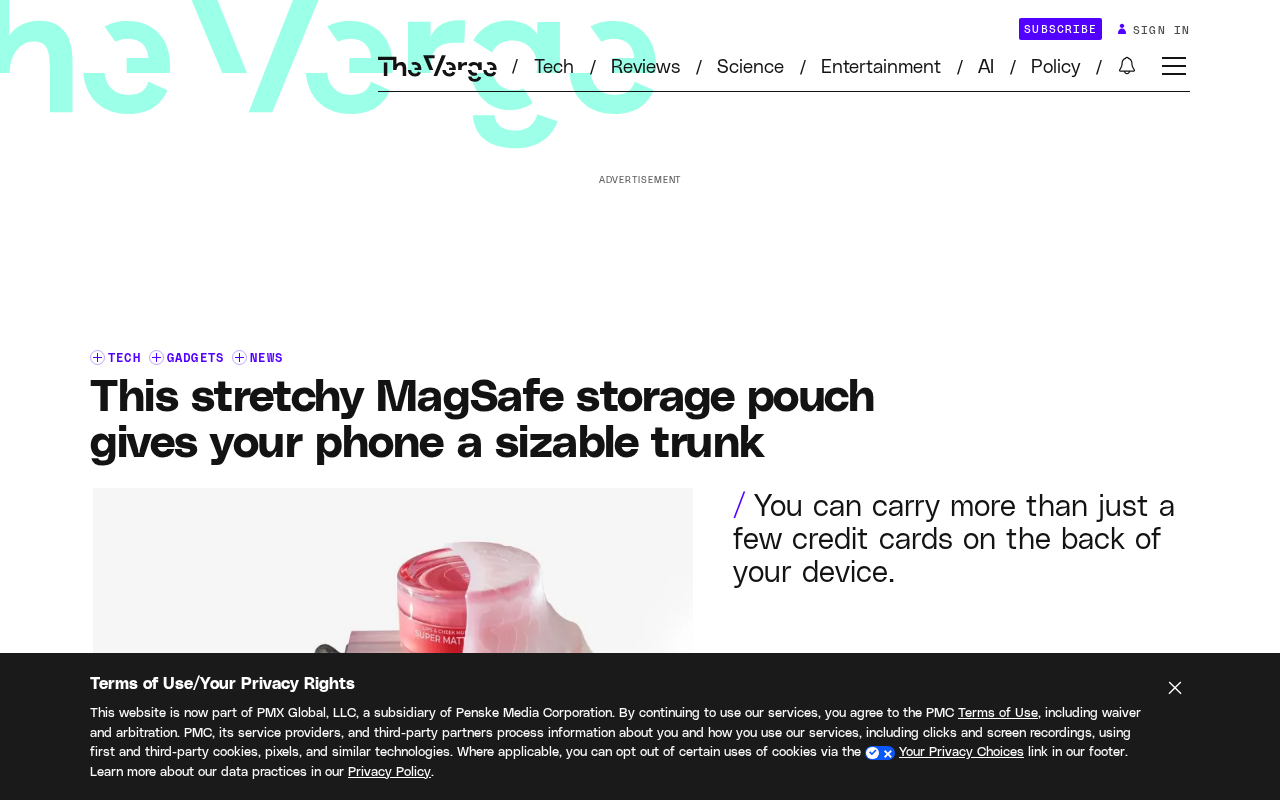
The "Expansion" Approach of a Magnetic Wallet
From the outside, the MagSafe Flex Pouch looks almost identical to the common magnetic wallet card holders on the market: flat, snug, magnetically attached to the back of your phone, used to hold a few credit cards or an ID. But its real selling point is "flexibility" — the pouch's main body uses a stretchable material that, when pulled open, can hold items far beyond the volume of a card holder.
According to the original report, this product sits somewhere between a "magnetic wallet" and a "mini storage pouch." It doesn't try to increase your phone's digital storage capacity, but instead leverages the MagSafe magnetic ecosystem to add an expandable physical storage space to your phone. For users who prefer to travel light and don't want to carry an extra bag, this design approach offers a middle-ground solution.
MagSafe is a magnetic wireless charging and accessory connection standard introduced by Apple starting with the iPhone 12 series. It embeds a ring of magnet arrays on the back of the phone, working with the wireless charging coil so that chargers, card holders, stands, and other accessories can automatically align and attach via magnetic force. MagSafe's holding force typically ranges from 800 to 1,100 grams, depending on the model and accessory design, which is enough to securely hold lightweight items like cards and batteries. Apple opens this interface to third-party manufacturers through the MFM (Made for MagSafe) certification system, requiring accessories to meet standards for magnetic force, charging efficiency, and other metrics. Products like the Flex Pouch require no electronic components, relying solely on MagSafe's physical attachment capability, so they aren't limited by charging modules — but they are still constrained by the interface's physical specifications in terms of magnetic load and long-term attachment stability.
Signals of Segmentation in the Magnetic Accessory Market
MagSafe has evolved from an Apple charging standard into an accessory ecosystem, spawning a range of products including magnetic stands, magnetic batteries, magnetic card holders, and magnetic cooling fans. The emergence of the Flex Pouch shows that this ecosystem is moving from "functional supplementation" toward "scenario segmentation."
Card holders solve the problem of "carrying one less card," while stretchy storage pouches solve the problem of "carrying one less bag." Both share the same magnetic interface but correspond to different travel scenarios. This segmentation means accessory manufacturers are starting to take seriously what users actually want to "mount" on the back of their phones, rather than simply copying a generic form factor.
The Trade-offs of Stretchy Materials
Stretchable material is a double-edged sword here. The advantages are obvious: it stays flat when retracted, without disrupting the phone's overall silhouette; when expanded, it offers considerable capacity, able to hold keys, earphones, cash, or even a small pack of tissues. But the loosening of elastic fabric over time and the attachment stability of the magnetic surface after repeated stretching are both issues that need real-world verification.
The original material doesn't provide specific capacity data or material details, making it hard to judge the actual balance point between "storage capability" and "daily portability." This is also why hands-on testing is most needed for reviews of this type of product.
The expansion of the MagSafe accessory ecosystem is essentially a shift from "charging interface" to "physical mounting point." Early products were mainly magnetic wireless chargers and magnetic batteries, solving the problem of energy replenishment; the magnetic card holders and stands that followed turned the back of the phone into an expandable functional area. This evolution parallels the trend toward integrated, portless smartphones: as headphone jacks, removable batteries, and storage card slots gradually disappear, users' demand for physical expansion gets transferred to external accessories. The standardization of the magnetic interface lowered the barrier for manufacturers to enter, and also allows the same interface to carry different functional modules — charging, storage, support, cooling. The "stretchy storage" direction represented by the Flex Pouch is precisely a further exploration under this trend of "what else can be mounted on the back of a phone," and its success depends on whether it can find sufficiently high-frequency use scenarios within magnetic force limitations.
Who It's For, and Who It's Not
This product is clearly not for everyone. If you're used to using your phone bare and hate any bump on the back, the Flex Pouch's thickness when full will most likely make you uncomfortable. If you already have a magnetic card holder, its incremental value mainly depends on whether you frequently encounter situations where "your pockets aren't big enough."
Conversely, for scenarios like running, walking the dog, or a quick trip to pick up a package — where you "only bring your phone but don't want empty hands" — a stretchy storage pouch offers a solution lighter than a waist bag and more secure than a pocket. Its core users aren't tech geeks, but everyday users who treat their phone as their only carry-on device.
The habit of treating the phone as one's only carry-on device has become increasingly common in recent years in urban commuting and light outdoor scenarios. The digitization of mobile payments, electronic IDs, access cards, transit cards, and other functions means many people only need to bring a phone when going out. But the physical world still has items that can't be digitized: keys, tissues, earphones, a small amount of cash, pet waste bags, etc. The traditional solution is a waist bag or small crossbody bag, but these add extra wearing burden. The magnetic stretchy storage pouch attempts to transfer this burden to the back of the phone, utilizing the previously idle back space. The core contradiction is: since the phone is a high-frequency handheld device, adding any volume to the back affects grip and pocket storage. Therefore, this type of product is better suited for short-duration, low-intensity travel scenarios where the phone is the primary tool, rather than all-day daily use.
Where Are the Boundaries of the Magnetic Ecosystem
Products like the Flex Pouch raise an interesting question: how much physical load can MagSafe's holding force actually bear? Card holders typically only hold 2-3 cards, with limited weight; a fully loaded stretchy pouch, however, may see significant increases in both weight and volume. Whether the magnetic force is sufficient to stay secure during walking, bending, or sitting directly determines the lower bound of the product experience.
This is also a shared challenge for the MagSafe accessory ecosystem. The standardization of the magnetic interface brings convenience, but the upper limit of holding force is determined by physics. The room manufacturers have to innovate on form factor is ultimately limited by how much this magnet can hold.
For consumers, the significance of this type of product may not lie in buying it immediately, but in the possibility it demonstrates for phone accessories: as digital functions become increasingly integrated, physical expansion becomes a direction for differentiation.
One-line Summary
The MagSafe Flex Pouch is a stretchable magnetic storage pouch that adds physical expansion space to the back of your phone.
Paragraph Summary
The MagSafe Flex Pouch is a stretchable storage pouch that attaches to the back of your phone via the MagSafe magnetic interface, positioned between a magnetic wallet and a mini storage pouch. It uses elastic material, staying flat when retracted and holding keys, earphones, cash, and other small items when expanded, attempting to solve the scenario of "only bringing your phone but running out of pocket space." The article argues that this product reflects the magnetic accessory market's trend from functional supplementation toward scenario segmentation, with card holders and stretchy storage pouches corresponding to different travel needs. However, the long-term loosening of elastic material, the stability of the magnetic surface after repeated stretching, and the upper limit of magnetic load are all key uncertainties determining the experience. The target users are everyday users who prefer to travel light and treat their phone as their only carry-on device.
Related articles

Workbuddy for Absolute Beginners: How a Desktop AI Agent Fits Into Real Workflows
A beginner's guide to the Workbuddy desktop AI agent: installation, claiming credits, file management, and building automated workflows—compared with CodeX for fit and cost, helping professionals shift from AI question-askers to AI managers.

OpenAI's New Agent Stack: Computer Use, Decisions API, and Ultra-Fast Workflows
OpenAI Dev Day unveiled a new agent stack: Computer Use outperforms humans, Decisions API delivers ultra-low-latency classification via Luna, Agents API opens the same Computer Use capabilities, and GPT-6.1 Sol costs only one-seventh of Astra. Core updates, benchmark data, and developer insights.

Liang Wenfeng Open-Sources DeepInfo Inference Framework, Takes On U.S. Ban
DeepSeek open-sources its DeepInfo inference framework after its models, featuring GPU/CPU cross-pipelining, small-model prediction with large-model verification, and full Huawei Ascend and NVIDIA chip support—facing the U.S. federal ban head-on. This article analyzes its significance for AI deployment and open-source strategy.