Maildun for Mac: A Three-Mode Email Design Tool — Manual, AI, and MCP

Maildun for Mac unifies manual editing, AI collaboration, and MCP protocol into a native email builder for macOS.
Maildun for Mac is a native macOS email builder that integrates three workflows: traditional drag-and-drop editing, AI collaboration via Claude/ChatGPT and other LLMs (with AI edits presented as proposals the user can accept or reject), and an MCP server mode that lets coding agents like Cursor and Claude Code create and edit emails directly. This means email design can be incorporated into code workflows and automation scripts. The product also features client-isolated workspaces, brand kits, reusable saved sections, bring-your-own API key support, and R2/S3 self-hosted storage — reflecting a strong focus on cost transparency and data sovereignty. Currently macOS-only, it targets design agencies and independent developers; community feedback is still limited.
Maildun for Mac: Bringing AI Agents into the Email Design Workflow
Email marketing tools are everywhere, but most fall into one of two camps: purely manual drag-and-drop editors, or closed SaaS platforms. Maildun for Mac takes a different approach — it's an "agentic" email builder for macOS that combines manual design, AI collaboration, and MCP protocol support into a single native application. The product debuted at #16 on Product Hunt's daily leaderboard, earning 66 upvotes.
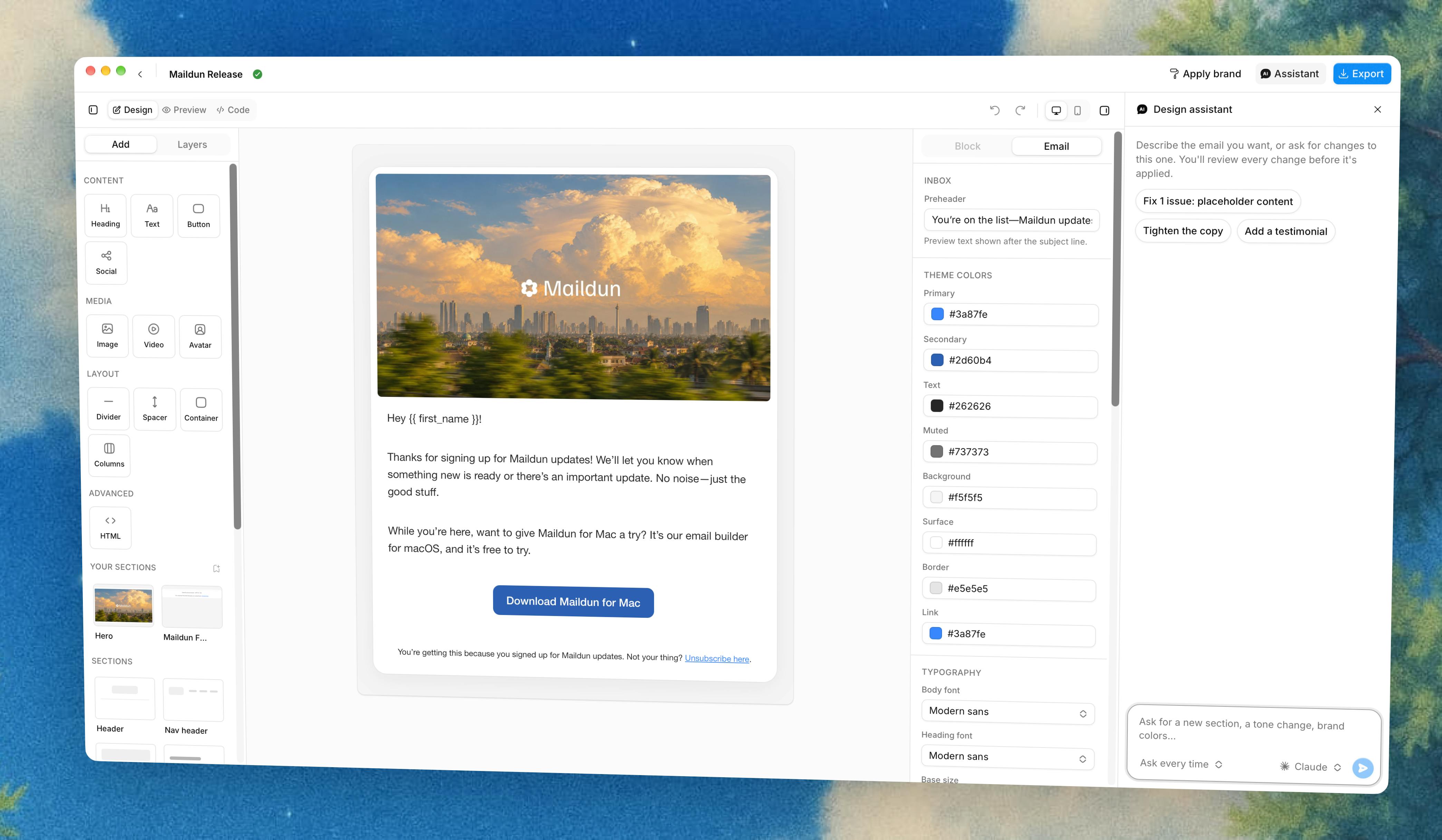
Three Design Modes: From Manual to Fully Automated
Maildun's core philosophy is giving users the freedom to choose how much they want AI involved in their workflow.
The first mode is the most traditional: building emails in a drag-and-drop editor with a WYSIWYG experience, ideal for designers who need precise visual control.
The second is AI collaboration mode. Users can connect Claude, ChatGPT, Gemini, or Grok using their own API keys. There's an interesting interaction detail worth noting — the AI assistant edits your design in real time, but all changes are presented as "proposals" for the user to accept or reject. This prevents AI from blindly overwriting manual work and keeps the final decision firmly in the designer's hands.
The third mode is developer-focused: MCP mode. By enabling the built-in MCP server, coding agents like Claude Code, Codex, or Cursor can directly create and edit emails. This means email design can be integrated into automated scripts and code workflows, rather than remaining an isolated GUI operation.
Why MCP Integration Is a Meaningful Signal
MCP (Model Context Protocol) is a protocol that has been rapidly gaining traction in developer tooling circles. It enables AI coding assistants to call external tools and data sources in a standardized way. By exposing email design capabilities as an MCP service, Maildun is essentially betting on a trend: that an increasing number of creative tasks will be driven by coding-style AI agents.
For teams already working with Cursor or Claude Code, this means they can use natural language instructions to have AI "generate a product update email that matches our brand guidelines" — without switching to a separate tool. This "tool as capability" mindset is precisely what distinguishes today's AI-native applications from traditional SaaS.
MCP (Model Context Protocol) was proposed and open-sourced by Anthropic in late 2024. At its core, it's a standardized communication protocol that enables AI models to interact with external tools and data sources. Before MCP, every AI application that needed to call an external tool — a database, file system, or third-party API — required developers to write custom "glue code" from scratch, which was costly to build and hard to reuse. MCP addresses this fragmentation with a unified client/server architecture: a tool provider only needs to expose an MCP-compliant server, and any AI client that supports the protocol (such as Claude, Cursor, or Codex) can discover and call that tool without additional integration work. For Maildun, wrapping its email-building capability in an MCP server means it's no longer an isolated GUI tool — it becomes an orchestratable node within an AI agent toolchain. Developers can create and edit entire emails through natural language instructions without ever opening a UI.
Features Built for Real Business Scenarios
Beyond its three design modes, Maildun has put considerable thought into engineering details, signaling that it's aimed at professional users rather than casual experimenters.
- Client-separated Workspaces: Ideal for agencies or freelancers managing multiple clients, with assets kept fully isolated between accounts.
- Brand Kits: Component styles inspired by shadcn's design language, ensuring visual consistency with a brand system. shadcn is a widely popular component design language in the frontend community — using it to constrain email styles is a clever choice.
- Saved Sections: Reusable content blocks that can be built once and used across multiple emails.
- Self-hosted Media Storage: Media assets can be stored in the user's own R2 or S3 bucket rather than on the vendor's servers — a meaningful plus for teams who care about data sovereignty.
- One-click publishing to maildun.com.
The combination of "bring your own API key" and "self-hosted storage" reveals Maildun's emphasis on privacy and cost transparency. Users don't pay a platform markup on AI calls, and they don't have to host their assets with a third party.
R2 and S3 are object storage services offered by Cloudflare and AWS, respectively. AWS S3 (Simple Storage Service) is the industry standard, nearly two decades old and widely used to store unstructured data like images, videos, and documents. Cloudflare R2 is the newer challenger — it's S3-compatible but eliminates egress fees, which can significantly reduce costs for workloads that frequently serve media assets. Maildun supports both storage backends, allowing users to upload email assets like images and banners to their own storage buckets rather than Maildun's servers. This offers two key benefits: first, your data isn't tied to a single vendor, so a service outage or shutdown won't cause you to lose historical assets; second, storage and bandwidth costs are billed directly by the cloud provider, with transparent pricing that's typically lower than what SaaS platforms bundle into their plans — well-suited for professional teams who prioritize cost control and data ownership.
Positioning and Potential Limitations
Maildun's target audience is clearly defined: macOS-native power users who are design-savvy and embrace AI toolchains — particularly design agencies and independent developers serving multiple clients. Through its native app format, it aims to strike a balance between fine-grained manual control and AI-powered automation efficiency.
That said, a few questions are worth keeping in mind based on currently available information. It's a macOS-exclusive application, leaving Windows and web users out in the cold for now. Additionally, AI functionality requires users to supply their own API keys — transparent in terms of cost, but a higher barrier to entry for non-technical users. With only 1 review on Product Hunt, the community feedback sample is still very limited, and real-world performance needs more validation.
Overall, Maildun represents a product category that's taking shape right now — not an old tool with an AI chatbox bolted on, but one that treats agentic collaboration as a first-class citizen, redesigning both the interaction paradigm and backend protocols around it. For teams looking to integrate email production into an AI-driven workflow, it's worth adding to your watchlist.
Related articles

DeepCell: One-Click AI Generation of Documents, Spreadsheets, and Slides
DeepCell tops Product Hunt with one-click generation of documents, spreadsheets, and slides, using the .deepcell format for linked updates, designed for System 2 tasks like modeling and sales reviews.

Doneas: 15-Minute Daily Accountability Calls That Keep Indie Developers From Procrastinating
Doneas is a daily accountability tool for indie developers: plan tasks on Monday, join a 15-minute call with five builders each day, and log deliveries on a public progress page. This article analyzes its core mechanics, effectiveness, and potential issues around retention and matching.

Fastlane 2.0: Fully Automated AI Ad Campaigns, From Creative to Optimization
Fastlane 2.0 is an AI ad automation tool: enter your website and it learns your brand, generates video and image ads, and runs and optimizes them on Meta, TikTok, Instagram, and YouTube.